Join in! Contribute! Animate! Here: http://www.exquisiteforest.com/tree/730809


” The reduction of listening–as an embodied practice–to the quantification and control of the audible spectrum, is, in other words, the history of compression”, – this post is relevant for the discussion about how to store ‘ the analogue’. I would argue that not only the mp3 is an expression of a tendency towards efficiency and making money, – any recording in any format is an expression of an industrial way of thinking. The logic of the recording as a sequence of small bites of information gives us a framework which makes us reproduce an idea of analogue storage as something linear and object like. Storing the analogue becomes an exercise similar to producing a good instead of being a culturally embedded practice, which is open and flexible, allowing for variation, chance and adaptability according to the moment, the use, the participants, etc..
 The point that had lingered with me after first reading Jonathan Sterne’s essay “The mp3 as Cultural Artifact,” was the idea that the mp3 was a promiscuous technology. “In a media-saturated environment,” Sterne writes, “portability and ease of acquisition trumps monomaniacle attention . . . at the psychoacoustic level as well as the industrial level, the mp3 is designed for promiscuity. This has been a long-term goal in the design of sound reproduction technologies” (836). A technology, promiscuous? I did not have to look far to find support. Like germs, I could find copies of mp3s that I had downloaded from Napster in 2000 scattered across generations of my old hard drives. Often they were redundant, too – iTunes having archived a copy separate from my original download.
But, for Sterne, mp3s are also socially promiscuous. They accumulate in the hard drives of the working class and are shared, almost…
View original post 1,431 more words
When working with compositional processes, we have a lot of assumptions, – whether we make it clear or not.
Since we have these assumptions in any case, we can as well make them explicit.
How we look at the work with compositional processes differs from person to person, and therefore it makes no sense to search for a unifying theory, a synthesis or an all-encompassing explanation.
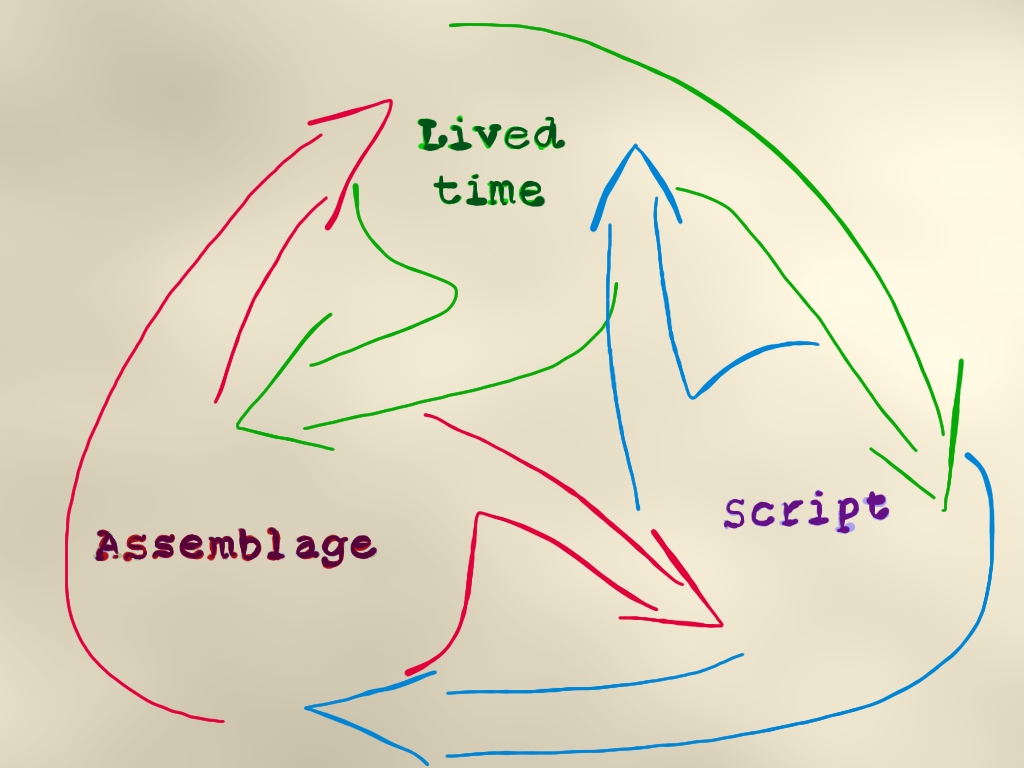
When we act together in a community, we are guided by different sets of more or less explicit rules or scripts. They can influence back on our daily lives in good and bad ways, but we can be aware of them and use them in compositional processes. Let’s call this process scripting. Good scripting is when one is aware of everyday life rhythms, analyse them well, and draw different ‘composable’ patterns out.
To compose is to put these patterns together in certain ways. A good composition process is when you bring (good) scripts into play, in a way so the process can feed back and create healthy change for the collective.
In the process between assemblage and lived time there will be a reversal, a transferthat can be clarified and strengthened through reflection. The items that are made in the composing towards the assemblage-pole, are being composted, as we move along to the lived time pole: they are broken down into smaller components in a way so that they can be part of a new compositional cycle.
The three poles are to be understood as snapshots. The relation between them is gradient, and they interact with each other in both directions. In this presentation, we assume that these processes are flowing freely in cultural sustainable communities.
There is sometimes a need for the facilitation of the processes. Good facilitation is when the facilitator 1) is able to read the collective’s own natural compositional cycle, 2) take responsibility for identifying controversies / arrhythmia, and 3) provide participants with tools to (re)create a culturally sustainable situation.
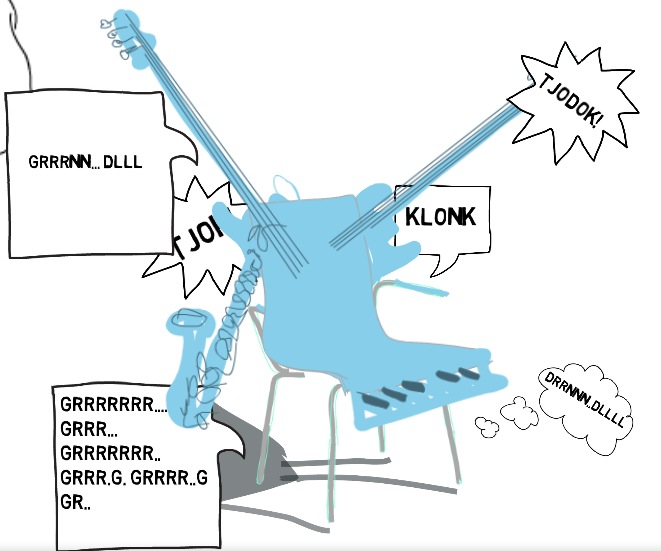
Watch my short ‘videoscribe’ about a workshop with 4 piano players, a guitar, a bass and a saxophone player.
Make your own mind maps with Mindomo.
I just discovered this great tool for mapping the conceptual framework in an intuitive a visual way.
The even greater thing is that I can link directly to my evernote notes from within the app. Check it out and give me some feedback!
[transcription of a ‘dictaphone street improvisation’, 2012-10-05]
“When talking about the culturally sustainable processes in a collective, I was talking about two aspects that are characterizing these processes, one being the fact of using what I term as cultural recycling, and the other being shared ownership.
I would like to add to the question about cultural recycling that what is different between a culturally sustainable collective and our current consumer based model is that in the latter there is an abundance of cultural tokens and of works of art, – the market is so to speak satiated by still more and more cultural products.
You see it when talking with people working as artists, that they often feel that their work is meaningless because there are SO many works of art, and so many good ones as it were. At some point they then seem to come up with a very good excuse, and continue producing works of art, – or they simply stop. The river of (divine?) inspiration simply dried out.
In a culturally sustainable collective this crisis simply doesn’t occur, since you don’t have an addition of art works, an accumulation of objects. If we stick to the metaphor from ecological sustainability, you could say that within a culturally sustainable collective, what happens is that you recycle the ‘cultural material’. The composed assemblages consist of ‘degradable’ elements, that are easily broken down into ‘reusable’ constituents. “
Related readings:
Learning from folklore – reversed colonialism 2.0 (akutsk.wordpress.com)
How do we store the analogue? (akutsk.wordpress.com)
Paola Antonelli Discusses R&D at MoMA (http://www.architectmagazine.com)
 |
| The logo of Danish copyright organisation floating with an abundance of cultural products, illustration by Casper Hernández Cordes |
“To be faithful to the experience of the social we have to take up three different duties in succession : deployment, stabilization, and composition. We first have to learn how to deploy controversies so as to gauge the number of new participants in any future assemblage (Part I); then we have to be able to follow how the actors themselves stabilize those uncertainties by building formats, standards, and metrologies (Part II); and finally, we want to see how the assemblages thus gathered can renew our sense of being in the same collective“
Bruno Latour: Reassembling the social, p 249
 |
| Bruno Latour, reflecting on the social |
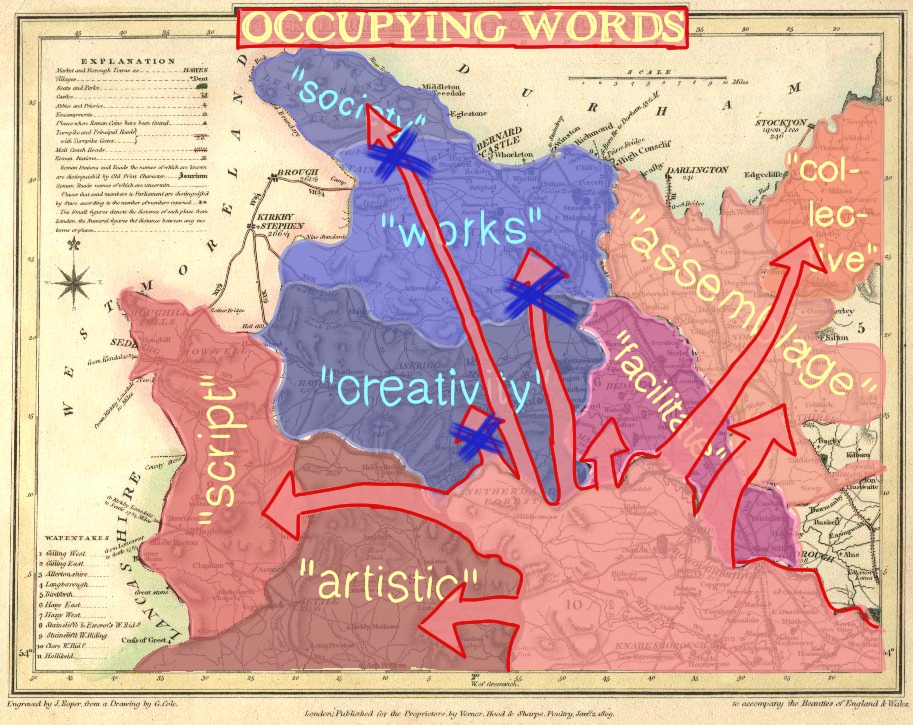
How do I construct this framework? I was thinking of the term occupation, and that you could see that this is a sort of occupation of words that have been used in mainstream ways of understanding similar issues, and what I’m doing is to cleanse them from their previous, mainstream connotations, and make them ready for use in this new framework.
In Bruno Latours “Reassembling the social”, he writes about this three step process of deploying, stabilizing and composition. Read the quotation here. When talking about deploying, he refers to the action of taking into account all the actors that we need to include, in order to reassemble the social. This is kind of what I’m doing with the words that I collect for constructing this framework: I take existing words that I consider still necessary, while excluding other words, that are simply worn out – like ‘creativity’, ‘works’, etc – and then I’m inviting new words to the assemblage.
My goal in making this new assemblage of words is to constitute a framework that is open enough to help us take into account the relevant aspects when working on the facilitation of compositional processes, while helping those who use the framework not to fall back to business as usual
 |
| Illustration by Casper Hernández Cordes |
Construting a conceptual framework on something implies, within a mainstream way of seeing things, that you refer to Theory, and that you are now going to suggest a new theory. I would then have to call my project “Artistic processes, a new theory on the effects of art on society”. Something like that. That would presuppose, that there is a) something, an essence, we can actually point to ‘out there’ that we can define as ‘art’, b) there is an essence we can locate, which we can define as ‘society’, and c) as an ‘explanation’ of the relation between the two, art / society, we can deduce our way to an underlying theory, the same way as an archaeologist digging out an ancient ruin, and that this work – although tedious, and very time-consuming – will at some point get us to the essence of the question.
I would very much like NOT to fall into that trap.
Instead of departing from a ‘theoretical’ background, discussing the current ‘development’ in music theory, art theory, etc., discussing the scientific validity of each, and then basing a new theory on some resilient new matters of facts, my approach will be different.
The theories of music / art, I have come across simply do not do the trick. At some point they always seem to miss the most important. They might departure from what we call psychology, and ‘explain’ our relation with music in terms of emotions, of affect. In this framework, art and music, is something that we use in our daily life to enrich it, to feel good, to relate to each other, etc. They might base themselves on theories about society, seeing music and art as instruments for different currents in the historical evolution of a society. Or the might simply use art ‘it self’ and music ‘it self’ as their ‘field of study’, and claim that these phenomenon simply do not have anything to do with anything else, that they are free from ‘the political’, and so on.
Common to these ‘theories’ is that they take for granted 1) that there is some kind of essence that can be dug up, – after years of reading and researching of course, 2) that we can identify the different parts of the ‘field of study’, that they are actually there, although maybe not physically, (and that’s one of the main challenges to these approaches), and 3) that the actual processes of music and art making, producing and perceiving is something that takes place in either an individual, – this is when studying perception, and ‘the creative’, etc., and on the other hand on a larger scale, ‘society’, where they look for the changes that art/music is ‘causing’.
The l’art pour l’art theories simply loose themselves in the mist of misty explanations always coming short at some point, where you simply have to accept that ‘art does things’. In an attempt to free music and art from being used as an instrument for political and other agendas, they actually work for the same forces that they want to be an opposition to. These approaches sustain the current state of affairs, because they remove from artistic processes their potential for change. They castrate art as a revolutionary force while allocating the artistic processes to a harmless, abstract, and almost religious sphere.
As a parallel, here is Bruno Latours illustration from a talk where he is doing his ‘critique of the critique’:
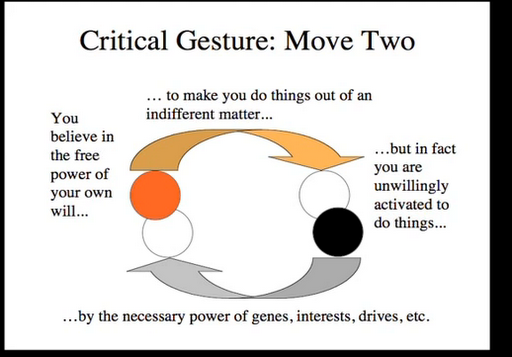
Instead of talking about theory, I will be talking about a conceptual framework. Instead of looking into the individual, and look for relations with society, I will take the collective as departure point. Artistic processes are embedded in collectives, in networked relations, not in a sum of individuals.
What I expect from a conceptual framework is that it
My current sketch for a framework is a triadic one as opposed to majority of mainstream thinking, which is essentially dyadic, and I will dedicate a blogpost to this question.
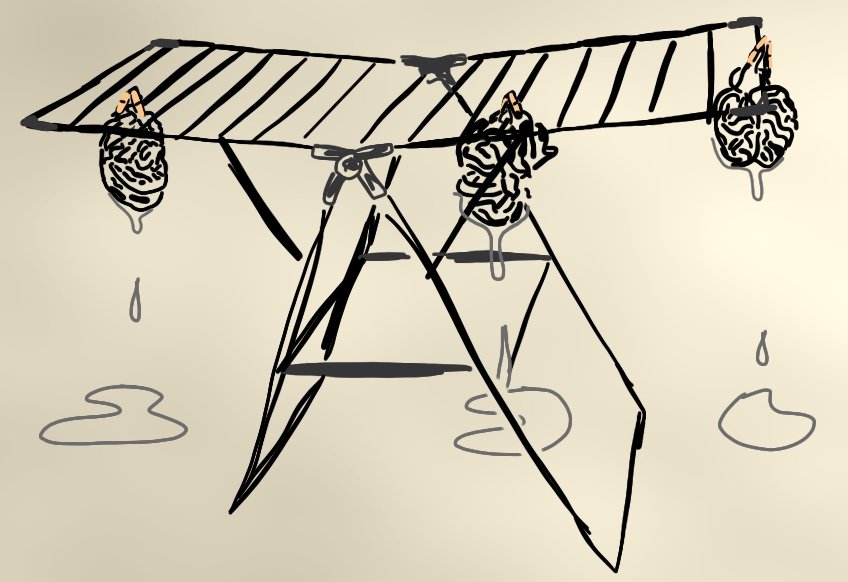 |
| Wet thoughts on a conceptual drying rack framework |
– Henri LEFEBVRE, sociologue : pourquoi il se définit comme “méta-philosophe”, le concept de mondialité ; ses origines, ses parents, ses rapports avec ses étudiants (allusion à Daniel COHN-BENDIT). Son activité d’opposant au sein du PCF pendant 10 ans, son exclusion du PCF, ce qu’il pense de Herbert MARCUSE, ce qu’il pense de l’humanisme, des Droits de l’Homme, l’évolution du PCF, son étude simultanée de la pensée de Karl MARX et du monde moderne, remarques sur le concept de l’Hisoire, sur les stratégies économiques et politiques, les éclairages que nous donnent les philosophes et la nécessité d’inventer des concepts nouveaux. (Entretien avec Jacques CHANCEL -56’41”). Source.
Interview with Henri Lefebvre at ORTF. Here is the whole transcription.


 Building Sound Collectives