unmusic

“Kraptavicius’ catalog has been recognized widely, with concerts and sound-art installations all across Europe. These events have helped to develop what he calls an aesthetic of “unnecessary notes.” Hence his particular love for digital compositions, since he feels that computers help to “pull” elements of unmusic into his portfolio: machines show scant regard for compositional norms.”

From Far From Moscow  about the Lithuanian collective known as Twentytwentyone.

“Today is a landmark day in the history of music.  On Saturday February 5th at 10:37 AM a new genre of music has been born.  Welcome to the world of UnMusic.  Many times I have read the song titles on albums and thought to myself “This album has great song titles, it’s too bad the songs are horrendous.”  If you have had that thought from time to time, then UnMusic is for you.  UnMusic removes the irritating and grating music that is on albums and merely gives you song titles. I give you the song title, what your imagination does with them is up to you. Think of the possibilities?  Music without the limitations of actually having a song!”

Keith Spillet in his blog The Tyranny of Tradition

These are two different ways of using the term unmusic, among surprisingly few google search results. I am looking for a term the can denote a way of working with sound that is musical in the sense that it draws on the essential elements of analogue reflection through sound, although it does not share the caracteristics that people in general would expect when they are presented with the term music.

There is the term unschooling, which is broadly used, it has over a million google hits, and a definition on wikipedia:

“Unschooling is a range of educational philosophies and practices centered on allowing children to learn through their natural life experiences, including play, game play, household responsibilities, work experience, and social interaction, rather than through a more traditional school curriculum.”

Would it make sense to use the un- in front of music in a similar way? The 2nd quotation above has a definition and a use of the term that makes sense, – the ‘un’ signifying a totally reversing of the way we in general think music, namely as something that unfolds through sound. Well in this use of the term, it simply denotes  silent or imagined music. One could state that there is not necessarily a natural opposition between music and silence, since what makes music musical is the way we use silence. This is obviously not very much the way most of the music people listen to is conceived, satiating each millisecond with a wall of sound.

In the first example above, from Far from Moscow, there is not a clear definition of the term unmusic. In the cited article, there is an equation of unmusic with “non-musical”, as well as “experimental electronics, electroacoustics, minimalism, phonography, improvisation, sound art”. It seems like just another genre term, of which the world has already got in abundance.

The un- in unschooling doesn’t set up an opposition to the goal of schooling, namely learning, but it questions the current framework of learning, namely the school. To the extent that we can consider music a term for the institution music, it makes sense to use the un- to reclaim the term music from its current use, so much infiltrated in the idea of music as a commodity or an object, and all the activities and categories supporting that misunderstanding: genre, styles, CD-release, labels, etc.

Unmusic in this sense would be a way of describing activities around sound that are collective, open ended, non-hierarchic, non-linear, including, in short human. Culturally as well as socially sustainable activities around sound. That is unmusic.

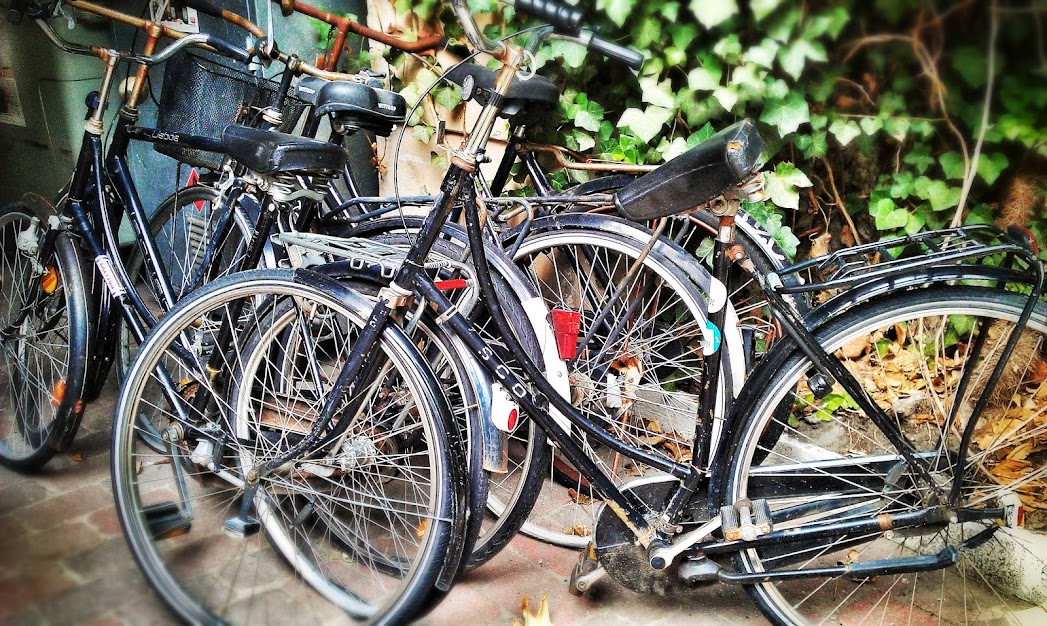
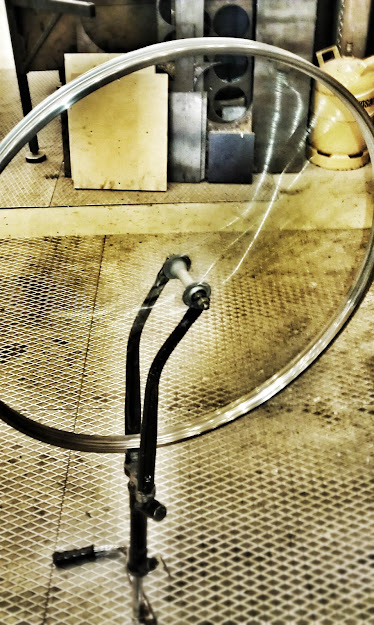
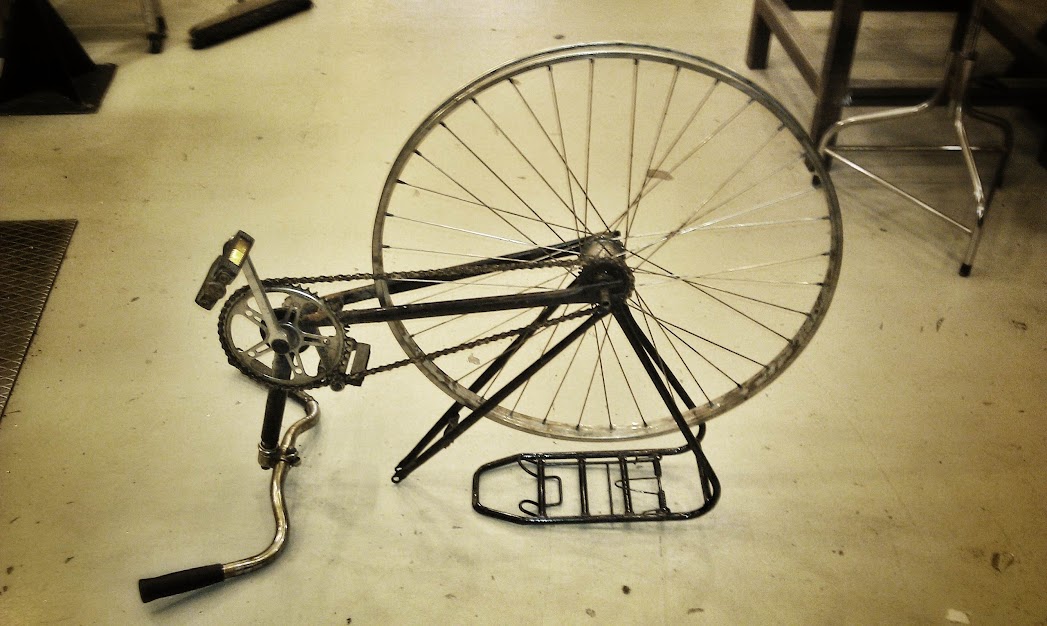
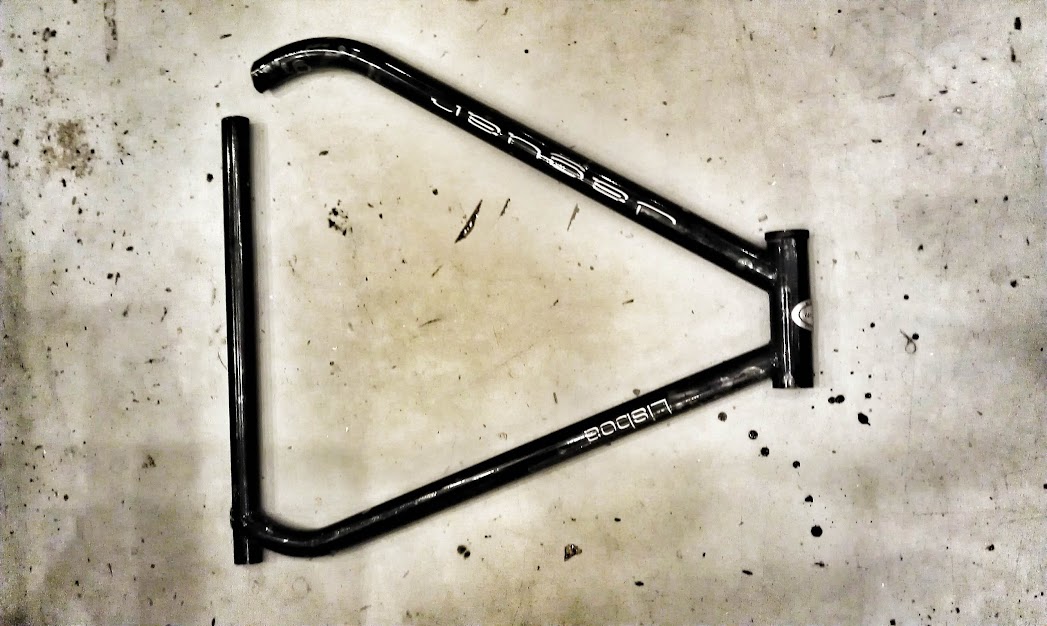
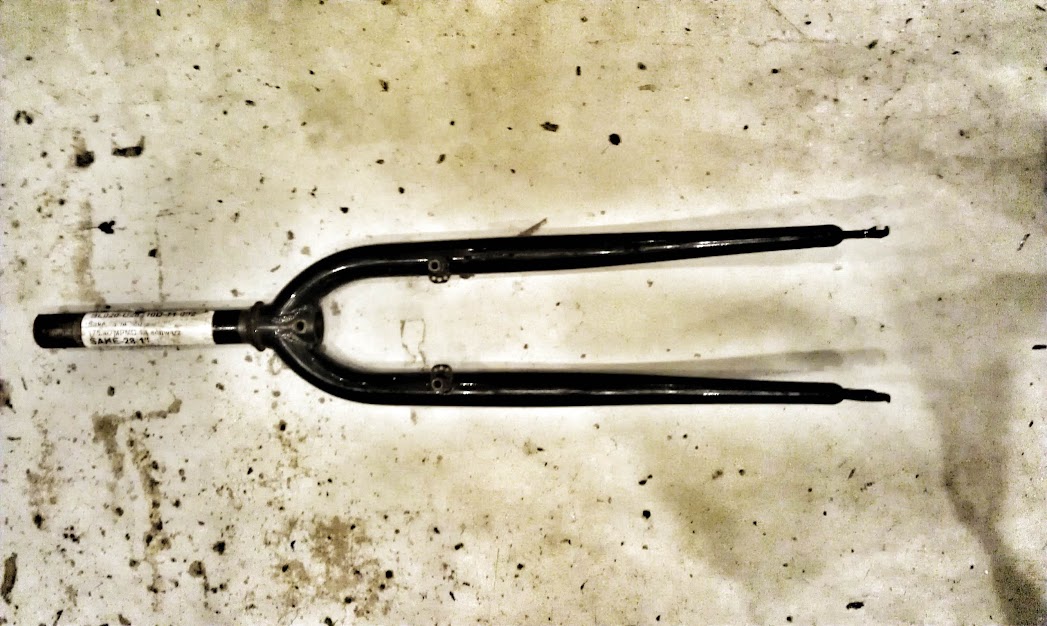
Bikestruments, the silver return

Political pimp-your bike-workshop, hacked for street politics

A local workshop hosted by a red-green political party with the agenda of promoting the bike as a preferred choice for transportation. The name of the workshop was “Pimp your bike”.

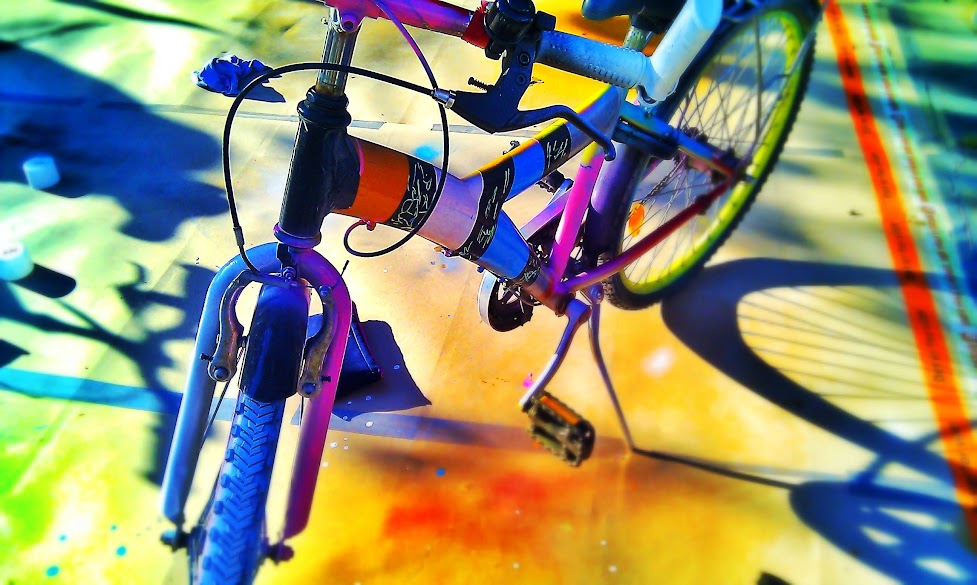
Fonografiti activists ‘hacked’ the event (to which you might question the environmentally friendliness of using spray paint for ‘pimping’ bikes, btw), and ‘pimped’ some bikestruments, spray painting them silver.

After being silverly pimped, the bikestruments were hanged on the same spot where the other – un-pimped – bikestruments had been violently abducted.

Now the question is: Does the ‘pimping’ of the bikestruments, possibly sending the message “we are street”, inspire passers-by to NOT remove them?

Now THIS is a pimped bike!! (Photo by Simon Cordes)

Ich bin auch ein Fahrrad, -or- Bikescream for QRow

sQRikebeam bor fow

-or- traffic jam session

Recommendation: Watch the video clip while listening to the sound:

The participants made sounds with the bikestruments and formed them with their voices through the Anthropomorfer. When working with the sounds via smartphones, how could we do with only very little space? I hadn’t prepared a silver concept for that part. Somehow someone came up with the idea to follow the passing cars, bikes and people with the sounds. So each participant chose one feature, for instance “everything yellow”, and each time a yellow car, bike og hat passed by, he/she would ‘follow’ the moving object with the sound, panning from left to right or vice versa. In this way, a new aspect was introduced in the the-street-as-an-instrument-concept: SILENCE!! Since there were not yellow things passing by all the time the participant following yellow things had to keep silent in the pauses. But since each participant followed his/her specific feature, – bike helmets, taxis, blondes, etc., a great variety of movements and velocities naturally came to the improvisations, thus creating variation and new mixes/collisions. QRaaaaa QRaaaa!

Related articles:

Bikestruharp, former bike now instrument (www.akutsk.wordpress.com)

Bikestruments, bridgestruments, anti padlock guerilla (www.akutsk.wordpress.com)

Ceci n’est pas une pub. This is not a commercial.

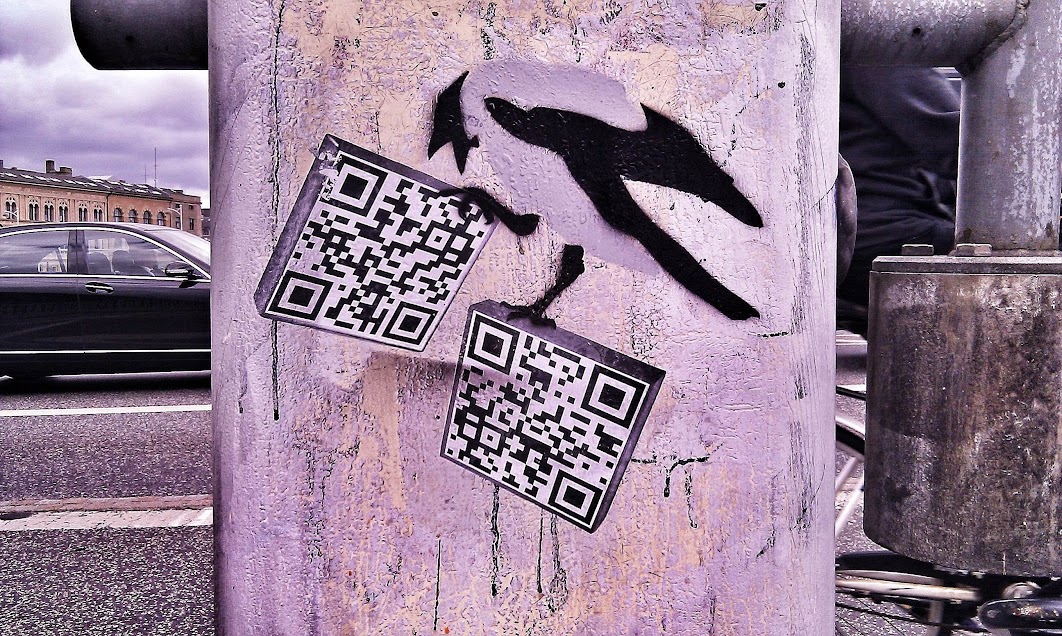
ImageThis qr code links to a recording of a street improvisation by ordinary passers by, facilitated by Akutsk, using the Anthropomorfer. Sound graffiti you may call it, I use the name fonografiti. When using a qr code, we embark on the colonisation of the still rather virginal web based virtual track of the street.

Although the medium is sonorous, the access to the location specific electro acoustic collective improvisation necessarily passes through the visual. The qr code must catch your attention before it can work as a key to the virtual audio track of the place.

QR codes are in many cases used in commercial contexts, and the first thing we need to do is to decolonise this technology from the logic of the market. I’ve met a good deal of people not aware that you can easily make these codes yourself. Using qr codes is probably the easiest way for anyone to interact (virtually) in the street through sound, – and any other media btw.

In order to make sure that people understand that this specific qr code is not a commercial – ceci n’est pas une pub – we must add something, visually, to the code itself. Streetsoundartist Medlyd uses CD boxes on which he paints the QR code. Using a technique that cannot be subject to mass production, Medlyd succeeds in communicating the non-commerciality of the code. And a CD box connotes music. It’s a CD release!

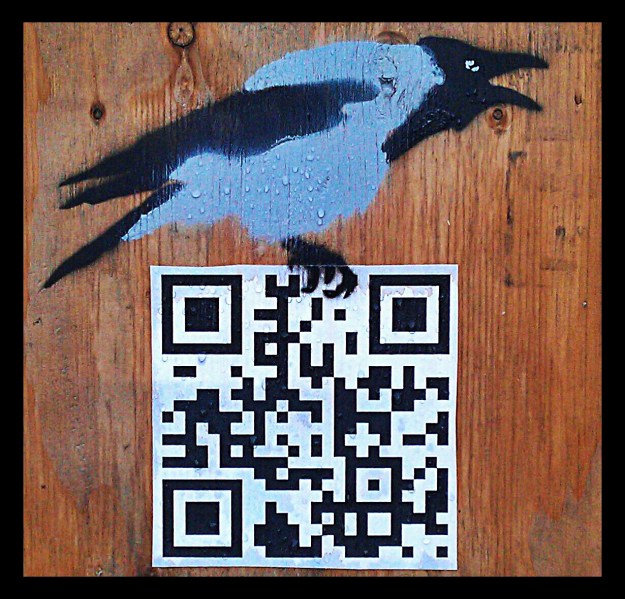
In this photo you see a stencil of a hooded crow on top of a paste up of a QR code measuring 15×15 cm. The obvious handy craft side to the work makes it obvious that this is not commercial, it is ‘street’.

Now scan the code! We won’t sell you anything. We want to share a unique piece of sound art improvised on this specific location using only sounds from this place.

Ceci n’est pas une pub.

Bikestruments, bridgestruments, anti padlock guerilla

Knippels bridge being streetstrumentalized, though momentarily interrupted by rain
Bike bells on bridge (anti padlock guerilla)
From bike to trike (?)
From bi- to tri-
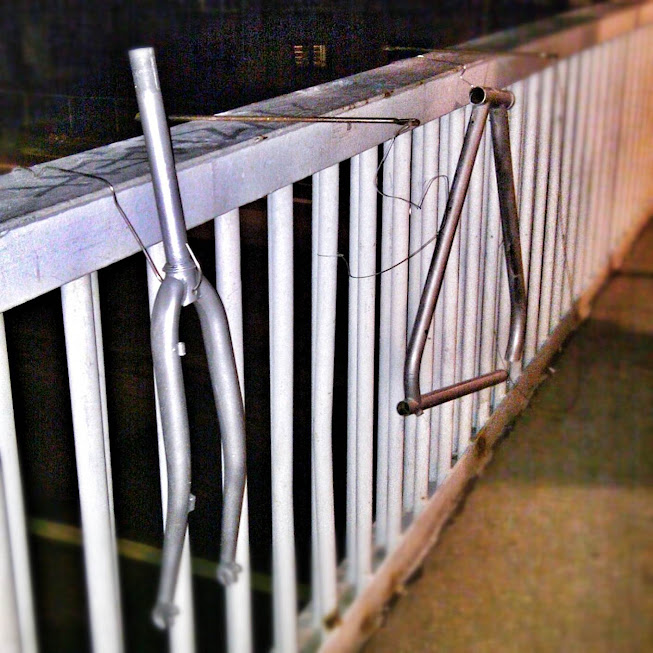
Bike bone hanging in bike nerve being attached by bike magnet
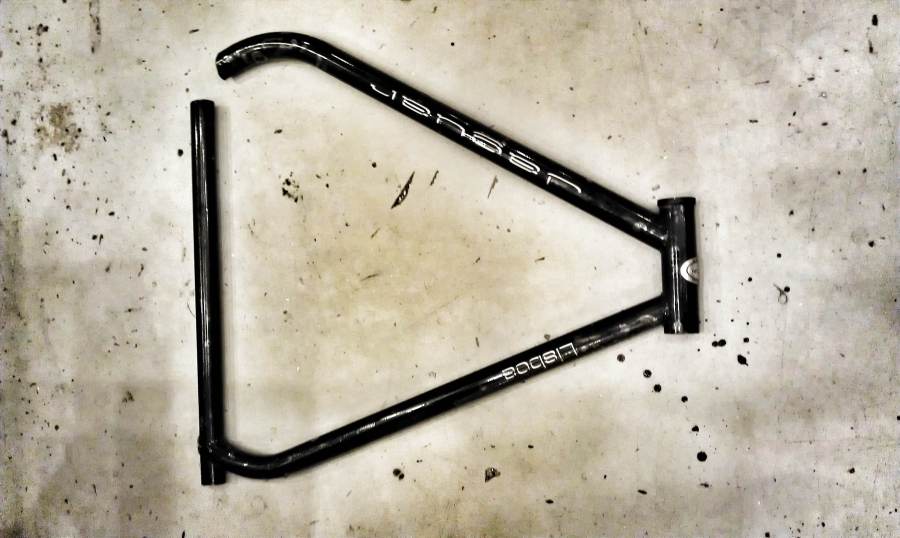
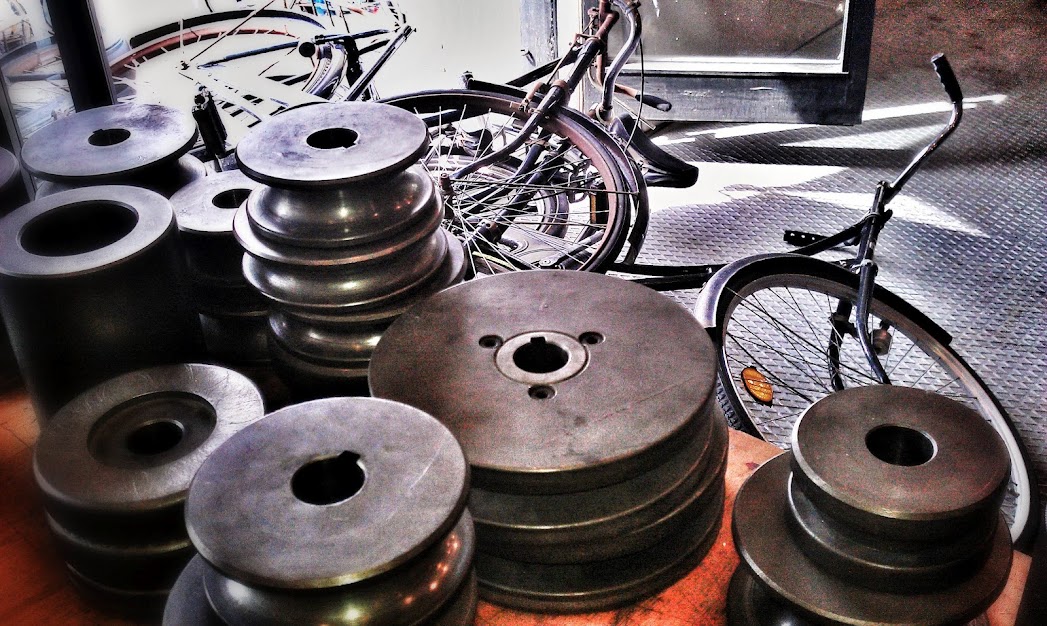
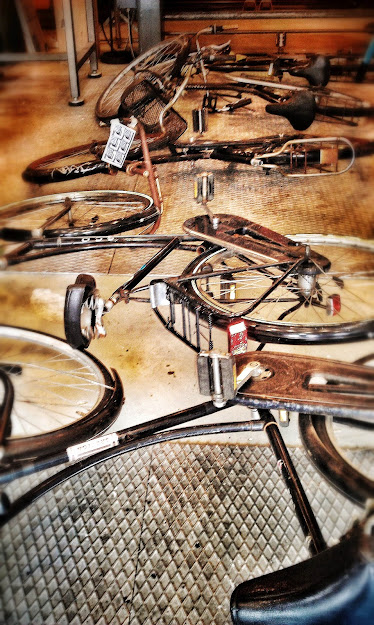
Preparing bikestruments in the State Workshops for Art

Help I’m a bike. Curate me !

So it’s official. I’ve often wondered what I should call what I’m doing. Well. It’s art.

I’ve found out that my participation in a sound art project at the Knippels Bridge (a bridge connecting main Copenhagen with the island of Amager), is in fact part of Copenhagen art festival 2012.

Being a part of a part of something to do with art, I’ve been given the possibility to use the “national workshops for art”. So now I’m chopping up old bikes in the official national workshops for art, and therefore I’m making ….. art!

Art art art art art.

In the outset I was planning on doing what whomever could do, namely take parts of old bikes and set them up in the street, and in this particular case a bridge.

It was supposed to be a sort of ignition fuelling a trend where people start putting up things in public space that can serve as  “streetstruments”, inspiring to engage in collective activities around sound.

The need to hang things in public space is strong, judging from the padlocks that people put everywhere, inadvertently enhancing the omnipresent focus in public space on reproduction. Well instead of (biological and other) reproduction, streetstruments should inspire people to engage in productive action beyond the twosomeness of the nuclear family and co.

And now I do art. Which is the same as saying I’m a name and a nationality. As in “John Cage (USA)”. Although I have been invited to participate in the festival, I’m not in the programme, for some reason,  – as opposed to John Cage. Looking forward to meet him.

I haven’t even been curated. The so-called curator, curating the sound art events at the Knippels Bridge hasn’t contacted me. So I have not had the chance to adhere to some sort of ‘overall concept’, which is generally the way these things work.

So I’m only halfway participating in the festival. Which makes me a halfway artist. And what I’m doing is consequently halfway art.

Which in the end might save my project.

Since it is not really art after all, then it is not really mostly an individualistic project promoting its creator, who is in the programme with a name and nationality (dead or alive), and who has been curated according to the overall so-called concept of the festival, which in the case of Copenhagen Art Festival 2012 is “Art in community”, a concept which is put into play through a large number of individual artists’ individual artworks in (mostly) solo exhibitions.

Since I’m not really an artist after all, I’m not really an expert producer of works of art, that the consumers-recipients-of-works-of-art will consume, after appropriately being guided by an expert knower-of-art or curator. Therefore there is a smaller risk that what I’m doing could not be done by anyone, and that it will actually be done by someone, that there will be people using the street as an instrument, without being curated, without having their name and nationality in a programme.

Building streetstruments: paint-bucket-bass, drain-trombone and sewer-chimes

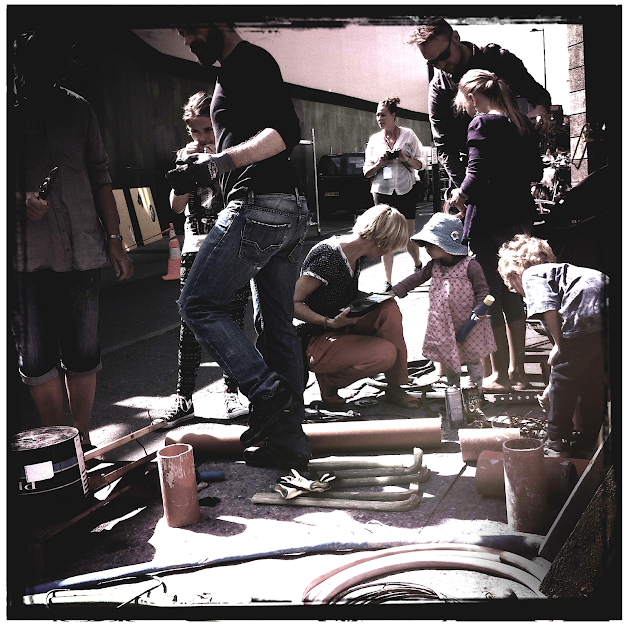
First workshop: constructing streetstruments

The street dressed for the streetstrument workshop

_

Materials from the construction site are lined up according to their characteristics

_

The participants are constructing streetstruments

_

Sewer chimes

Second workshop: Collective improvisations on electrified streetstruments

Improvising using the paint bucket bass

After the workshops: The streetstruments are left in their street, inspiring passers by to make their own street improvisations

Paint bucket bass and drain-trombone entrusted the passers by

Related posts:
Construction site interacts musically with neighbors

Quotation: Lefebvre about the living disorder of the street

The street sound activist’s toolkit

Organisation’s lethal selfpreservation

Luhmann, collage by CHC

Luhmann, collage by CHC

Luhmann argues that every autopoietic system has this sort of intra-systemic dimension. Autopoietic systems are, above all, organized around maintaining themselves or enduring. This raises serious questions about academic political theory. Academia is an autopoietic system. As an autopoietic system, it aims to endure, reproduce itself, etc. It must engage in operations or procedures from moment to moment to do so. These operations consist in the production of students that eventually become scholars or professors, the writing of articles, the giving of conferences, the production of books and classes, etc. All of these are operations through which the academic system maintains itself across time. The horrifying consequence of this is that the reasons we might give for why we do what we do might (and often) have little to do with what’s actually taking place in system continuance

Levi R Bryant

Regarding the intra-systemic dimension: I have made similar comments on the way the establishment around music in Denmark, – conservatories, universities, schools, high schools, etc. – works. Here’s one of my blogposts about it. (In Danish, google translated).

I actually think, that Levi R. Bryant’s point about intra-system’s lethal drive to selfpreservation is a general problem inherent in our interest based way of organising human activities. The way we have organised our collective problem solving activities, – in what we term as organisations, in which we work, the same problems we are theoretically trying to solve, will systematically drown in our effort to keep the organisations afloat.

Relevant reading from my  blog:

Learning from folklore / Reversed colonialism 2.0

larvalsubjects's avatarLarval Subjects .

For the last couple of days, I’ve found my thoughts haunted by McKenzie Wark’s brilliant interview over at Occupy Times.  Apart from Wark’s provocative claim that politics doesn’t exist– though perhaps it could come to exist, in a sense analogous to how Meillassoux talk of a “virtual god”? –this passage, in particular, stuck out to me:

…the problem is:  how do you occupy an abstraction?  Power has become vectoral.  It can move money and power anywhere on the planet with unprecedented speeds.  You can block a particular site of power, but vectoral power routes around such sites.

The abstraction Wark is talking about is, of course, contemporary capitalism.  Contemporary capitalism seems to be characterized by two features:  First, it has the characteristic of being everywhere and nowhere.  You can’t point to a particular site of contemporary capitalism and say “there it is!”.  Rather, it pervades every aspect of contemporary life…

View original post 2,092 more words

Construction site interacts musically with neighbors

Tubes from the ground, now getting a sonorous aftelife
Tubes from the underground. Now getting a sonorous afterlife in a streetstrument/ giving-back-the-noise workshop

Concept: During a street art decoration of the wall around the local metro construction site, akutsk is making a ‘streetstrument’ workshop.

The workshop is going to be in two parts:

  1. a streetstrument building workshop. In these weeks, I’m collecting debris from the construction. At the event August 11, these objects will be the material for instruments.
  2. a Anthropomorfer workshop, where the participants form the sounds and improvise collectively via laptop and smartphones

Everything is on location, anyone can join, and afterwards we paste up QR-codes linking to recordings of the impros.
Here is the Facebook event.