Quotation: H. Marcuse on the individual’s loss of autonomy

“It is not only the speed and range which distinguishes the means of mass communication from their predecessors. The new quality is introduced by the progressive transfer of power from the human individual to the technical or bureaucratic apparatus, from living to dead labor, from personal to remote control, from a machine or group of machines to a whole mechanized system. I should like to reiterate that I do not yet evaluate this development: it may be progressive or regressive, humanizing or dehumanizing. But what actually occurs in this transfer of power is also a transfer of guilt feeling responsibility. It releases the individual from being an autonomous person in work and in leisure, in his needs and satisfactions, in his thought and emotions.”

Herbert Marcuse, THE INDIVIDUAL IN THE “GREAT SOCIETY”

The street sound activist’s toolkit

The fundamental reason why I work with these “street interventions”, using the Anthropomorpher as a tool for inviting passers by in the street to make collective improvisations on the street’s sounds, is because I want to ignite a trend where people start making sound art as street art. There is no official name for this, – I have suggested ‘fonografiti’ (intended misspelling), ‘proto urban folklore’, or ‘soundtagging’. I have only seen few examples of sound art as street art (see my page with examples), and I have seen no examples of collective street improvisations using electroacoustic tools, – a part from my own project, that is. As always, I invite the reader to give feedback: if you have examples of sound art as street art, and collective electroacoustic improvisation in the street, please give me a comment!

But why electroacoustic collective street improvisations, you might ask? Why is this approach important, necessary, indispensable?

Why street? Public space is the only place where there is a possibility for random meetings between people, across differences in gender, age, occupation, income etc. People are different, and when they engage in problem-solving activities in contexts with only people of a similar kind, the way the problems are solved will tend to exclude the viewpoints of other kinds of people. Therefore, the street is a potential motor for balancing contrasting interests. Public space is invaded by commercial and municipal interests to an extend where we ‘ordinary people’ tend to forget that the street is a common space for all of us. The visual ‘screen’ of the street is already full, so to say, BUT there is a whole new ground for expression left untouched: sound!

In the unfair battle between commercial- municipal interests and the citizens, there is space left open, allowing ordinary people to express themselves through sound, while adding a virtual track to the all encompassing visual track of public space.

Why collective improvisations? In posing the problem: how does this street sound, and what can we express through the sounds of this street, on this time and place, the concept I’m developing is setting up an example showing that collective problem solving involving different kinds of people is indeed possible. Improvisation is a very important aspect of inclusive problem solving activities, where a predefined agenda will always favour the interests of some to the expend of others. An improvisation in the akutsk sense is a reflexive collective activity, involving a process where the participants agree on a common ad hoc script for the collective improvisation, thus giving the example of a collaboration around a problem solving activity, with sound as a medium.

In general, people regard public space as a distance they have to cross in order to get to the places that are important to them, all of which contain people that are in general of the same kind. A street sound improvisation can work as a interest-free brake for this stream of people hurrying from A to B. A collective street sound improvisation is not aimed at serving specific interests, the participants being the ones defining the aim and content of the activity within the given framework. It is an attempt at setting up an ideal form of interchange between contrasting interests, an experience that can be scaled to a broader, societal perspective.

Why electroacoustic? I talked to a guy who has a lot of experience in performances, street theatre and the like, and he was sceptic about the level of technology required for the Akutsk concept of collective street sound improvisations. There are many examples of people making musical activities in the street, ranging from street musicians, over flash mobs to stomp inspired activities. Common to these activities is that they do not challenge the traditional duality between performer and audience, not succeeding in inviting the latter to reflexive (co-)creativity.

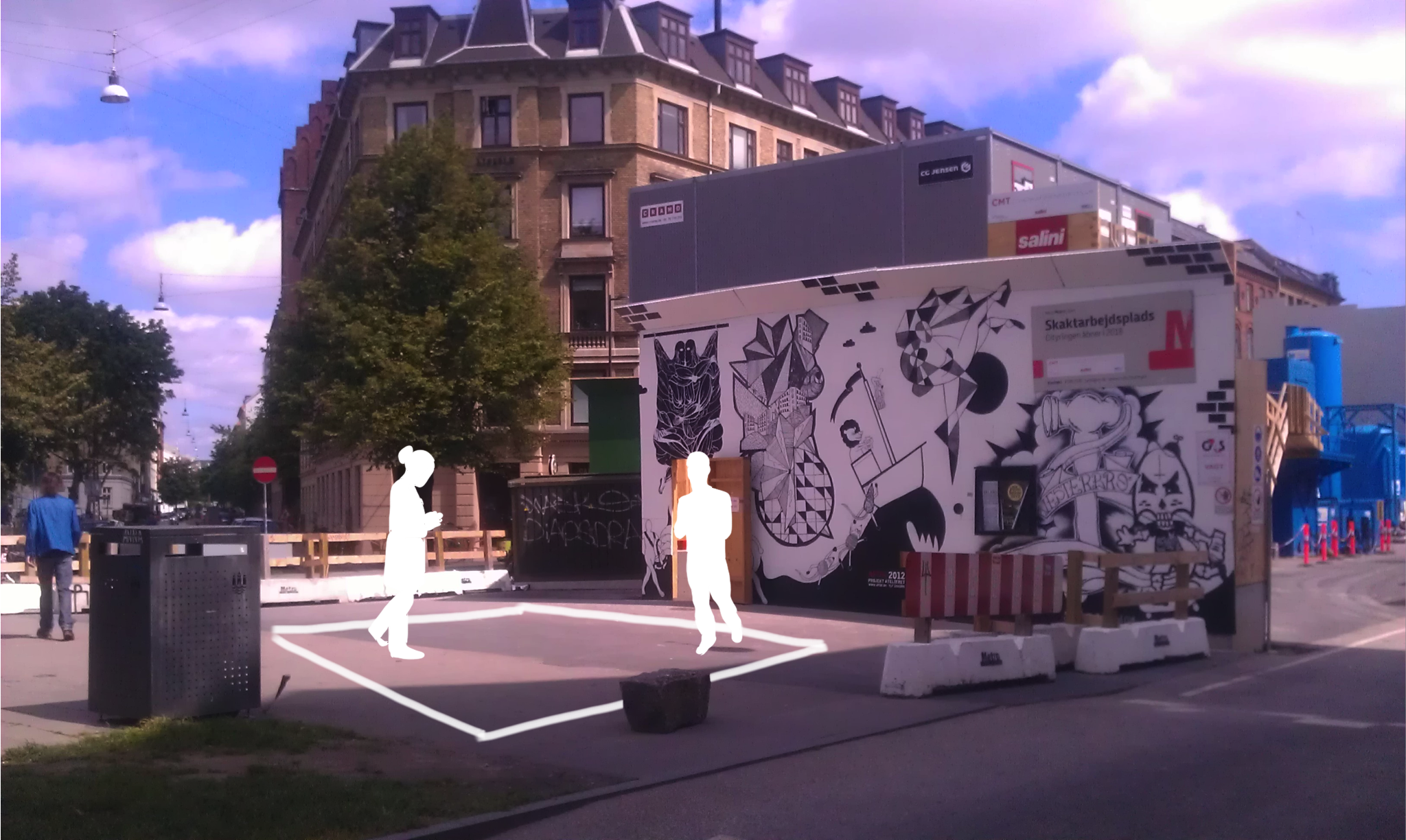
Although the relatively high level of technology required for the akutsk approach is a challenge for the possible spreading of the concept, it is an obstacle worth the while considering the benefits it entails. Reflection and informed decision making is central to the concept, and the way I use the computer eases the path to this considerably. With the possibility for the participants to record a sound, listen to it, form it with their voice, and subsequently listen to it together with the other participants, the Anthropomorpher bridges the gap for most people not trained as musicians, that inhibits them from expressing themselves in a creative and reflected way through sound. In addition, smartphones connected with the computer through (portable) wifi, serving as individual remote controls for each participant’s sound, facilitates the use of space as a ‘resistance’. The participants move in a traced field on the ground representing the sound’s virtual space as gestalted by changes in volume and panning by each of the participants.

This could be done acoustically, – people using their voices or improvised instruments, but this is probably to far from most peoples zone of comfort. Using a smartphone as a remote is comfortable. Using your voice in a mic, and walking around in a field in the street with strangers are sufficient barriers to overcome, and although they exclude some people, I think that they exclude people in less predictable ways than the traditional acoustic variant of street performances favouring people who consider themselves ‘musical’ or ‘extrovert’.

With my aspirations for a proliferation of this approach – or similar approaches – it is essential that the procedures are simple,and easy to copy. For the time being, I think that the complexity of the electroacoustic method and the technical requirements are posing a serious barrier.

In a global context, you can argue that the approach is excluded for most of the communities in the Global South. You might say though that we northerners are more challenged when it comes to spontaneous expression in a public setting, and that we need technical aid to overcome this. For the sake of people interested in engaging in activities inspired by the akutsk approach, I have made this list of tools needed for the aspiring street sound art activist:
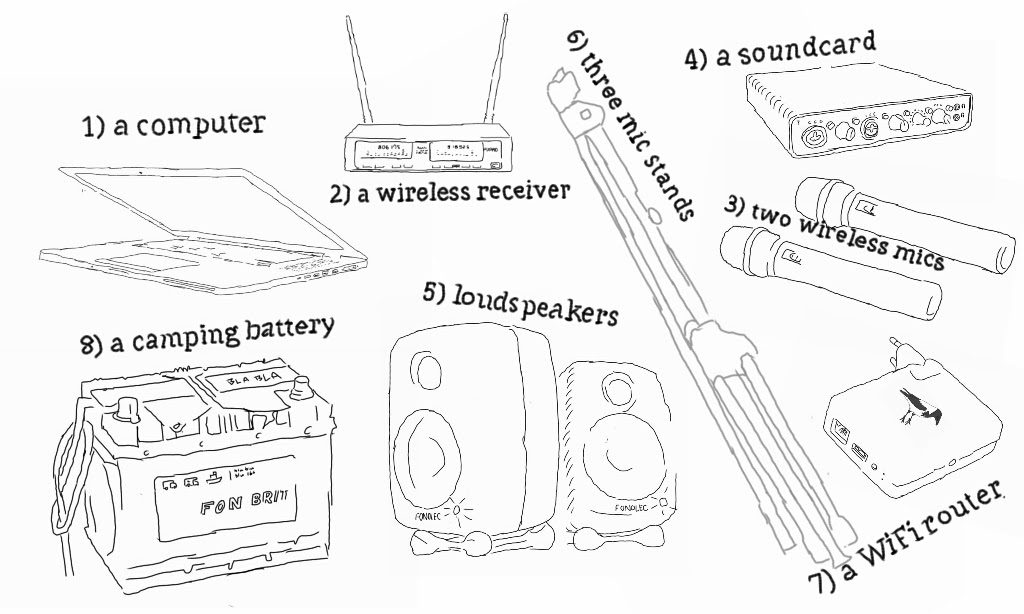
Though summing up to I don’t know how many years of wage for an average garment worker in Bangladesh, I believe that it is not inconceivable that a local group of activits in a Northern welfare state could get their hands on these things.

Quotations: Lefebvre on the living disorder of the street.
Spelling out the invisible social wall

Owing to the curious lay-out of the town it is quite possible for someone to live for years in Manchester and to travel daily to and from his work without ever seeing a working-class quarter or coming into contact with an artisan. He who visits Manchester simply on business or for pleasure need never see the slums, mainly because the working-class districts and the middle-class districts are quite distinct … To such an extent has the convenience of the rich been considered in the planning of Manchester that these plutocrats can travel from their houses to their places of business in the centre of the town by the shortest routes, which run entirely through working-class districts, without even realizing how close they are to the misery and filth which lie on both sides of the road.

Friedrich Engels

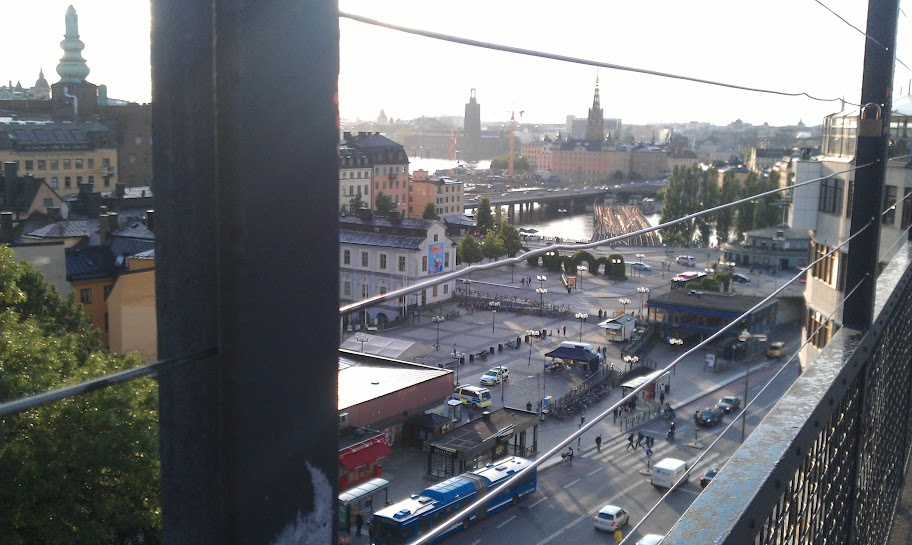
Stockholm is an extremely beautiful city. The buildings are well kept, beautiful, old. Everything is clean and in good order. Streets are clean. And the water! There is water everywhere, and contrary to Copenhagen, the old city is including the sea to an extent to which you find yourself always looking across water, when looking at the beautiful architecture.

Stockholm – a beautiful city with an amazing mix of see and city, Capital of Scandinavia, or just another urban area in the Global North with strong but invisible social walls

In central Stockholm you get the idea that people in Sweden all just happen to own (at least) a yacht.

By the end of my 6 days stay in Stockholm, I wanted to find a flee market, so I checked The Visual Guide to Stockholm. Thumbing through this book, my impression of Stockholm as a place for only very beautiful houses where only people with (at least) a yacht live were completely reaffirmed. It mentioned a flee market in a place called Skärholmen. Supposedly the only place in Stockholm, where people go when they want to go to a flee market.

I asked a woman in the street if she knew about this flee market. She actually grew up in that place, she told me, but hadn’t been to the place in 10 years. I clumsily tried to get out of her what kind of neighbourhood it was, asking if it was a residential area, urban, or where only old people lived. She didn’t really get my point, but stated that it was a ‘mixed’ area. So I went there.

The trip in the subway launched a totally new experience with the city. First: the sounds. From a soundscape with birds, boats, ferrys, waves etc. I entered this gloomy ugly soundscape of the subterranean. There are excuses for the sounds that the trains, lifts, escalators etc make (although we know that where there is a prestigious market for things, – a lot of money is spend in designing the incidental sounds that our products make). These sounds can be ugly and you can accept it because you know that when the train stops it needs to use breaks. And the train is heavy, so of cause it makes a loud annoying sound. But the intentional sounds !!!!  – the sounds that are created in order to signal things to the users, like ‘the doors are closing’, and the way the pre-recorded voices announcing the name of the next station. These sounds do not necessarily need to be ugly, impersonal, depressing. Then there is the visual side.  There are many shades of yellow. But why use THIS yellow for the places you must put your hands in the train!

Arriving at the station where the flee market is, the sound of corvids met me, and the sight of people that probably do not own a yacht (or anything else).

Fleemarket in suburbian Stockholm

If this was a movie people would think, you don’t have to overdo things that much! The flee market was in the basement of a mart-like construction by the underground station. Large tubes running in the low ceiling and non-yacht-owners sitting each at his/her stand, immobile, looking out in the air. It took me some time and the purchase of an old hunting horn for my son, to get used to the quite heavy atmosphere of the place. There were light moments of people small talking and laughing, but it seemed that most of the people didn’t consider the flee market spirit interesting as such, and were more in it for the money so to say. The woman I had asked in central Stockholm about the flee market hadn’t been back to her place of birth in ten years, – a connexion?

My experiences in Stockholm, although in general on the positive side (which probably had to do with the purpose of my visit, – I was there for a workshop, and not for collecting bottles), inspired to reflection on the relation between how many yachts you own, and how much right you have for beautiful sound and sights.This is of course quite banal, but Stockholm does a pretty good job spelling it out. As if it was meant to be so, I stumbled upon this book at the Moderna Museet, from which I have the initial quotation:

this is my diy copy of the image of the front page

As it shows, this book is extremely inspiring. I have always avoided these kinds of texts because I thought that these questions were for architects and designers and not for sound artists. How wrong I was!! Questions about the urban space are extremely important for all of us!! Not least when it comes to sound. First of all there is the question about the soundscape itself. It certainly makes sense to question the way sound meets us in our public space. And then there is the general fact that public space is the only place of encounters of people of all kinds, and therefore a potential place of interchange between different ways of living and seeing life.

The space-time vector converges to zero in urban space; every point can become a focal point that attracts all, a priviliged place upon which everything converges.

Henri Lefebvre according to Christian Schmid

Quotations: Lefebvre on the living disorder of the street.

Giantophone

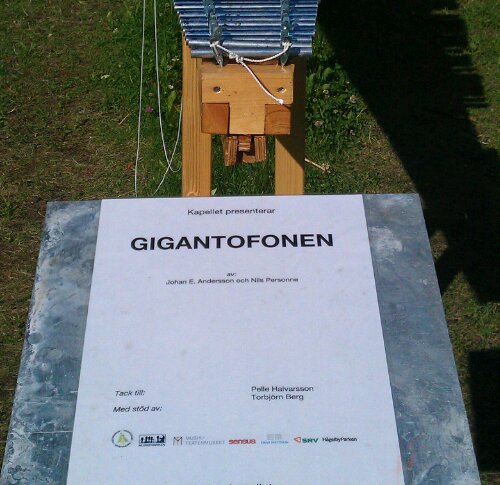
During my trip to Stockholm where I  am participating in a workshop about forum theatre methods, I discovered this …. thing in the neighboring museum of modern art: a “Gigantophone”.
image
Made of tubes, ladders, pieces of wood, this I-don’t-know-how-long instrument stood there, outdoors in a lawn, accessible to anyone. Of course I had to test it!

One of my current projects is to incite those who make decisions about our public urban streetscapes to start thinking about the ‘street-furniture’ in terms of the possibilities for passers by to make sounds on them, to use them as ‘streetstruments’. This is an example of a rather conventional way to give us a means of making sound in public space.

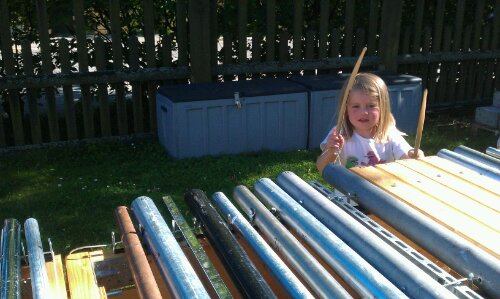
However, as I discovered the following day, it certainly has an appeal on people….

image
... kids as well as adults

This evening, I experienced a perfectly clear illustration of the ‘audience crisis’ of contemporary artistic expressions. And a possible solution. Approximately 5 meters from the giantophone there is a tent meant for performances, concerts etc. Here, the Fylkingen (Swedish electro acoustic music organisation) hosted an event at which sound artists had a public jam session.

image

So: You see two groups of people engaged in the same kind of activity. Both groups immersed in the creative exploration of sound, curiously, open and collectively. But not together. Actually the ‘real’ musicians had as few people, or less, watching as the ‘amateur’ guests playing on (/with) the giantophone, 5 meters away.

Would it be conceivable to join the activities of the two groups into one collective, learning, curious, openminded, sharing activity, where the ‘guests’ would get inspiration from the ‘pros’, and the pros would have their competencies with sound as a means to expression put into play with people who are not normally involved in this?

I think the answer is obvious, and the way to do it is extremely simple: mic it up! Put microphones on the ‘streetstrument’ and use ‘ordinary people’s’ sounds in your avantgarde musical processes.

This is an impro I made on the giantophone:

Collective street improvisations, – how do we get people involved?

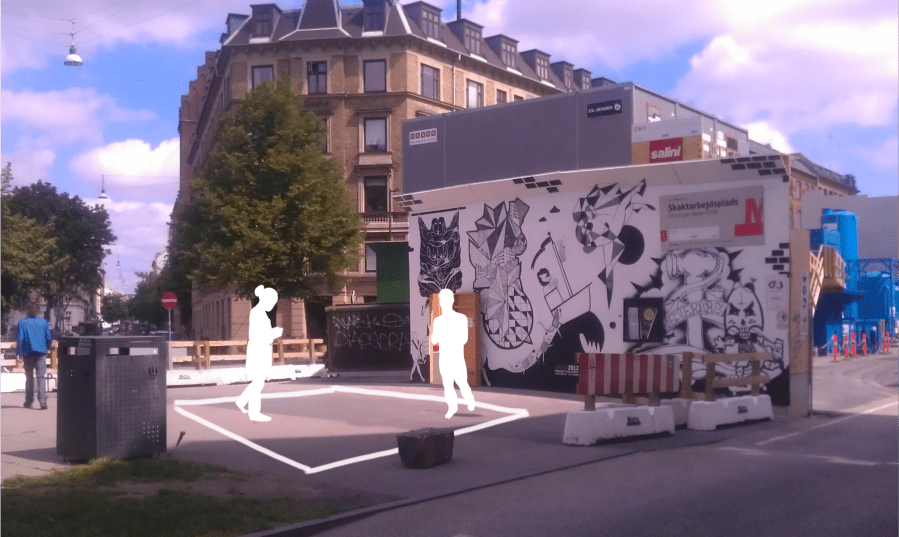
street improvisation; field for collective improvisation

How can you start a new trend, create changes in other people’s lives, making them start doing things no-one has done before? How can you make more people start doing what only few people did before?

The basic goal of all my activities in the ongoing process I call Akutsk, is to inspire people who are not professional musicians or composers to work with sound as a means of expression in a creative, reflected and situated way.

I’m pursuing a bottom up approach, where I use the street as a place where people are presented with the methods/technologies for collective street improvisations, through workshops and flash mob inspired interventions.

With the workshop concept,  I aim at making a number of 3 hours workshops in local communities, starting by the ones close to where I live. The main target group consists of young people aged 13 – 16, a central criteria of success being to engage young people from not-so-well-off neighbourhoods.

How can I engage young people in taking part in collective street improvisations? I have three strategies:

  1. Go through the adults they trust. Pedagogues in the youth club, teachers, neighbourhood workers, etc. The challenge is to actually get in touch with these people, they seem to be always busy
  2. Participants from one workshop are invited to participate in the next one. This helps overcome the shyness, and it can also create new connections between young people from different neighbourhoods. And it empowers the ones who participate the second time, giving them a role as peer trainers.
  3. Have a group of facilitators, young adults by preference, that help on the workshops, giving the example of the work flow of the method. It’s always easier to engage in something, when you can see how it works.

The largest barrier to inspire people to get involved in these activities lies of course in the answer to the question ‘what’s in it for me?’. Since there is no money involved, I have to come up with something else. For the participants in the workshop, the answer would be, that it provides them with new means of expression through sound. It gives them a framework, as a collective, in which they can create something unique out of the sounds that are there at a given time and place. And the ‘something’ they create leaves a mark on the place in the form of a QR code. The participants can tell others about this moment by referring to the QR code. In addition, the process itself is fun, it’s playful, physical, and the way we work with the material is flexible, personal and situated. At least this is what I believe!!

The main challenge is to make people pass the barrier of shyness, and of why-should-I-start-doing-this-stupid-thing-ness. We all experience these situations from time to time, where someone wants us to do something in front of others that seem awkward and unnatural in the moment. My solution is to

  1. have a set-up that is simple. What meets the participant is: a quadrangular field. Two microphones, one set of headphones. A smartphone in his/her hand.
  2. have a set of play rules that are simple. There might be a weak point to my concept here, though I think that newcomers can quite rapidly get the hang of it. It consists of 4 steps:
    1. find a sound, explore the area for interesting ‘streetstruments’
    2. record it (by tapping your smartphone)
    3. form your sound with your voice (after putting on the headphones and turning your smartphone upside down)
    4. move yourself and your phrase in the quadrangular collective improvisational field (by using your smartphone as a remote control turning up/down the volume and the panning of your phrase)
  3. Have a couple of people who already know the processes start up the activities, and gradually make new participants replace them.

street improvisation; field for collective improvisation

Two days ago, I got an answer from the local community centre in a neighbourhood called Valby, that they accepted my application for two workshops. The workshops are set to August 2012. I also have a pilot workshop in collaboration with the Copenhagen Jazz Festival, July 6. I still wait for the answer to 4 additional workshops, but in any case, I will be making improvised street ‘interventions’ whenever I have the time for it. In total this gives a fair number of occasions, where the magic can begin. And it gives a basis for a group of volunteers to work for the project.

This is the next step: Starting up a group of volunteers or ‘fonografists’. I think there are a number of reasons why someone would want to get involved in this project. First of all, it is something new. Working with sound in street art is very little developed, since it has been to complicated and expensive until now, and being part of a movement towards a new form of expression is simply extremely inspiring. Being a voluntary in this project also means experimenting with how to extend the ordinary way you use your voice and body into a form in which you can develop a sound improvisation in a collective. And it means guiding others in doing so. It means experiences in how to develop the tools and methods for involving non-musicians in working with sound as a means for expression. And then there are the additional experiences in documenting, communicating, organisational development, fundraising, etc. But most of all, there is the kick in making events at unexpected places, to create occasions where magic can enter in our everyday lives.

Quotations: Lefebvre on the living disorder of the street.

Ich bin ein Amateur!!

Similarities in composition

Collection, composition, reflection, these are the three main elements of an artistic process, and here I’m going to do the third.

For a detailed account on my “cycle of artistic processess”, read here: http://www.wix.com/akutsk/akutsk#!artistic-processes-cycle

For the processes of collection and composition I use the Anthropomorfer. This is an instrument I have build in the computer, using a program called MAXMSP. The Anthropomorfer in its current version makes it possible to record sound in 8 ‘players’. For each recording, the user uses his voice in a 2nd microphone, adding a ‘meta-layer’ to the first recording, let’s call it the “voice” of the player. The meta layer works as a mould for 1st recording, – the “body” of the player. You do not hear the second layer; what happens is that the Anthropomorfer makes an analysis of the second layer of sound, and uses this analysis to form the first layer according to  two sets of parameters:

  1. Volume and pitch.  The analysis of the volume and pitch of the 2nd layer controls the amplitude and sample rate of the first player. As a result, you perceive changes in melody and rhythm. This is the prosodic level of speech, and it is – among other things – our means for using our voices to imitate movement. We use prosody when we are moved, and we use prosody to move a virtual fist in the face of the other in a discussion. In the Anthropomorfer, this is where ‘the voice’ makes ‘the body’ move.
  2. Timbre. The analysis of timbre of the voice/the 2nd layer is being used as a filter for the body/the 1st layer. Timbre, we also call it tone quality or simply color, is the domain of phonemes, quality of voice, and different ways of using the oral cavity. We use timbre when we form words, and also as a mark of our feeling state. We distinguish between voices according to timbre. Timbre has to do with identity. The identity granted to a thing/concept, when we use words; the identity of a person, when we hear his/her voice; and the identity of an emotional state. In the Anthropomorfer, timbre is a way of infecting a layer with the identity of another layer. What you perceive are changes in the spectral quality of the sound. It corresponds to instrumentation in an orchestral score. In popular music the effect of tweaking the EQ of a theme/track is extremely common.

So. You have a body. And you have a voice. The voice moves the body and changes its appearance. In the Anthropomorfer, it doesn’t stop there, though. There are 8 players. Actually any ‘player-voice’ attached to a ‘player-body’ can form any of the other players. In ‘movement’ or ‘identity’ or both. And what’s more: The player-bodies themselves can form each other. In moving the other ‘player-bodies’. Or infecting the other player-bodies with its own timbre-identity . The only thing that can’t happen is a player-body controlling its own ‘movement’ – it stands still!

Imagine 8 player-bodies, playing around, making each other move, and infecting each other with their appearances. Like independent actors each with its own will, sometimes being influenced, though keeping its own basic characteristics, sometimes influencing others. In the current version of Anthropomorfer, your role as an improviser is akin to the role of a director. I have made an iPad user interface for the Anthropomorfer, where you can control:

  • the overall volume and pan of each player, thus being able to move each of the player-bodies to the front/back (volume) and the right/left side (pan) of the soundspace.
  • the degree of ‘timbre-susceptibility’. You can fine tune how sensible a given player-body is to the viral influence of another player-body or player-voice. This is being perceived as the saturation of the sound, sometimes to a degree of overdrive
  • the influence-matrix. Which player-body or player-voice is influencing which player-body’s movement and/or identity. This is done through two 8X24 matrices.

You can mould any player with your voice (or any other sound) in real time. Actually up to 8 external players (IRL) can participate.

In the improvisation ‘Æææææ’ I use two microphones. One hanging out of my window, recording the sounds from my street, and the other in front of my mouth. At the moment of the improvisation, there were workers working on the construction site in front of my house, listening to the radio and mounting some plywood on a wall. People were passing by, talking. All these sounds make up the recorded player-body layer. I use my voice for the recorded player-voice layer, and I use it while improvising, in real time.

Listen to this improvisation, headphones recommended.

It is my own improvisation. Nevertheless, I will try to listen to it as if it was exterior to me. This is what I call level 1 of exteriorisation. It is a very important part of the cycle of artistic processes. But it is often ignored. With the Anthropomorfer, a good deal of the result is not a direct consequence of the improvisers intentions, and this gives it an open quality, where you can actually surprise yourself. This is why the first level of exteriorisation is more easily reached, when working with the Anthropomorfer.

So, what happens in the improvisation Æææææ? It seems, there are two overall movements.

  1. A rhythmic pattern, in a quasi 5/4 meter, with a hammer-like sound, garnished with other sounds.
  2. A dense complex mass of thick sound with elements of human speech.

These two movements intertwine, the 1st being present through the whole improvisation, though a little subdued, while the 2nd comes and goes, insisting, dense and confused, brutal. There is an overall division in two of the improvisation. The first part is where the two movements intertwine, the second messing around where the 1st keeps a calm repetition. At a moment, the 2nd movement disappears, and the 1st stands back, while being changed in color. A sharper, more crisp sound, in comparison with the more warmer sound at the beginning.

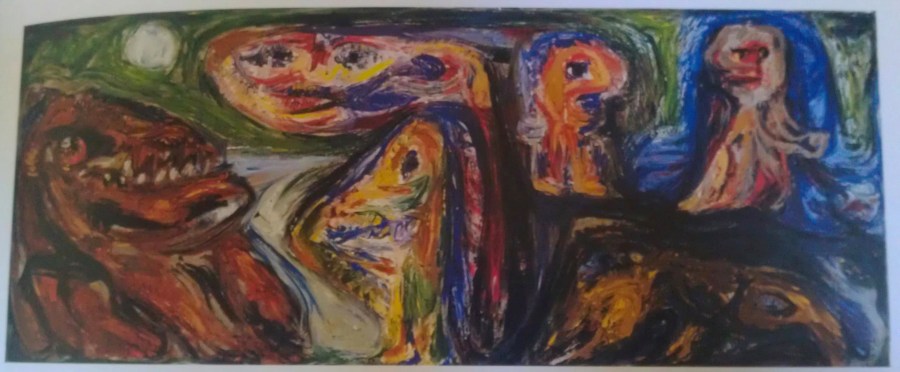
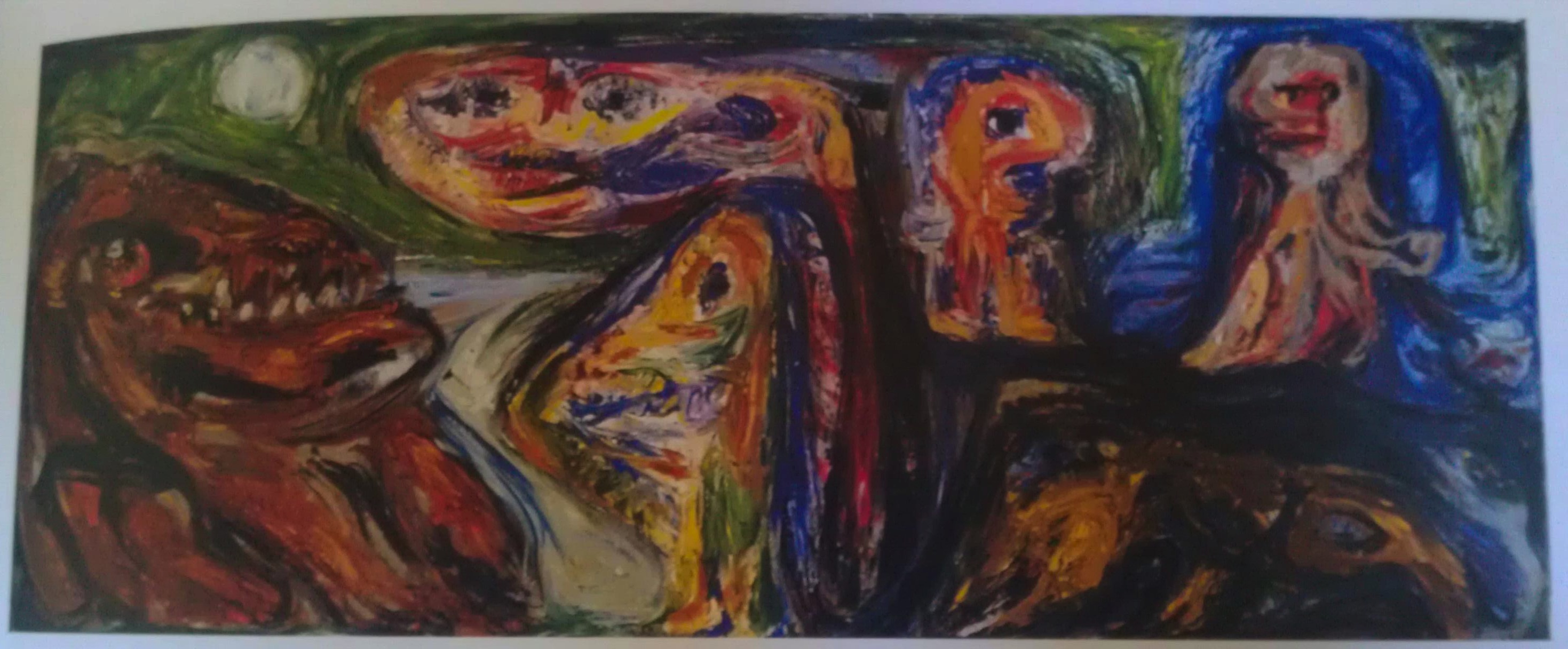
To me, there is a similarity between the way this improvisation works, and this painting by Asger Jorn:

Similarities in composition, used with assumed tacit accept by the painter

I use the Anthropomorfer for improvisation mainly to ‘try my own medicine. I want to make improvisations the way anyone with the instrument would be able to do it. In that sense, my approach is essentially one of an amateur. Being an amateur means loving what you are doing (the root of the word is ‘love’), it is about sharing, since you love it so much, and you want others to be a part of it. There is no issue about who did what, since there is no money involved.

In that sense, I’m proud of declaring: “Ich bin ein Amateur!!”

____________________________________________

Do you want to microsponsor akutsk?

Anthropomorfer – a tool for intercontinental collective sound art improvisation?

We are all virtuosos with our voices. Imagine being able to improvise over the sounds around you using your voice as an infinitely fine-tuned  controller. While  real time jamming with someone on the other side of the planet.

The mission is: I want to find the optimal tool to allow people to improvise sound art in collectives across the planet, in a creative, pleasurable, and reflective way. I have developed the Anthropomorfer as a desktop application, allowing collectives to improvise, while being in the same place. Now, I want to extend the functionality from a local wifi based context to a global web-based one.

The tool is intended for anyone interested in working with sound as a means for expression, but these contexts are of special interest:

  • working with children developing their analogue literacy and their divergent thinking
  • in organisations enhancing communication skills

What will the participant experience:

1) Open your app. Start a group or sign up for one. Select a sound, either by recording it on the spot, or from a database of sounds that other users have chosen. 2) You now hear your audio while viewing it as a waveform on your smartphone. You choose which part of the sound you want. 3) When all the participants in your group has chosen and cut their sound, start your session 3… 2… 1…. and:  4) improvise together. You can turn volume up and down, pan, and you can shape your sound with your voice via the phone’s microphone. 5) afterwards, you listen to the improvisation, give it thumbs up or down, and if a majority votes for it, the improvisation is saved on the server. Here you can comment and discuss it.

What lies behind:

Technically, there must be a server where the program runs, and audio files are stored. From each cell phone the server receives  1) an upload of a short sound file (max. 15 seconds). Or a selected audio file, which is already on the server. 2) A flow of analysis of the voice. Not the voice. Just analysis of pitch and volume. The server streams audio from the collective improvisation to the participants.

____________________________________________

Do you want to microsponsor akutsk?

Sound becoming color

A series of improvisations using the Vocogram-addition to Anthropomorfer: using my voice as an equalizer. The concept: an improvisation for each vowel sound in Danish. (there are many!!)

Read my reflection over Æææææ in my post Ich bin ein Amateur!!

Read about the vocogram in my Danish blog (translated by google): http://translate.google.com/translate?hl=da&langpair=da|en&u=http://oerermedfilter.wordpress.com//

____________________________________________

Do you want to microsponsor akutsk?

Music as an incorporeal species…. How to re-invent social practices, or: how to become analogue literates?


N.S. Anderson's avatarNicholas S. Anderson

[H]ow do we change mentalities, how do we reinvent social practices that would give back to humanity—if it ever had it—a sense of responsibility, not only for its own survival, but equally for the future of all life on the planet, for animal and vegetable species, likewise for incorporeal species such as music, the arts, cinema, the relation with time, love and compassion for others, the feeling of fusion at the heart of the cosmos?

Félix Guattari, Chaosmosis: An Ethico-Aesthetic Paradigm, trans. Paul Bains and Julian Pefanis (Bloomington: Indiana University Press, 1995), 119.

View original post

Embodiment in New Media

immanentterrain2's avatarImmanent Terrain

Hansen in New Philosophy for New Media [1] argues that New Media brings the possibility of overcoming the immobility and passiveness of observer as it was the case in theater, photography, cinema, etc. and enabling user to create meaning for digital data by unfolding it through embodied interaction. But a piece that is ignored is that the mediation happens through a software to create a reaction to users’ body. In a natural environment users action is propagated through environment creating a series of crystallization and events, creating a series of zones of in-determination that are unfolding through time. In case of a digital interface (embodied or a flat screen) the results are in most cases a series of causal deterministic events that are designed by the designer (artist) to respond to users’ interaction. If there is any degree of indeterminacy, it is either the result of hardware flaws (software by…

View original post 306 more words