What is the ideal ensemble for playing contemporary music?

What does the typical contemporary music ensemble look like? I haven’t been able to find an answer to this question, so I decided to make my own enquiry.

There seems to be three categories: Larger ensembles, typically in the format of sinfoniettas. Ensembles in traditional formats, ie. string quartets, wind quintets, etc. And then: ecclectic, new, experimental formats. I have noticed, that when there are call for scores, it seems as if the formats available are most often within the 3rd category.

I decided to make a small investigation into the question, narrowing my research, so I looked for ensembles within the 3rd category, with these conditions:

  • the ensemble must be active now, 2022
  • they must be playing composed music (not excluding ensembles also doing other formats)
  • consisting of from 3 to 10 players
  • playing acoustic instruments, although ensembles also including electronics were also ok

I gathered info in a google sheet, and here is the result:

  1. I found (sofar) 18 ensembles
  2. They are based in Argentina Australia Denmark Finland France Germany Irland Italy Serbia UK USA
  3. They have between 8 and 3 members

What instruments are they playing?

All in all, these instruments were used: Voice Recorder Flute Obo Saxophone Clarinet Bassoon Trumpet Trombone Guitar Harp Accordeon Piano Percussion Violin Viola Cello Double Bass Electronics

What is the most frequently used instruments?

1Piano79%
2Clarinet74%
3Flute68%
4Cello68%
5Violin58%
6Percussion53%
7Voice26%
8Viola26%
9Obo21%
10Double Bass21%
11Electronics16%
12Bassoon11%
13Guitar11%
14Accordeon11%
15Recorder5%
16Saxophone5%
17Trumpet5%
18Trombone5%
19Harp5%
The piano was part of 79% of the ensembles.

Since the average size of these ensembles were 6 players, I found it useful to look at the six most frequently used instruments, marked in bold above, and these are: Piano, Clarinet, Flute, Cello, Violin, Percussion.

What my mini-research has shown, so far, is that the typical ensemble playing contemporary music is a sextet with the so-called Pierrot ensemble with an added percussion player.

Here is the list of ensembles:

NameWWWCountry
AlephFranceFrance
Scenatethttps://www.scenatet.dk/portfolio/Denmark
FiguraDenmark
Uuisinta Ensemblehttp://www.uusintaensemble.fi/about.htmlFinland
Concordehttp://homepage.eircom.net/~concorde/index.htmlIrland
Da capohttps://www.dacapochamberplayers.org/the-musiciansUSA
Dynamis Ensemblehttps://www.dynamisensemble.it/page1.htmlItaly
Eighth Blacbirdhttps://www.eighthblackbird.org/sextetmusiciansUSA
Ensemble KapariloArgentina
Ensemble RechercheGermany
Ensemble Sortisatiohttps://en.wikipedia.org/wiki/Ensemble_SortisatioGermany
Ensemble Studio6http://www.studio6.st/ensemble.htmlSerbia
The New York New Music Ensemblehttps://www.nynme.org/homeUSA
Psapphahttps://www.psappha.com/about-us/UK
relachehttps://www.relache.org/musiciansUSA
Sentieri selvaggihttp://sentieriselvaggi.org/il-progetto/Italy
Sond’artehttps://www.sondarte.com/repertoire-mainItaly
Topologyhttps://topologymusic.com/who-is-topology/Australia
Three of these ensembles are consisting of exactly the six most typical instruments, marked in bold. Two ensembles included the six instruments, while adding 1 or 2 others.

Information

I based my search mostly in this “List of contemporary classical ensembles” (wikipedia). It is of course rather incomplete, and many of the listed ensembles are historical. What I find curious is that I had such a hard time finding information on these things online. It is really difficult for me to find updated databases on the current ensembles, and for that matter, festivals, calls for scores, and so on. In short: Information about the contemporary music scene seems to be really scarce.

This leads of course to my typical last words: Help! If you have information about good, updated ressources for contemporary music, composers, festivals, musicians and so on. If you know about more ensembles to include in my enquiry. And, of course, if you know about real, maybe even academic, enquiries into these questions: Help!
What does the typical contemporary music ensemble look like? Read about the results of my mini-enquiry - And give a hand finding out more:-)
“The confused composer”
Segar, CC BY-SA 4.0 https://creativecommons.org/licenses/by-sa/4.0, via Wikimedia Commons
Problem solving in math and music – what is the connection?

Take a look at these two series of numbers:

6-4-4-3-3-2 5-3-3-2-2-X

What number would you put at X’s place? Would it be 1? I think most people would come to that conclusion. What if you were asked to find the series of six numbers before the 644332 sequence? Wouldn’t you choose 7-5-5-4-4-3? And after the 533221 series, you would probably expect the combination: 4-2-2-1-1-0, right?

Now you have solved a mathematical problem. Does that feel good?

If I told you, that the two series of numbers are from a piece of music, do you think, you can guess which (hint: you probably would have to be Danish to know 🙂 )?

OK, you guessed correctly! They are from the Danish children’s tune, “Jeg ved en lærkerede” (“The lark’s nest“) by Carl Nielsen. It’s a very simple tune, and as a composition, it is brilliantly done. Here you can here the melody, made in Google Song Maker:

The Lark’s Nest – simple midi version of the song

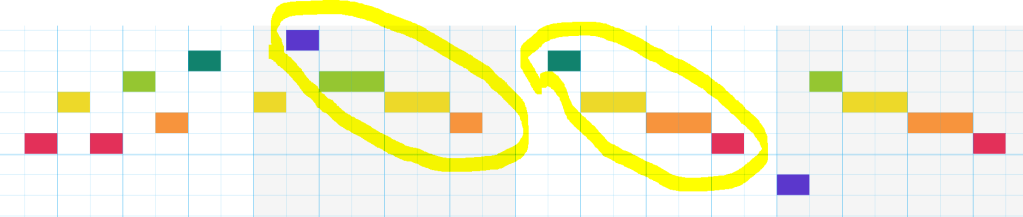
In the melody, the two series of numbers appear in the middle of the song, in note names: C-E-C-F-D-G- -E-A-F-F-E-E-D- – -G-E-E-D-D-C– -A-F-E-E-D-D-C- – –

Looking at the melody in midi notation, we can see, that the logic of the two series can also be immediately grasped, when represented as geometric patterns:

The ‘Lark’s nest’ melody as midi/boomwhacker notation (made in Google Song Maker)

Why does it feel good to solve a math problem? You found that the missing number was 1. And you came to that conclusion via a process of looking for a pattern in the number series, and through logical thinking coming to a conclusion. How is this gratifying? Is it the fact of experiencing a confirmation that the world turned out to be, what you would expected it to be?

When you listen to or sing the melody of ‘The Lark’s Nest’, and you experience the tone C at the end of series two, was this what you expected? And if so: was the feeling of experiencing something in the world that turned out as expected gratifying? Was the feeling related, somehow to the feeling, when solving a math problem? Is listening to and playing music (also) some kind of problem solving?

Sudoku and music

I have a habit. When I need to relax my brain, I play Sudokus. I actually play a version called ‘Killer Sudoku’. In math terms, solving a killer sudoku means using basic adding/subtracting, which is of cours good training, but the satisfying part is the part where it’s actually about solving equations. I’ve been doing this for quite some time, and contrary to other time killer apps, I seem to stick to this one. It means predictability, since I know I will always solve the Sudoku, eventually; I know some tricks that will help me crack the problems; but what is more is, that it means discovering new tricks.

At a session with my composition mentor, Jexper Holmen, we talked about musical form. I am working on a series of variations for piano, and Holmen suggested that I ‘coded’ the variations with certain formal elements, something in the beginning, in the middle, and in the end, that could be easily recognized. These elements should help build a ‘contract’ with the listener, setting up something to expect; once there is expectation, expectation can be fulfilled or not, and in this way there is ‘something at play’.

In the children’s tune ‘The Lark’s Nest’, there is a build up of expectation, within the melody itself, and the fulfilling of this expectation is what makes it a good melody.

The sound of sudoku

Now, with the ideas from my mentor in the back of my head, and sitting, as usual, killing time with my killer sudoku, an idea struck me. This is what I knew:

  • solving a sudoku is basically about solving equations
  • solving equations is a gratifying thing
  • music can be build as series of numbers
  • series that follow a logical sequence, thus fulfilling the listeners expectations, it can be gratifying to listen to

So my idea was of course: What if I turned a (Killer) Sudoku into music? What kind of music would that be? As is the case with turning DNA code into music, the fact that the system used for generating music is foreign to the sound itself, makes the connection between sound and system arbitrary. Just like with letters and phonemes in language. The letters H-O-R-S-E are supposed to sound in a specific way, when spoken. In language, the relation between spoken and written words is arbitrary. However, once established, the system makes sense to the reader.

So, if I want to make a sudoku into music, I need to choose a way of translating the sudoku’s math problems and their solutions into sound. And the choice of a translation system will necessarily be arbitrary. However, there might be a chance, and this is indeed my purpose, that the audible result will make sense in a way similar to the sudoku.

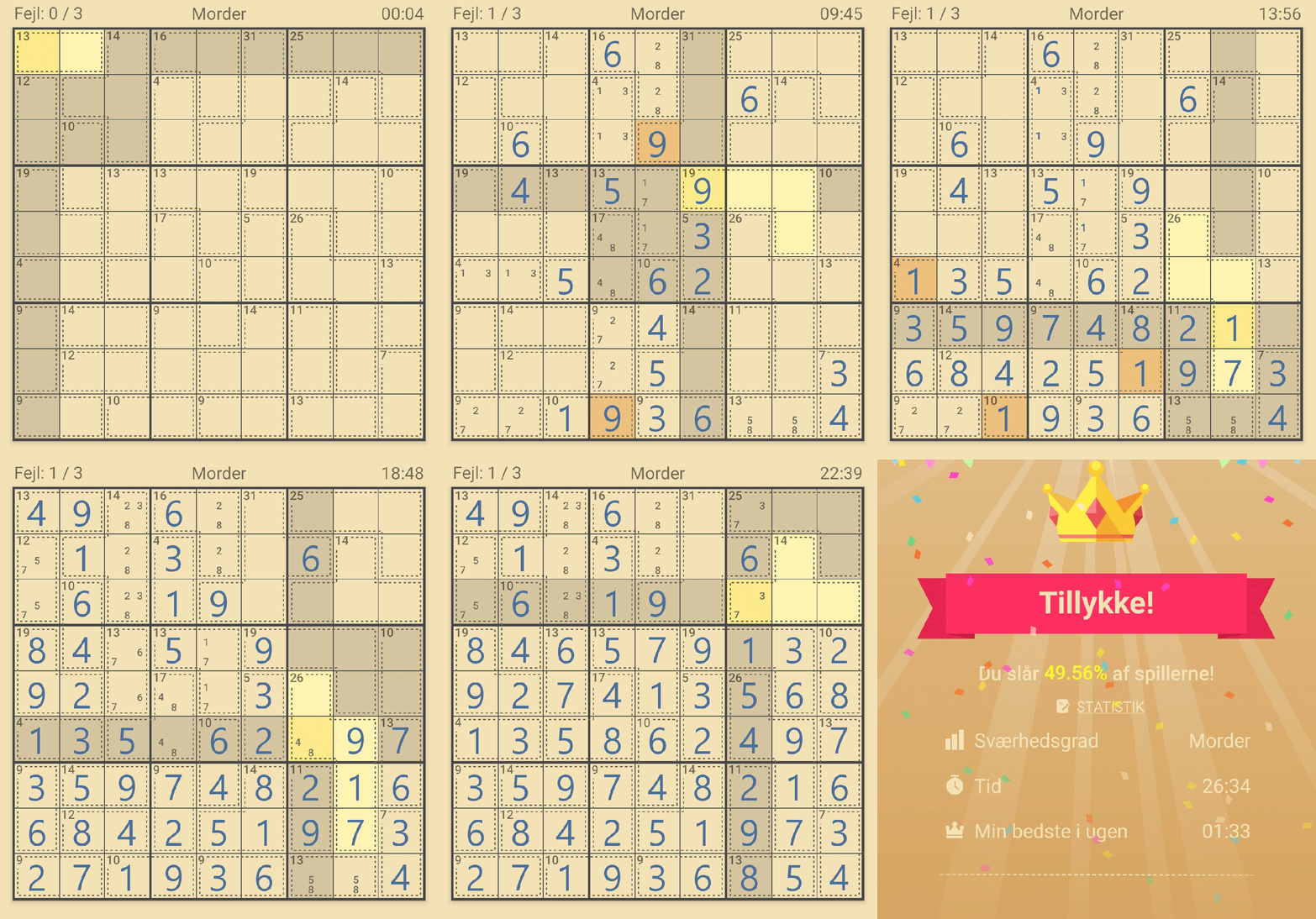
Here is a sudoku, I’ve solved.

A sudoku being solved

How can this mathematical problem solving become a piece of music?

First, let’s establish some points. Solving a Sudoku takes time. For me, this makes a ‘translation’ into music meaningful, since music is a time based art form. The sequence, and maybe duration, of the problem solving in the sudoku could be used as the outset for the unfolding of the composition.

Secondly, a sudoku is based on numbers. In music, sounds and rhythms can be thought of as numbers. The sudoku uses the numbers 1 – 9 in a variety of combinations. In music, I think, it makes sense to use these combinations to generate patterns of pitch (melody, chord, interval) and rhythm. As we saw in the children’s tune, a simple sequence of numbers can generate musically meaningful sequences of pitch.

Thirdly, in a sudoku, you solve one problem at a time, but all problems are ultimately connected; solving one problems makes it possible to solve the next; in some cases, there will be an intermediary situation, where there are 2 – 3 possible solutions to a problem; reducing the problem to that, can help finding the final solution to another problem. In other words: Solving a sudoku means untangling a web of connections between connections. How can this be translated into music?

Experiments

In order to answer this question, we need to conduct some experiments. Here is a setup, I’m working on.

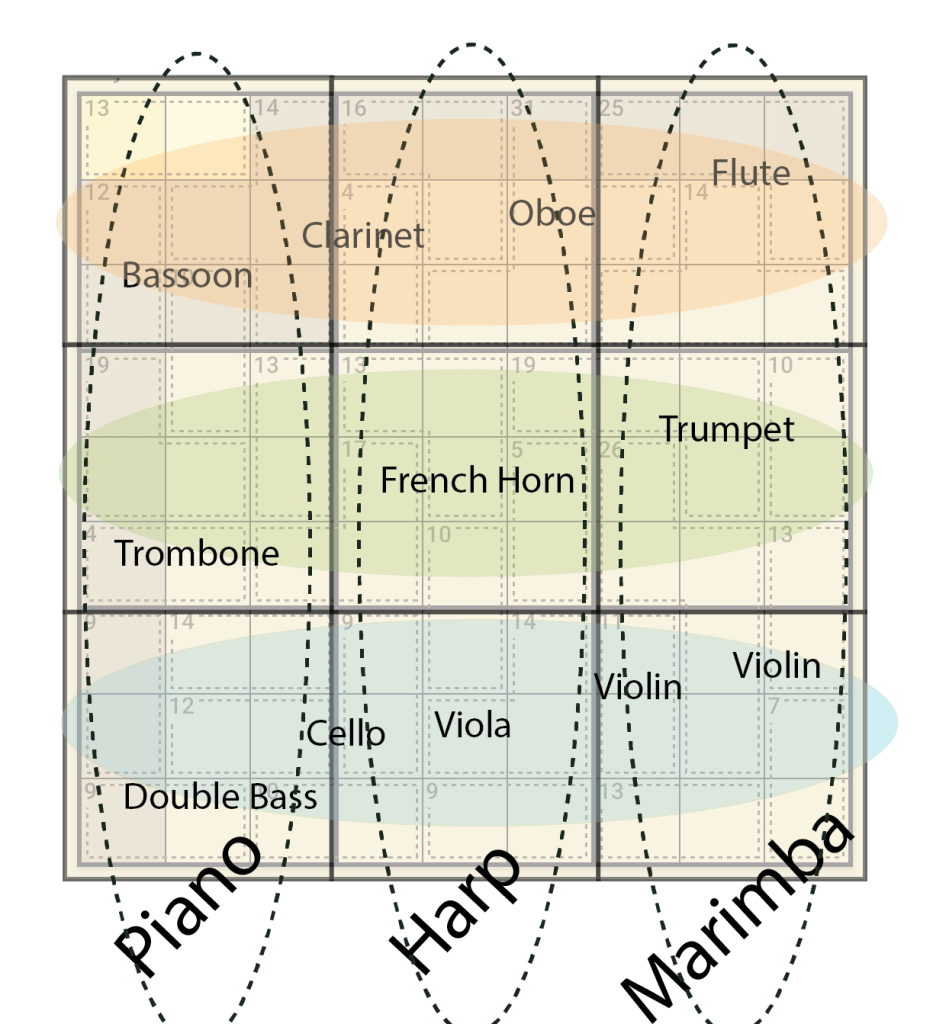
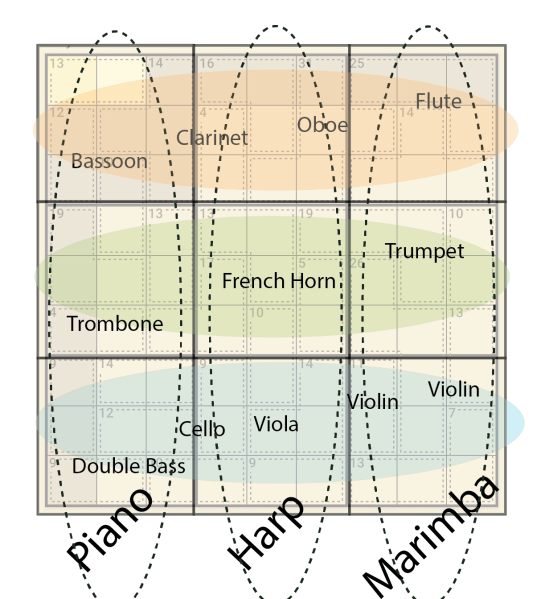
First of all, I think more instruments are needed. In order to establish a ‘solution’ to a problem, there is a need for something recognizable, and distributing different solutions to different instruments might do the job. The sudoku consists of 9 fields, nine vertical, and 9 horisontal lines, each with the numbers 1 – 9. A single number solution therefore affects a field, and two lines. In order to ‘translate’ this problem solving grid into musical timbre, I suggest that we divide the instruments in groups. In order to cover the whole field of problems, we need a certain number of instruments. How about a sinfonietta*?

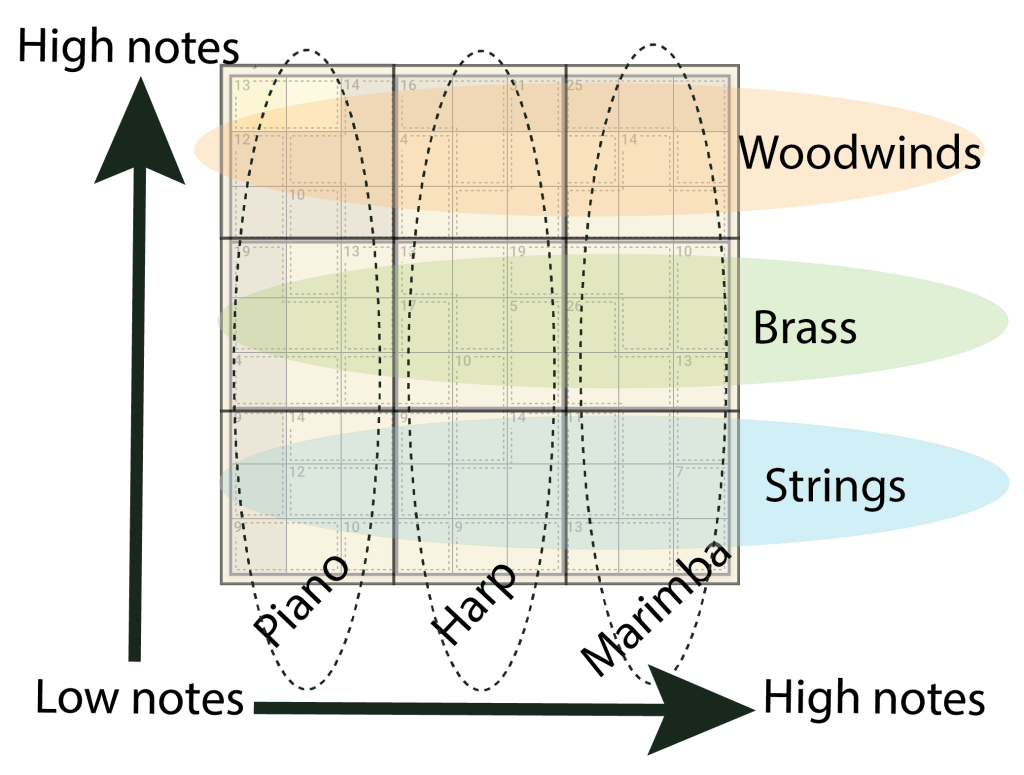
Since the occurrence of a solved problem, in a sudoku, is represented in the space of the grid, my idea is to allocate different instruments to different parts of the grid. In order to further enhance the ‘formatting’ of the spatial distribution of the sudoku’s math problem solving, I also coded the grid with pitch differences, going from deep pitches in the bottom left, to high pitches in the top right.

Mapping the spatial logic of the sudoku’s math problem solving onto musical timbre and pitch range.

Each instrument would ‘account’ for a problem solving in a certain region, and groups of instruments would gestalt the vertical and horisontal connections.

An idea for distributing the instruments spatially, mapped on the Sudoku grid

From here to a final result: a lot of hard work….!

* A sinfonietta is a kind of ensemble , typically, consists of 1 of each instrument from the symphony orchestra. In a sinfonietta, we typically have a flute, an oboe, a clarinet, a bassoon, a French horn, a trumpet, a trombone, two percussion players, a piano, a harp, two violins, a viola, a cello and a double bass.