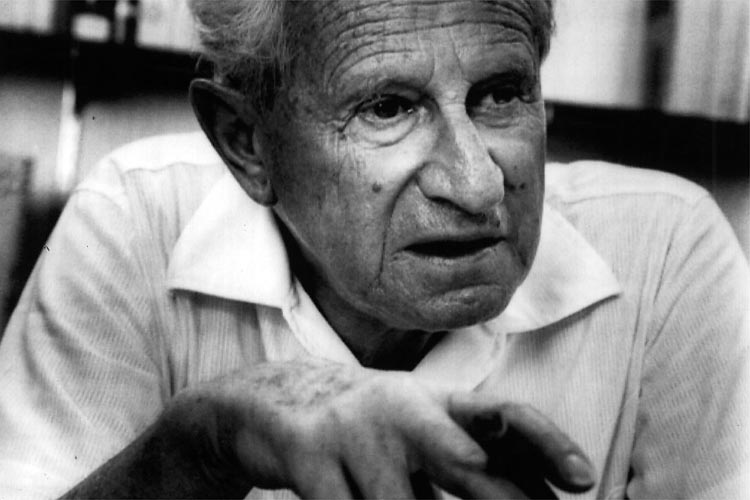
Henri Lefebvre: Audio ressources on the Web

Interview, 56’41” 1975-10-02

– Henri LEFEBVRE, sociologue : pourquoi il se définit comme “méta-philosophe”, le concept de mondialité ; ses origines, ses parents, ses rapports avec ses étudiants (allusion à Daniel COHN-BENDIT). Son activité d’opposant au sein du PCF pendant 10 ans, son exclusion du PCF, ce qu’il pense de Herbert MARCUSE, ce qu’il pense de l’humanisme, des Droits de l’Homme, l’évolution du PCF, son étude simultanée de la pensée de Karl MARX et du monde moderne, remarques sur le concept de l’Hisoire, sur les stratégies économiques et politiques, les éclairages que nous donnent les philosophes et la nécessité d’inventer des concepts nouveaux. (Entretien avec Jacques CHANCEL -56’41”). Source.

Interview, 2’45” 1970-05-15

Interview with Henri Lefebvre at ORTF. Here is the whole transcription.

Here is the source.

Interview, 33’30” 1970

URBANOSE – THE SPACE AS A LIVED EXPERIENCE? Interview with HENRI LEFEBVRE (1901-1991), 1970’s (l’office national du film du canada): Source.


Please give me a note if you find more sources with Henri Lefebvre speaking.

Organisation’s lethal selfpreservation

Luhmann, collage by CHC

Luhmann, collage by CHC

Luhmann argues that every autopoietic system has this sort of intra-systemic dimension. Autopoietic systems are, above all, organized around maintaining themselves or enduring. This raises serious questions about academic political theory. Academia is an autopoietic system. As an autopoietic system, it aims to endure, reproduce itself, etc. It must engage in operations or procedures from moment to moment to do so. These operations consist in the production of students that eventually become scholars or professors, the writing of articles, the giving of conferences, the production of books and classes, etc. All of these are operations through which the academic system maintains itself across time. The horrifying consequence of this is that the reasons we might give for why we do what we do might (and often) have little to do with what’s actually taking place in system continuance

Levi R Bryant

Regarding the intra-systemic dimension: I have made similar comments on the way the establishment around music in Denmark, – conservatories, universities, schools, high schools, etc. – works. Here’s one of my blogposts about it. (In Danish, google translated).

I actually think, that Levi R. Bryant’s point about intra-system’s lethal drive to selfpreservation is a general problem inherent in our interest based way of organising human activities. The way we have organised our collective problem solving activities, – in what we term as organisations, in which we work, the same problems we are theoretically trying to solve, will systematically drown in our effort to keep the organisations afloat.

Relevant reading from my  blog:

Learning from folklore / Reversed colonialism 2.0

larvalsubjects's avatarLarval Subjects .

For the last couple of days, I’ve found my thoughts haunted by McKenzie Wark’s brilliant interview over at Occupy Times.  Apart from Wark’s provocative claim that politics doesn’t exist– though perhaps it could come to exist, in a sense analogous to how Meillassoux talk of a “virtual god”? –this passage, in particular, stuck out to me:

…the problem is:  how do you occupy an abstraction?  Power has become vectoral.  It can move money and power anywhere on the planet with unprecedented speeds.  You can block a particular site of power, but vectoral power routes around such sites.

The abstraction Wark is talking about is, of course, contemporary capitalism.  Contemporary capitalism seems to be characterized by two features:  First, it has the characteristic of being everywhere and nowhere.  You can’t point to a particular site of contemporary capitalism and say “there it is!”.  Rather, it pervades every aspect of contemporary life…

View original post 2,092 more words

Quotation: H. Marcuse on the individual’s loss of autonomy

“It is not only the speed and range which distinguishes the means of mass communication from their predecessors. The new quality is introduced by the progressive transfer of power from the human individual to the technical or bureaucratic apparatus, from living to dead labor, from personal to remote control, from a machine or group of machines to a whole mechanized system. I should like to reiterate that I do not yet evaluate this development: it may be progressive or regressive, humanizing or dehumanizing. But what actually occurs in this transfer of power is also a transfer of guilt feeling responsibility. It releases the individual from being an autonomous person in work and in leisure, in his needs and satisfactions, in his thought and emotions.”

Herbert Marcuse, THE INDIVIDUAL IN THE “GREAT SOCIETY”