VLOG 4: Nearing True Machine-Musician Interaction? Exploring Rhythm through Fractal Proportions

We are nearing our objective of enabling our computer to interact with a live musician in a manner that closely resembles the interaction with another musician. In this fourth vlog, we explore the user interface developed by Samuel Peirce-Davies, which employs the ml.markov object to learn music from MIDI files. Our aim is to extend this functionality to accommodate music played by a live musician, which we’ve found requires certain adjustments.

Specifically, we’ve discovered that the realm of rhythm, or the temporal aspect of music, necessitates a distinct approach beyond the straightforward, millisecond-based logic. The key lies in thinking in terms of PROPORTIONS. Essentially, we’re dealing with the relationship between pulse and rhythm. This relationship needs to be quantized into a limited number of steps or index numbers that can be input into the Markov model.

Vlog 4

To achieve this, I’ve employed what might best be described as a fractal approach. We’re investigating the interaction between pulse and rhythm, moving away from a linear methodology that divides the pulse into equally spaced steps. Instead, we aim to determine the proportion, leading us to work with a list of fractions that divide the beat into segments like 1/6, 1/4, 1/3, 1/2, and so on.

By setting the maximum rhythmic duration to 4/1 of a beat, we have distilled the complexity down to just 13 different index values. This is in contrast to an equal steps approach, which would yield 48 index values if each beat were divided into 12 equal parts.

Consider whether you would truly notice a difference between a duration of 48/48 versus 47/48. Likely not, which illustrates why 13 index numbers are more meaningful to the Markov model compared to 48. This is especially relevant when considering Samuel’s approach, where any duration, measured in milliseconds, could potentially be integrated into the Markov model.
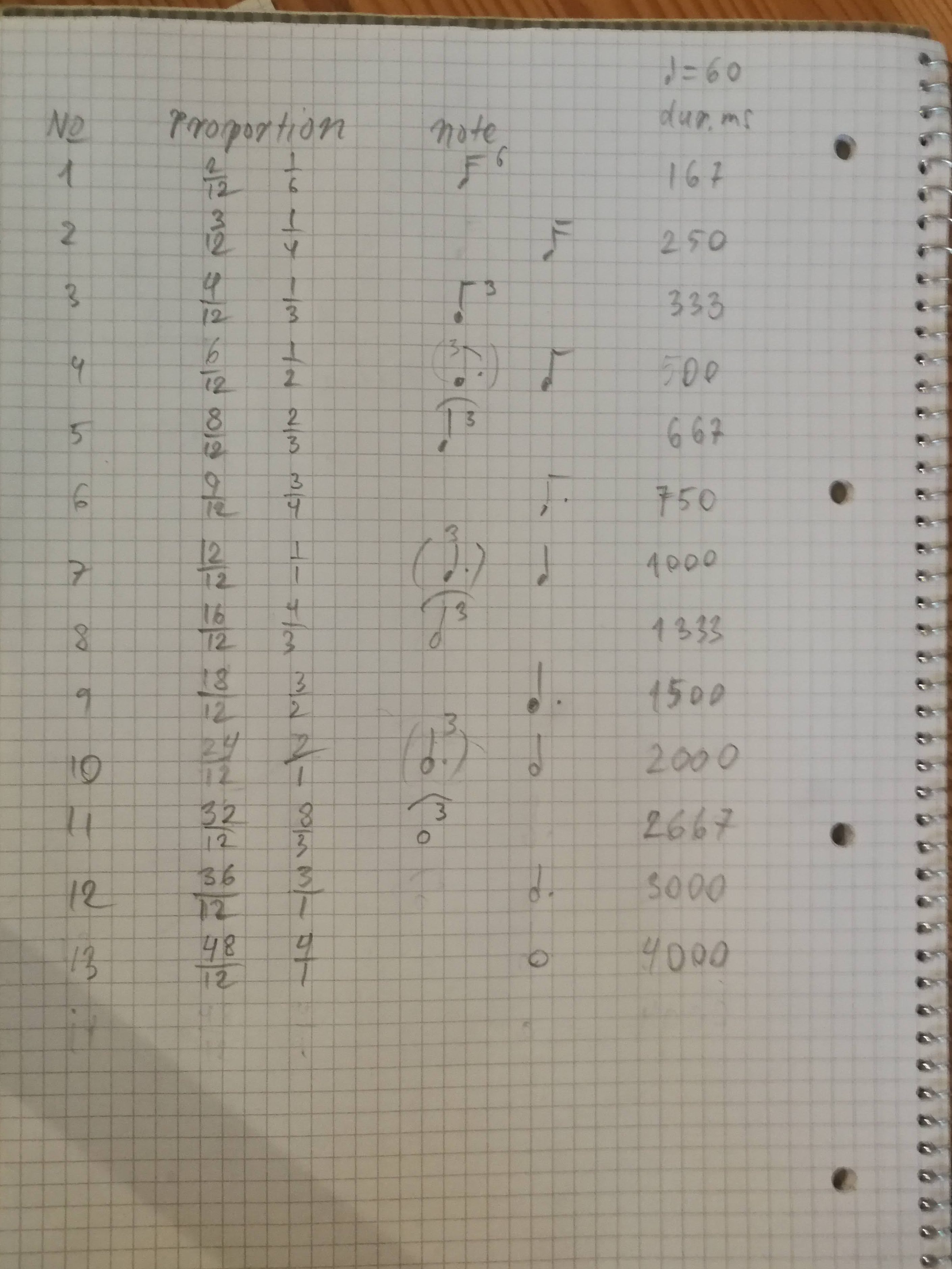
Sketch to a fractal concept of rhythmical proportions, turning rhythm into 13 index values to be fed into the markov model.

Update, 2024-02-17

After quite some messing around with geogebra, sheets, papir&pencil, I’ve come up with a visual representation of the fractal like structure of the duration index values.

It’s based on the series of duration fractions dividing the beat into triplets and quadruplets following the logic of double value, then dotted value, etc. Here is the series of fractions: 2/12 3/12 4/12 6/12 8/12 9/12 12/12 16/12 18/12 24/12 32/12 36/12 48/12

And here is how these fractions will look when ‘translated’ into squares with a common center:

Notice the self similarity (IE fractal-ness) of the proportion between the blue, pink and brown squares at each level.

If you want a closer look at the maths behind this graphic, here’s the geogebra-patch, I’ve made.

Useful links:

Pattern Play

Navigating the Intricacies of Markov Models in Sound


In our latest exploration within the “Mycelium and Sound Collectives” project, we dive deeper into the realm of machine learning, focusing on the pivotal step of feature engineering – transforming raw musical data into a machine-readable format. This process is crucial for our goals, ensuring the data highlights the musical characteristics essential for algorithmic learning and interpretation.

Today, we spotlight our third vlog, which delves into the intricacies of the Markov model through MAX/MSP, showcasing how the ml.markov object’s ‘order’ command significantly expands the model’s memory. This allows it to recognize and generate more complex musical patterns, revealing the potential of machine learning in music composition and improvisation.

This exploration not only enhances our understanding of Markov models but also highlights the importance of precise data preparation in machine learning. By improving how data is fed into the model, we can greatly enhance its predictive capabilities, offering new possibilities for musical creativity at the intersection of technology and art.

Stay tuned as we continue to push the boundaries of music, mycology, and machine learning, uncovering new insights and possibilities in this innovative project.

Unveiling Musical Aesthetics

Markov Model Exploration for AI Improvisation

Following up from my last post, I am going more into detail in the project “Mycelium and Sound Collectives”, working more in depth with the question of musical genre and how to make the musical data ready for the machine learning, a process known as feature engineering.

In this 2nd episode of our vlog, we guide musicians and composers in harnessing the power of the Markov model for music improvisation. We dive into the essentials of machine learning, emphasizing tailored feature engineering for unique musical styles. Through a radar chart analysis, we prioritize key parameters….

Join me in this exploration by watching the vlog episode. If you find it insightful, don’t forget to like and subscribe – you know the drill – but sincerely: your support means a lot. Thanks for tuning in, and stay tuned for more vlog episodes to come!

Can my computer learn to improvise music?

As a part of my project “Mycelium and Sound Collectives”, I am currently doing some research into the question of machine learning and music.

The project is scheduled for autumn 2024, as an outdoor performance, which introduces a rather peculiar ensemble – an amalgamation of a saxophone player, an analog synth with a computer, and then a rather unconventional performer: a mycelium network forming a fairy ring in the soil where the concert unfolds.

In my current research, I am delving into the intersection of machine learning and music composition, questioning the potential for computers to genuinely improvise music.

My examination uncovers the complexities of the artistic process, exploring choices within sound composition. I scrutinize loop pedals, sequencers, and the Markov model, viewing them not merely as tools but as integral components shaping a dialogue between live musicians and evolving machine capabilities.

As documentation for the process, I am doing a vlog, and in the first episode, I am asking: “Can my computer learn to improvise music?”.


In this vlog episode, I don’t provide a definitive answer to the question posed in the title. Instead, I aim to unfold the various aspects at play when delving into the complexities of this inquiry. This involves discussing diverse examples of machine learning models, ranging from the rudimentary to the advanced, in connection with music. As you’ll see when you are watching it, I also demonstrate their functionality within the MAXMSP software, using concrete sound examples. Additionally, I delve into the conceptual framework essential for making informed artistic choices at the intersection of art and technical solutions.

Join me in this exploration by watching the vlog episode. If you find it insightful, don’t forget to like and subscribe – you know the drill – but sincerely: your support means a lot. Thanks for tuning in, and stay tuned for more vlog episodes to come!

Is Spinoza an analogist, naturalist or … animist? – A pocket memo…

As a part of my ‘pocket research design 2‘, I am reading Descola’s Beyond Nature and Culture (see my selective pocket summary in progress here). While reading, ideas for my coming synthesis/pocket essay are beginning to condensate in my brain. Descola is a structuralist, (see my discussion here) and in order to take advantage of his work, it makes sense to go directly to the structural core of his thinking: the 4 ontological regimes, and the 2×3 modes of relationality.

In this memo, I would like to briefly reflect a little on how I imagine a path forward, in an effort to link Descola’s ‘system’ to my pocket research design 2:  “Pre-modern forager societies vs Spinoza’s polis. A model for a more sustainable way of life in our time?”.

In a broad perspective these are the overall questions at play here: How does Descola’s system relate to Spinoza’s thinking? In which kind of ontology/cosmology according to Descola’s typology should we place Spinoza’s thinking? And what about relationality? How do the 2×3 forms of relationality come into play in Spinoza’s visions for a society?

In order to process these questions, we need to complete the following tasks:

  1. a short paragraph synthesizing Descola’s system, thus preparing the tools for
  2. an analysis of Spinoza’s thinking in relation to the four types of ontology, and
  3. an analysis of Spinoza’s ideas about society through the lense of Descola’s 2×3 forms of relationality.

This requires a rather comprehensive text reading / hermeneutical effort, but for now, please allow me to do a risky improvisation using the debris of insight I have so far….

Let’s jump right into the core question, ie. where to place Spinoza in Descola’s typology. To do so, it’s relevant to take note on two aspects of Descola’s discussion on naturalism and analogism. He places the birth of the naturalist ontology in the renaissance, where the early stages of modern science took form. In his analysis of analogism, he points to commonalities between the ontologies of medieval Europe, (premodern) China and the Aztecs.

Since Spinoza lived in the transition  between the medieval and (proto-)modern period, it seems to make sense to place him historically, in a transition period between Descola’s analogism and naturalism. Another preliminary perspective has to do with Descola’s description of analogism, where he compares medieval Europe with (premodern?) China. Spinoza’s thinking has been linked by many scholars with taoism and similar Eastern ontologies. A third perspective is Spinoza’s method, which Spinoza himself describes in terms of natural science – in latin: more geometrico – the geometrical method . These two perspectives combined place him, again, somewhere between the two types of ontology, naturalism and analogism. This way, there seems to be reason to look for Spinoza’s thinking at an interstice between analogism and naturalism, from a historical as well as an epistemological perspective.

On the other hand – isn’t there a good deal of animism to Spinoza’s thinking?  Isn’t this evident from his blurring of the boundary between what’s me and what’s in my environment? IE the thought, that I, as an individual, am composed of a myriad of beings, all individuals, and that I take part in a larger organism, composed of me plus other beings that I interact with, a process of composition which, at the end, makes Nature as a whole, one being. And isn’t it also evident from the way Spinoza thinks of ideas? That my body exists for my as a physical extension as well as the idea of that physical extension, and that all that exists in Nature, a stone, a plant, a horse, a human being exist as a combination of idea plus physical extension? So in fact, a stone has an idea about itself, just as much as I have – but to a different degree. This is a very central trait to animism, – actually the name derives from it –  in the sense that everything is animated. A third point is Spinoza’s poignant anti-hierarchism. This is at least what a deleuzian reading would argue. According to Descola animist cultures – as opposed to what seems to be the case for those with a totemist ontology – are characterized by a very low to non-existent degree of hierarchy.

To finish off my improvisation. What I am  – sofar – thinking on this issue is, that it seems to make sens to place Spinoza – historically and epistemologically – somewhere between analogism and naturalism. However, there seems to be some kind of leap going on, that takes him out of his expected ‘thought habitat’, and – as opposed to his contemporaries – links his thinking with animism. The only one of Descola’s 4 ontological regimes that Spinoza’s thinking seems to leave untouched is totemism. I guess that this might have to do with the question of hierarchy, as I have hinted at above. It also might be related to the fact that Spinoza doesn’t see the world in terms of categories. The world and its beings are, to Spinoza, a myriad of individuals, relating to each other not so much according to their ‘species’ or some other possible categorization based on physical og mental characteristics, as seems to be the case for totemism. Individuals are relating and making connections according to local, context based features. In this sense, what we understand as ‘a human being’ might build a stronger relation to ‘a mouse’ than to another human being. This is similar to totemism, with the important difference that the spinozist man-mouse relation is not based on an idea of a societal relationship – connecting a certain society of people to a (generalized) species of mice. The relationship is ad hoc.

In order to go further, it seems to make sense to do three comparative (pocket) studies, linking Spinoza’s thinking with respectively analogism, naturalism and animism…

Anyone out there who can help would be appreciated:-)

Reading Descola – a doubtful pitstop…. (memo)

As I have promised (myself) in my second pocket research design, I am reading French Anthropologist Philippe Descola’s book “Beyond Nature and Culture”, while writing a ‘selective pocket summary’ here. And while reading: thinking… I am attacking Descola’s mammoth work from various angles at the time. I am reading it as a pdf, in English and French, in paper format, in French, and listening to the text via an app that reads pdfs with an artificial voice. This way, I am immersing myself in the work at different speeds, in different parts, at the same time. I am also reading comments by other scholars about the work, for instance this one: “Descola’s Beyond nature and culture, viewed from Central Brazil” (link). I am also listening to Descola’s current lectures at Collège de France titled “La composition des collectifs: Formes d’hybridation“.

From a global perspective, I begin to see a fundamental issue around the question of Descola’s Structuralism. Here, I will make a short pit stop, giving this issue a few thoughts before moving on. As you know, what I am doing here, is pocket research, and therefore I must assess the relation between time invested and possible outcome for my research. Descola’s book is immense, and I am having some doubts that my time is well spent, if its foundation is not solid. What I am trying to say is, that there seems to be an incongruity between on the one hand Descola’s ambition about wanting to understand each ethnic group from its own point of view, ie. its cosmology or ontology, while on the other, he wants to install a “structural framework”, that would allow us (… and who are ‘we’?), to “set up a typology of possible relationships to the world and others, be they human or nonhuman, and to examine their compatibilities and incompatibilities.” The problem is – as is always the case with universalisms – the question of centrality. Why would someone want to collect and centralise knowledge about the whereabouts of other people? This is what Descola does with his ambition of a ‘typology’ with its four different “ontological regimes” ― animism, totemism, analogism, and naturalism. According to Descola he himself is a naturalist, as we are all, in the West. It would  be interesting to ask the question (as I believe Descola does somewhere in the book), how someone from one of the other ontological regimes would have conceived of a typology for the peoples of the world.

In any case, Descola’s endeavour makes me think about Max Weber and his ideal types. The idea is that we can’t access reality without categories. And reality is never really clean cut fitting into whichever category. It will always be a mix. This way, Descola’s argument would be (I am assuming), that real people will always live in some kind of mix, a hybrid between a combination of Descola’s ontological regimes.   So for instance a little bit of animism combined with 20% totemism, etc. So why would someone want to centralise information about people(s)? First of all, we have to remind ourselves about the early raison d’être of Anthropology, which was to provide colonizers with information about local indigenous groups, in order to provide the former with tools for controlling and subverting the latter. Of course, Descola is well aware of that (and he mentions it somewhere I think in the beginning of the text). On the other hand, collecting information about our surroundings, processing them, learning from them, is part of something essential to life (cf. my thoughts on Spinoza, communication and information in living systems). This is one reason why I have decided to keep on reading: My aim – as stated in my pocket research design 2 –  is to find out whether and how we Westerners might learn from “pre-modern forager societies” who adhere to “proto-ecological guidelines” to build a “bio-synergetic civilisation”. Another reason is part of my own personal intellectual history. Before taking my MA in Educational Anthropology, I was working – in a proto-academic fashion – on a model for what makes us a community

By continuing on the path traced out by Descola, I am being true to ‘my former  self’, trying to develop these earlier thoughts further, while of course submitting them to a sharp critical scrutiny.

In other words: I am going back to reading!! As to you, dear reader: Keep on pitching in with your ideas, comments and suggestions!

Pocket research design 2: Pre-modern forager societies vs Spinoza’s polis. A model for a more sustainable way of life in our time?

As a part of my ‘pocket research program’, titled “Can we reason with nature?”, this is my second pocket research design. Here, I would like to follow up on a point, that Australian professor in environmental philosophy Freya Mathews raises in her article “Towards a Deeper Philosophy of Biomimicry” (read my pocket summary here):

“The outlines of a bio-synergistic civilization are still far from being worked out. Evidently such a civilization was – very faintly – fore-shadowed by pre-modern forager societies, or those of them at any rate that adhered to proto-ecological guidelines.”

I read two implicit questions in this paragraph that invite to a (pocket) research program:

  1. In what way can pre-modern forager societies be said to adhere to proto-ecological guidelines?
  2. How can these societies serve as a model for a bio-synergistic civilization?

I would like to address these questions, adding a spinozean conceptual framework to a pocket research design with the (working) title:

“Pre-modern forager societies vs Spinoza’s polis. A model for a more sustainable way of life in our time?”

Here is my plan: I want to

  1. find out more about the cosmologies of the Amerindian peoples, and whether they can be said to live according to ‘proto-ecological guidelines’. For this, I will read Philippe Descola’s book “Par-delà nature et culture”, and make a pocket summary, here.
  2. on this background I will write an essay about the extent to which these cosmologies might provide some kind of guidelines for a more sustainable way of interacting with our environment, in our current modern Western mass communities
  3. On the other hand, there is Spinoza’s pantheism, which is conceived in the run-up to modernity, and which explicitly refers to urbanity, the polis. Here I expect to read some Arne Næss and deep ecology. Probably also Matheron. We’ll see, when I get there.

An initial thought: I have often wondered why there are no more research done about a possible connection, between Spinoza’s thinking and pre-modern pagan traditions, including those whom the West must have had knowledge of from the colonies, at Spinoza’s time.

Will knowing nature make us better humans? Pocket research design 1

How can we create better connections amongst ourselves, and with our environment? Would we become better at connecting with each other if we were good at connecting with our environment? And vice versa?

This is my first ‘pocket research design‘, (read about my pocket method here), sketching the following ‘pocket research program’:

  • First, I read Australian professor of environmental philosophy Freya Mathews’ article Towards a Deeper Philosophy of Biomimicry. See my summary here.
  • Next, I discuss the question of a possible relationship between hierarchical societies and the way they treat their surroundings. Read my essay here.
  • Finally, I discuss what role communication and cognition play in living systems and their interactions. (Coming up)

Update 2018-06-09

My third bullet is a really important project, however, I have understood the necessity of digging more into some aspects of human-environment interaction, which is why I by May 3rd 2018 launched my ‘Pocket research design 2’: Pre-modern forager societies vs Spinoza’s polis. A model for a more sustainable way of life in our time?

Feel free to read, comment, share, etc.!

On my ‘pocket research method’ and hamster wheels

Since my life is pretty much a hamster wheel, and my time for working on getting my ideas in order is limited to the two times 1 hour commuting time I have to my job, daily, there is a limit as to how thoroughly I can work on these ideas. I therefore have to find some formats for my working that will allow me to 1) proceed in my reading, looking for answers to my research questions, while 2) processing the reading, accommodating it – in my head – with the ideas I have build up, so far, and in the meantime 3) manage to trace the newly build ‘collective’ of ideas in writing. How do I keep on expanding my understanding, in a qualified manner, while keeping the balance between too much and to little detail? My answer for the moment is to work with some pretty simple formats. Since all parts of this proces is going to be faster, shorter, smaller, than what I would prefer, I prefer to talk about this as ‘pocket research‘. My pocket research will thus unfold in a circular movement including three steps:

  1. First, I gather some ideas, and intuitions/hypotheses in a ‘pocket research design‘ (see them here). This implies some reading, which is why I need to
  2. secondly, write pocket summaries of texts (here they are), where I sum up the points, not of the text in an abstract way on ‘its own conditions’, but simply carving out the points that are relevant to my pocket research program.
  3. thirdly, there is the memo. The memo is a format, where I have shorter discussions (with myself) on subparts of the current pocket research question.
  4. finally, I collect my ideas while synthesizing ideas from the read texts, into a pocket essay (see them here).

A fourth format, which deals with topics outside the circular pocket research loop, is a meta format like the text you are reading right now. I will collect these texts under the category ‘on method’, see here.

jam_5__hamster_wheel_by_jennibee-d377mrr

Life is short, there is a limited time to do things, we are finite beings, the hamster wheel is spinning, spinning, spinning…..

Any comments/suggestions/crazy ideas are welcome, please comment below 🙂

Descola – beyond nature and culture; a selective pocket summary

As a first step in my ‘pocket research program’ “Pre-modern forager societies vs Spinoza’s polis” (read more here), I am reading French anthropologist Philippe Descola’s book Beyond Nature and Culture (published 2013. Original title: Par-delà nature et culture (2005)). This is my selective pocket summary.

I am reading this mammoth work from a very selective viewpoint, in accordance with my pocket research design, namely to “find out more about the cosmologies of the Amerindian peoples, and whether they can be said live according to ‘proto-ecological guidelines’”.

I am publishing this draft while reading and writing. Here are my reading notes. Feel free to pitch in with your ideas, suggestions, comments, etc.

Beyond Nature and Culture

What is this book about? In the foreword to the English edition, American anthropologist Marshall Sahlins’ short summary of the entirety of the work comes in handy:

“The project is a comparative anthropology of ontology. Four basic ontological regimes of wide distribution―animism, totemism, analogism, and naturalism ― are developed from an investigation of the identities and differences between humans and other beings and things in matters of their physical makeup and subjective or mental capacities. Each of these major ontologies is associated with specific ways of forming social collectives and characteristic moralities, as well as distinctive modes of knowing what there is. Further, the major ontological configurations are cross-cut by several types of relationship―exchange, predation, production, and so on―that are variously compatible or incompatible with them.”

He also adds that

“Such is the general architecture. To thus state it, however, only betrays the richness of the text, which is marked by carefully described and analyzed ethnographic demonstrations, including much from the author’s own fieldwork among the Achuar of Amazonia”

This last point is of course relevant to my ‘pocket research question’, which is also why I have selected Descola as my primary reference. However, the overall project of the book is immensely relevant to my question, since it lines out a framework to rethink our current Western model in comparison with other ontologies – in my case notably the Amerindian cosmology, which I guess will be labelled as animism (I haven’t read that far, yet).

Reading on….