Houses without walls in gated communities
The first thing that stroke me, when arriving to Cali, Colombia is the fact that
the houses don’t have walls!!
The house my wife stays in, and where I am staying untill my residency at Lugar a Dudas starts June 4, doesn’t have a wall to the patio. No wall, no doors. It’s not needed, because it is never cold, here!
The houses don’t have walls to the patio, but they do have walls to the street! And fences. Cali is a city with many gated communities.
Another thing that stroke me was the way that people are doing all kinds of things to earn a living. There is a lively business going on around every traffic light, where people are selling lollipops, cleaning windshields, and even doing acrobatics.
What’s very much in vogue right now are yellow t-shirts, from the national football team. Everything is sports right now. In Giro de Italia, the colombian team is winning. The owner of the house where my wife lives is super happy. Everyone is so proud about their bicycle champion, here!
Read more about my experiences from my residency in Cali here.
My residency in Cali has been made possible with help from 
Let’s make our basic assumptions clear
When working with compositional processes, we have a lot of assumptions, – whether we make it clear or not.
Since we have these assumptions in any case, we can as well make them explicit.
How we look at the work with compositional processes differs from person to person, and therefore it makes no sense to search for a unifying theory, a synthesis or an all-encompassing explanation.
When I draw the following assumptions as the basis for a conceptual framework, I base it on the reflections over my own practice. This should not be seen as an expression of an underlying truth, – it is a construction, and as such it can and must be discussed and changed depending on how practice develops.
-
Compositional processes are part of everyday life. Bringing elements of daily life into play in new ways that can bring about change in the collective is a fundamental human competence
-
Compositional processes are necessarily embedded in collectives, and unfold with the collective as a framework.
-
They may unfold with sound as a medium, but also using other media
-
The choice of media for the processes is related to the type of change that is needed in the collective
-
Collectives may be more or less culturally sustainable, ie. more or less competent to independently perform transformational processes
-
Culturally sustainable change happens through successful compositional processes
-
The relationship between daily life and compositional processes is direct, mimetic and cross modal
-
Compositional processes draw on forms derived from everyday life. These forms are transferred to other modalities or extended / modulated in the modality it was originally expressed in.
-
The correlation between daily life processes and compositional processes is symmetric in the sense that daily life relate mimetically to the compositional processes, and successful compositional processes allow a reversal that creates culturally sustainable change.
Compositional processes are cyclical. They base themselves on daily life forms and rhythms and the specific way these unfold in time and space, extracting characteristics of them. These features are processed, prolonged, extended and pulled together and the forms and rhythms are combined in different ways, establishing ‘something else’. And from this something else the rhythms and forms are transferred back to daily life, in a manner similar to the first, challenging, supplementing and transforming the usual forms and rhythms of daily life.In the cyclic movement departing from daily life across ‘something else’ and back again, it makes sense to speak of three stations or poles:
-
Lived time
-
Script
-
Assemblage
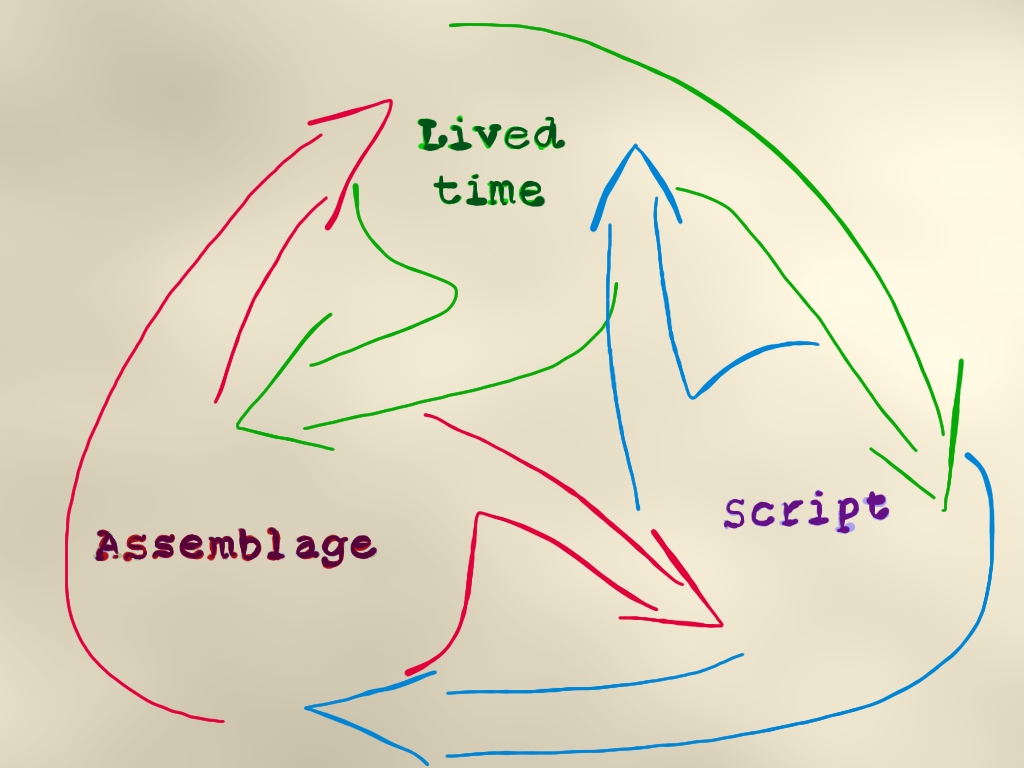
The starting point for the compositional processes is daily life, – lived time. The rhythms, movements, impulses, narratives, etc. of the collective, and how these interact internally and with other communities are the very foundation of our compositional processes.
When we act together in a community, we are guided by different sets of more or less explicit rules or scripts. They can influence back on our daily lives in good and bad ways, but we can be aware of them and use them in compositional processes. Let’s call this process scripting. Good scripting is when one is aware of everyday life rhythms, analyse them well, and draw different ‘composable’ patterns out.
To compose is to put these patterns together in certain ways. A good composition process is when you bring (good) scripts into play, in a way so the process can feed back and create healthy change for the collective.
In the process between assemblage and lived time there will be a reversal, a transferthat can be clarified and strengthened through reflection. The items that are made in the composing towards the assemblage-pole, are being composted, as we move along to the lived time pole: they are broken down into smaller components in a way so that they can be part of a new compositional cycle.
The three poles are to be understood as snapshots. The relation between them is gradient, and they interact with each other in both directions. In this presentation, we assume that these processes are flowing freely in cultural sustainable communities.
There is sometimes a need for the facilitation of the processes. Good facilitation is when the facilitator 1) is able to read the collective’s own natural compositional cycle, 2) take responsibility for identifying controversies / arrhythmia, and 3) provide participants with tools to (re)create a culturally sustainable situation.
Related reading: Unmusic (akutsk.wordpress.com)
Compositional processes and mutated chairs, – experiences from a workshop with young musicians
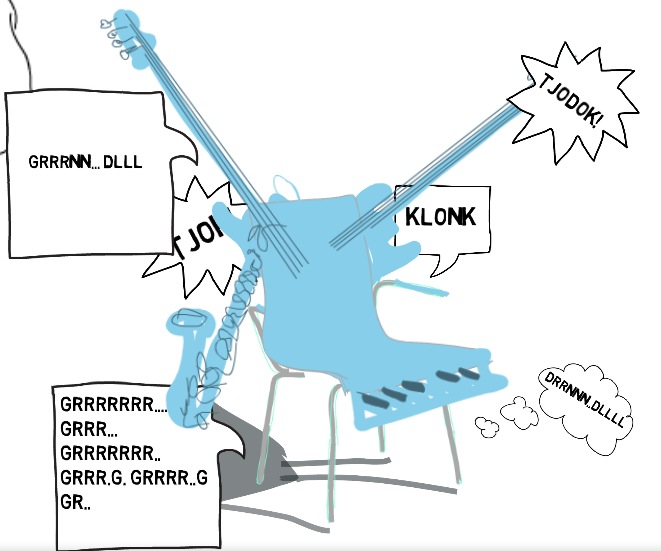
Watch my short ‘videoscribe’ about a workshop with 4 piano players, a guitar, a bass and a saxophone player.
Cultural sustainability
[transcription of a ‘dictaphone street improvisation’, 2012-10-05]
“When talking about the culturally sustainable processes in a collective, I was talking about two aspects that are characterizing these processes, one being the fact of using what I term as cultural recycling, and the other being shared ownership.
I would like to add to the question about cultural recycling that what is different between a culturally sustainable collective and our current consumer based model is that in the latter there is an abundance of cultural tokens and of works of art, – the market is so to speak satiated by still more and more cultural products.
You see it when talking with people working as artists, that they often feel that their work is meaningless because there are SO many works of art, and so many good ones as it were. At some point they then seem to come up with a very good excuse, and continue producing works of art, – or they simply stop. The river of (divine?) inspiration simply dried out.
In a culturally sustainable collective this crisis simply doesn’t occur, since you don’t have an addition of art works, an accumulation of objects. If we stick to the metaphor from ecological sustainability, you could say that within a culturally sustainable collective, what happens is that you recycle the ‘cultural material’. The composed assemblages consist of ‘degradable’ elements, that are easily broken down into ‘reusable’ constituents. “
Related readings:
Learning from folklore – reversed colonialism 2.0 (akutsk.wordpress.com)
How do we store the analogue? (akutsk.wordpress.com)
Paola Antonelli Discusses R&D at MoMA (http://www.architectmagazine.com)
 |
| The logo of Danish copyright organisation floating with an abundance of cultural products, illustration by Casper Hernández Cordes |
Occupying words for a new framework
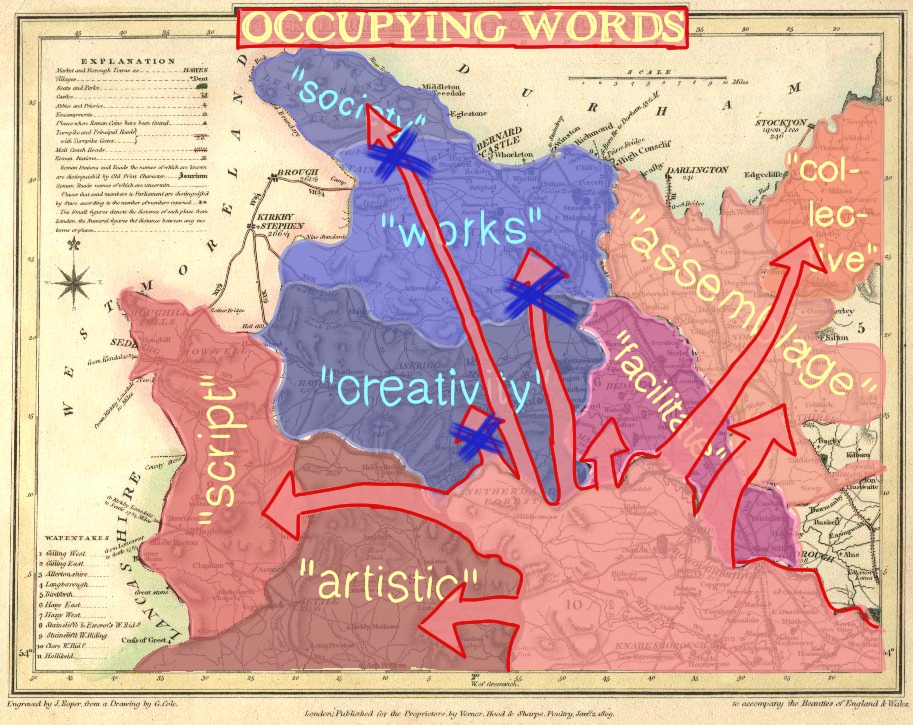
How do I construct this framework? I was thinking of the term occupation, and that you could see that this is a sort of occupation of words that have been used in mainstream ways of understanding similar issues, and what I’m doing is to cleanse them from their previous, mainstream connotations, and make them ready for use in this new framework.
In Bruno Latours “Reassembling the social”, he writes about this three step process of deploying, stabilizing and composition. Read the quotation here. When talking about deploying, he refers to the action of taking into account all the actors that we need to include, in order to reassemble the social. This is kind of what I’m doing with the words that I collect for constructing this framework: I take existing words that I consider still necessary, while excluding other words, that are simply worn out – like ‘creativity’, ‘works’, etc – and then I’m inviting new words to the assemblage.
My goal in making this new assemblage of words is to constitute a framework that is open enough to help us take into account the relevant aspects when working on the facilitation of compositional processes, while helping those who use the framework not to fall back to business as usual
 |
| Illustration by Casper Hernández Cordes |
Wet thoughts on a conceptual framework-drying rack
The first obstacle I would like to level out, is the question of what is the framework going to be ‘based on’. Well the simple answer is ‘nothing’!!
Construting a conceptual framework on something implies, within a mainstream way of seeing things, that you refer to Theory, and that you are now going to suggest a new theory. I would then have to call my project “Artistic processes, a new theory on the effects of art on society”. Something like that. That would presuppose, that there is a) something, an essence, we can actually point to ‘out there’ that we can define as ‘art’, b) there is an essence we can locate, which we can define as ‘society’, and c) as an ‘explanation’ of the relation between the two, art / society, we can deduce our way to an underlying theory, the same way as an archaeologist digging out an ancient ruin, and that this work – although tedious, and very time-consuming – will at some point get us to the essence of the question.
I would very much like NOT to fall into that trap.
Instead of departing from a ‘theoretical’ background, discussing the current ‘development’ in music theory, art theory, etc., discussing the scientific validity of each, and then basing a new theory on some resilient new matters of facts, my approach will be different.
The theories of music / art, I have come across simply do not do the trick. At some point they always seem to miss the most important. They might departure from what we call psychology, and ‘explain’ our relation with music in terms of emotions, of affect. In this framework, art and music, is something that we use in our daily life to enrich it, to feel good, to relate to each other, etc. They might base themselves on theories about society, seeing music and art as instruments for different currents in the historical evolution of a society. Or the might simply use art ‘it self’ and music ‘it self’ as their ‘field of study’, and claim that these phenomenon simply do not have anything to do with anything else, that they are free from ‘the political’, and so on.
Common to these ‘theories’ is that they take for granted 1) that there is some kind of essence that can be dug up, – after years of reading and researching of course, 2) that we can identify the different parts of the ‘field of study’, that they are actually there, although maybe not physically, (and that’s one of the main challenges to these approaches), and 3) that the actual processes of music and art making, producing and perceiving is something that takes place in either an individual, – this is when studying perception, and ‘the creative’, etc., and on the other hand on a larger scale, ‘society’, where they look for the changes that art/music is ‘causing’.
The l’art pour l’art theories simply loose themselves in the mist of misty explanations always coming short at some point, where you simply have to accept that ‘art does things’. In an attempt to free music and art from being used as an instrument for political and other agendas, they actually work for the same forces that they want to be an opposition to. These approaches sustain the current state of affairs, because they remove from artistic processes their potential for change. They castrate art as a revolutionary force while allocating the artistic processes to a harmless, abstract, and almost religious sphere.
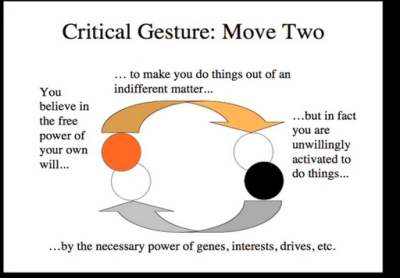
As a parallel, here is Bruno Latours illustration from a talk where he is doing his ‘critique of the critique’:
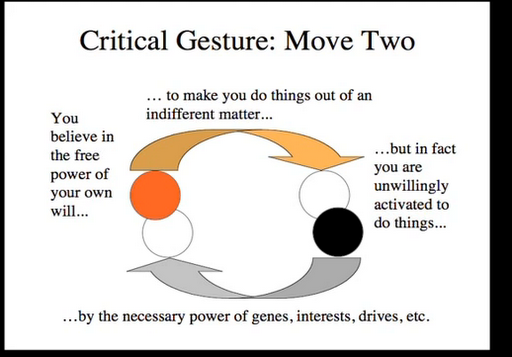
Instead of talking about theory, I will be talking about a conceptual framework. Instead of looking into the individual, and look for relations with society, I will take the collective as departure point. Artistic processes are embedded in collectives, in networked relations, not in a sum of individuals.
What I expect from a conceptual framework is that it
- can serve as a drying rack on which to hang the still wet thoughts, I collect from reading books, talking with other people, and from observing my surroundings
- is flexible, and can change along the way according to how my thoughts develop
- is accumulative and hybridising, that it can accommodate thoughts from diverse and contradictory sources, whether academic, artistic, common sense-ish, esoteric, etc.
My current sketch for a framework is a triadic one as opposed to majority of mainstream thinking, which is essentially dyadic, and I will dedicate a blogpost to this question.
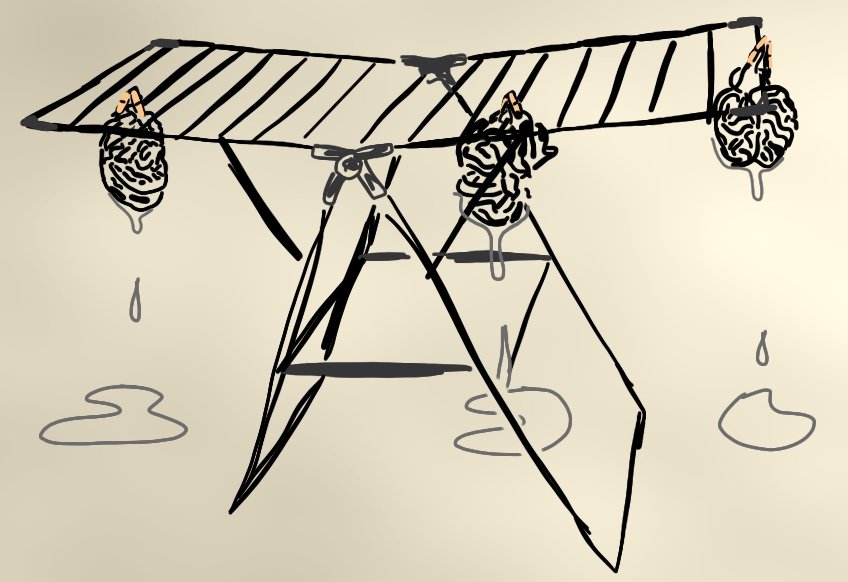 |
| Wet thoughts on a conceptual drying rack framework |
unmusic
“Kraptavicius’ catalog has been recognized widely, with concerts and sound-art installations all across Europe. These events have helped to develop what he calls an aesthetic of “unnecessary notes.” Hence his particular love for digital compositions, since he feels that computers help to “pull” elements of unmusic into his portfolio: machines show scant regard for compositional norms.”
From Far From Moscow about the Lithuanian collective known as Twentytwentyone.
“Today is a landmark day in the history of music. On Saturday February 5th at 10:37 AM a new genre of music has been born. Welcome to the world of UnMusic. Many times I have read the song titles on albums and thought to myself “This album has great song titles, it’s too bad the songs are horrendous.” If you have had that thought from time to time, then UnMusic is for you. UnMusic removes the irritating and grating music that is on albums and merely gives you song titles. I give you the song title, what your imagination does with them is up to you. Think of the possibilities? Music without the limitations of actually having a song!”
Keith Spillet in his blog The Tyranny of Tradition
These are two different ways of using the term unmusic, among surprisingly few google search results. I am looking for a term the can denote a way of working with sound that is musical in the sense that it draws on the essential elements of analogue reflection through sound, although it does not share the caracteristics that people in general would expect when they are presented with the term music.
There is the term unschooling, which is broadly used, it has over a million google hits, and a definition on wikipedia:
“Unschooling is a range of educational philosophies and practices centered on allowing children to learn through their natural life experiences, including play, game play, household responsibilities, work experience, and social interaction, rather than through a more traditional school curriculum.”
Would it make sense to use the un- in front of music in a similar way? The 2nd quotation above has a definition and a use of the term that makes sense, – the ‘un’ signifying a totally reversing of the way we in general think music, namely as something that unfolds through sound. Well in this use of the term, it simply denotes silent or imagined music. One could state that there is not necessarily a natural opposition between music and silence, since what makes music musical is the way we use silence. This is obviously not very much the way most of the music people listen to is conceived, satiating each millisecond with a wall of sound.
In the first example above, from Far from Moscow, there is not a clear definition of the term unmusic. In the cited article, there is an equation of unmusic with “non-musical”, as well as “experimental electronics, electroacoustics, minimalism, phonography, improvisation, sound art”. It seems like just another genre term, of which the world has already got in abundance.
The un- in unschooling doesn’t set up an opposition to the goal of schooling, namely learning, but it questions the current framework of learning, namely the school. To the extent that we can consider music a term for the institution music, it makes sense to use the un- to reclaim the term music from its current use, so much infiltrated in the idea of music as a commodity or an object, and all the activities and categories supporting that misunderstanding: genre, styles, CD-release, labels, etc.
Unmusic in this sense would be a way of describing activities around sound that are collective, open ended, non-hierarchic, non-linear, including, in short human. Culturally as well as socially sustainable activities around sound. That is unmusic.
Bikestruments, the silver return


A local workshop hosted by a red-green political party with the agenda of promoting the bike as a preferred choice for transportation. The name of the workshop was “Pimp your bike”.
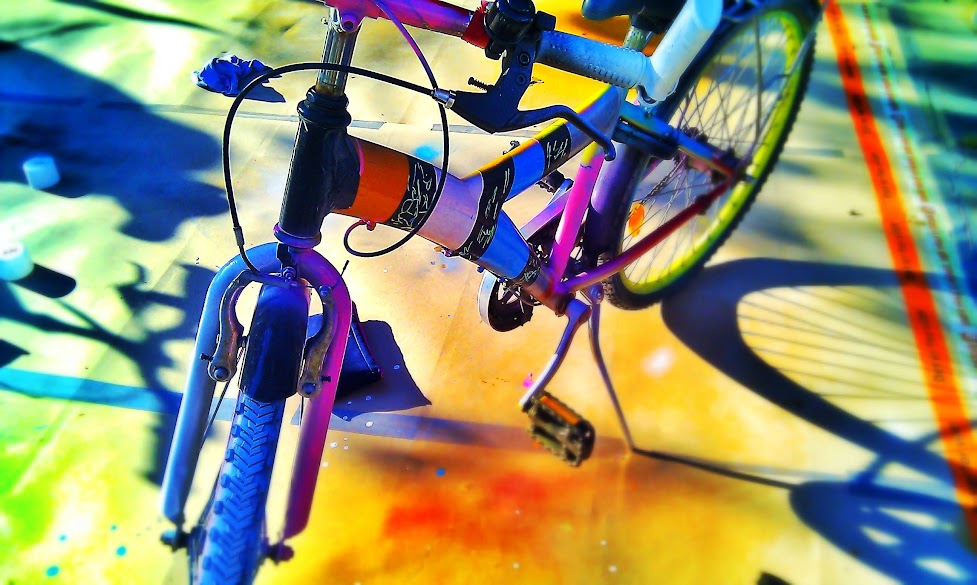
Fonografiti activists ‘hacked’ the event (to which you might question the environmentally friendliness of using spray paint for ‘pimping’ bikes, btw), and ‘pimped’ some bikestruments, spray painting them silver.

Now the question is: Does the ‘pimping’ of the bikestruments, possibly sending the message “we are street”, inspire passers-by to NOT remove them?
 Building Sound Collectives