Movement, sound and people – a transnordic dialogue in progress

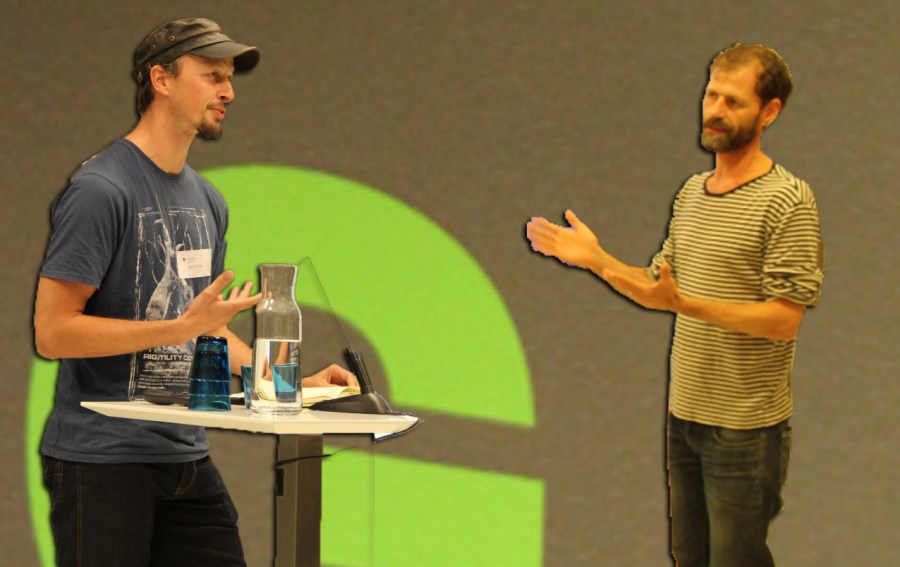
At the seminar The Role of Culture in a Sustainable Society – Sustainability in Art and Cultural Projects, composer Casper Hernández Cordes did a workshop, and choreographer Kenneth Flak had the role of reflecting on the workshop. This started a really interesting discussion, that we would like to continue, this time in a ‘plugged’, online version, for everyone to join, commentate and share.

Welcome!!!

Casper:  “Hi Kenneth, thanks a lot for a great collaboration / confrontation at the seminar on culture, art and sustainability. I felt we embarked on some really relevant issues, and I would like to invite you for a further development of some of the topics.

You said you liked the fact of a composer (me) choosing to only use gesture as a means of expression, as I did in the workshop/experiment. Usually I get the opposite reaction, people saying: “but what about sound??”. In fact my choice is based on the assumption that you can’t have sound without movement, so somehow movement is something more fundamental to human expression. At least, I have this idea, that non-artists are more comfortable in general using gesture as a means of expression than sound. What are your thoughts?”

Kenneth: “Hi Casper, I thoroughly enjoyed your intervention in the seminar, and, as you mentioned, a lot of it had to do with the use of compositional principles applied on different areas. Obviously, the principles you used in the seminar (mainly to do with mimicry, repetition and variation) are as fundamental to choreographic composition as they are to the organization of sound. For me as a kind of dual creature, working both as a choreographer and a composer, I am always looking for these kinds of principles that can be applied to both areas.

It is actually becoming more and more of a challenge for me finding principles that are exclusive to one domain. Right now I can’t really think of any. Obviously, dance probably has a stronger spatial component than sound, in the way that it moves around the space, but this is an advantage that has largely been obliterated by the development of music technology, with the advent of different surround sound formats. And of course, live music on actual instruments has always had this strong spatial component, especially when there are no microphones or cables around to hinder movement.

Of course, I totally agree with you that sound is impossible without movement, but then we still need to think a bit about what kind of movement we are dealing with: is it movement of the human body or for example the movement of your home stereo speakers that do what your computer tells it to? Both represent physical movement, but the difference in perception is enormous. When it comes to sound that is produced by the human body, there is absolutely no question that movement precedes sound, and then merges entirely with it for as long as the sound is produced. It is a very intimate connection, to the point where it becomes impossible to separate. And the really interesting thing (which was demonstrated very clearly in your workshop) was that even when the sound is absent, we tend to “fill in” sound where there is none. I think every dancer does this intuitively, “singing” the movement as s/he performs it, sometimes out loud. This was actually becoming a bit of a problem for me at some point, so I had to consciously unlearn it. It just didn’t look very good on stage, me hopping around providing my own soundtrack to the movement with various crappy sound effects, not even aware that I was doing it.

For the average non-artist I certainly think gesture is a slightly more comfortable area to explore than sound, but I think this depends very much on the kind of sound and movement we are talking about. I could easily picture non-artists happily whacking two sticks together, but once you ask them to use the voice things get much, much more difficult. Vocal sound abstracted from any meaning is a very tricky area for a lot of people (many artists included), somehow there are so many taboos, conventions and emotions connected with the use of the voice that most people are very careful about how they use it. This is, of course, also the case with movement. I think this is why it is important to start out with ways of moving that are socially acceptable, like the use of simple, pantomimic gestures. And even this is very difficult to deal with for people that have no training in contemporary dance or performance, as was evidenced in the seminar: there was this running commentary going, trying verbally to make sense of what was happening, what was expected of them.”

What are you doing with your hands?

For the second time this year – and in my life – I had the luck to be invited to Helsinki, Finland. This time the host was Nordic Culture Point (Kulturkontakt Nord), and the occasion was the seminar:

The Role of Culture in a Sustainable Society – Sustainability in Art and Cultural Projects

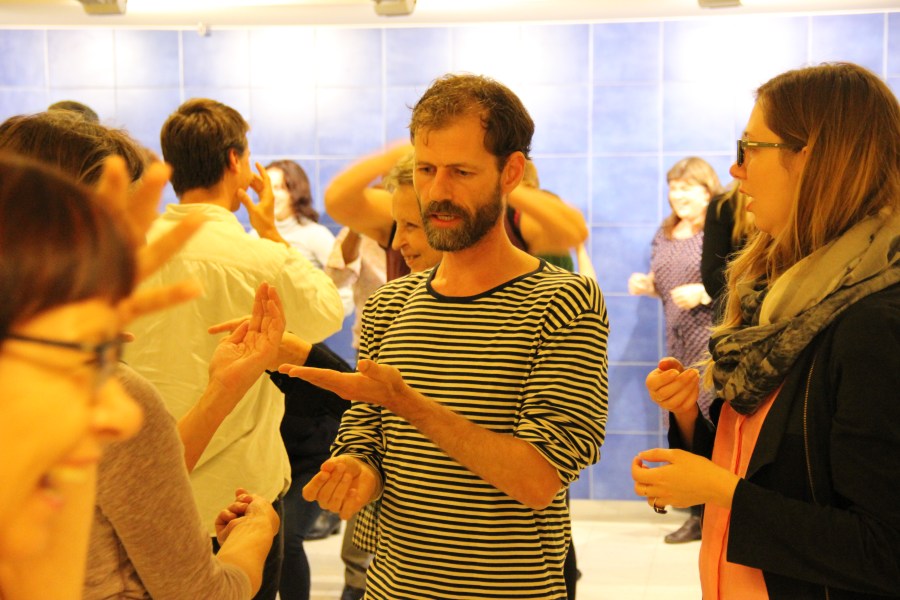
My contribution was a workshop, and as I am stubbornly continuing in my aim to find out what we can do to build sound collectives, this time as well, I invited the participants to a collective experimentation with – not drugs  – but gesture.

The participants at the seminar were people who in some way or another dedicate their professional life to arts and culture, and I saw this as a great opportunity to try out something new. You see, I have this thing for our everyday life practices, things we do with our hands, things we create, we produce, etc.

The inspiration springs from my thoughts when going back from my residency in Cali, Colombia, 2014. I had a project there about informal work, street vendors, etc., and in Cali this was an area of very diverse, rich, and sophisticated gestures. The project focused on these gestures, and together with an ad hoc group of artists, I had gathered, we made workshops, happenings, videos, etc., around the patterns of these gestures. These gestures have a very heavy cultural significance, embedded in the everyday lives of the majority, and in the plane from Cali to Copenhagen, I thought: Well, how can we work with something similar in the modern welfare states? All these manual processes, manufacturing goods, etc., have been rationalized, centralized, robotized, and the gestures of our work lives are reduced to taps on our touchpads!

As you can see, the perspective of having a group of people whose work lives are full of sophisticated manual procedures was a really happy one. On top of that, the event itself was a place where it would make a lot of sense to ask the participants to take a round of introduction. The typical format one would use to this end would be the obligatory “speed dating” session.

I felt there was an inherent impulse in the group for getting to know each other, and I chose to grab this and direct it into a collective experiment, where – instead of using language, speed dating – we would get introduced to each other’s worlds through gesture.

Instead of simply asking the participants to do whatever kind of gesture, as I usually do, this time I invited them to do a gesture from an everyday life productive activity, and specified that it be something they felt good about, something they liked doing. Of course some of the participants would choose gestures from their professional life, – I am sure that I spotted some painters and some weavers, maybe a ceramicist – but I left it open for people to include, what they would be doing outside their specific professions.

So, what is the point of all this? Of course there is a great challenge in putting into words what sense it makes to interact without words, and I must admit that the first part where I had tried to explain these things, via good old powerpoint and everything, didn’t seem to have the same effect as the second, practical, part. I guess this is what they mean, when they say “show it”? In any case, if you are interested in being confused on a higher level, as they say, you can read my introductory speech here.

To get an idea about the participant’s response to the workshop itself, see it for yourself:

Links:
Second seminar on Culture and Sustainability presented practical examples from the field,  an article by Annika Nummelin about the seminar.

The Role of Culture in a Sustainable Society – Sustainability in Art and Cultural Projects, about the seminar.

Art as consumption vs artists engaging in real life collective processes, my speech at the seminar.

Art as consumption vs artists engaging in real life collective processes

This is (part of) my speech at the seminar The Role of Culture in a Sustainable Society – Sustainability in Art and Cultural Projects, Helsinki, Finland, 2015-09-23
Artistic workshop about sustainable collectives through sound and movement

( I start by reciting my blogpost What Makes us a Collective? explaining the model above, and then continue … )

” … This model stresses the circular relationship between producing and consuming, and it suggests to regard these two processes as if they are unfolding in a space of their own. It also suggests that this producing-consuming space is embedded in a space of playing, and that there is a circular relationship between these two spaces.

Finally, I would like to add that the model will sharpen the focus on the synchronicity of the elements. It will open our eyes for the everyday life muddy human activities, where people are producing something, consuming something, and playing with the elements around them, creating new connections between things and activities.

Where do artistic processes fit in this model? The way our art world is working in general, right now, I would say that art is something people consume. Maybe the artist him-/herself is engaged in a process where he or she, according to this model, would be entering the “playing space”/ third space. But the people benefitting from this playful process are not part of it.

Still, people do engage in playful activities in their everyday lives, and as I am trying to say with this model, these are very important elements of building and sustaining sound collectives.

This is why I am saying: What happens if an artist opens up a common “playing space” with people in an actually lived, more or less culturally sustainable, collective?

What happens if artists engage real life collectives in activities that are based on the artist’s knowledge and tools? These tools that the artist has developed and used for playing with elements from the immediate surroundings, and that can now be used to play with the everyday life elements of a given collective. Not in the form of artistic products to be consumed by the collective, but in the form of a collective process, including non-artists in the artistic process.

What we are going to try in the other room, is to enter this modality of playing, while drawing on elements from our everyday activities. The same way we would be doing, if we were working with any kind of collective, as artists.”

Read about the workshop here: What are you doing with your hands?

Creating a sense of communality through sound and gesture – Minna Liski’s report on Building Sound Collectives

Minna Liski’s comments/report on
Building Sound Collectives Workshop
Casper Hernández Cordes, Fonografit (Denmark)
Fri 8th at 11.30-13.00

The Open Stage concept of the conference was about forming an experimental platform where art and science could meet and establish a dialogue. It is understood that this dialogue may help artists and scientists gain new perspectives on their own work and together acquire new ways and tools to reflect on sustainable development issues. Although science and art have become to be identified as two separate areas they however share an underlying will and motivation to extend our experience of the world and our understanding of it. I believe that at the heart of both science and art is a desire for the pleasure of understanding something new and communicating this to others. One can say that science is more interested in finding answers and truths, whereas art is more interested in asking questions and is therefore more comfortable with uncertainty. This quality of art is however extremely useful when dealing with complicated and wicked problems related to the future of this planet.

As part of the Open Stage, the workshop facilitated by composer Casper Hernández Cordes was an example of using arts-based methods in trying to find a common understanding. This workshop in particular tried to find answers and questions on what roles non-verbal communication may play in our efforts in building collectives and if it is possible to build a collective from scratch, from an ad-hoc and diverse group of people, such as the group of conference participants.

We humans normally talk, discuss, argue, make speeches, give presentations, debate, ie. communicate verbally when we try to find a common understanding. But as Hernández Cordes said in his workshop introduction, it is not that words are bad, but there are other ways of experiencing the world and much more at play in human interaction. For example Dr. Albert Mehrabian, who conducted several studies on nonverbal communication concluded that only around 7% of any message is conveyed through words, 38% through certain vocal elements, and 55% through nonverbal elements (facial expressions, gestures, posture, etc). One can disagree with his findings, but they should make us think deeper into the role of sounds and gestures in our expression, however. As is noted in the workshop abstract these forms of non-verbal interaction are ”closely linked with our fundamental capacities for building trust and showing empathy, and for relating to our peers in ways that circumvent hierarchies and prejudice”.

Arts-based methods are a general conception for all kinds of actions ranging from community art projects to workplace development interventions. They might be a one-time workshop like this one during the conference or applied for longer periods depending on the aims set. It is believed that the methods can promote (co-)learning, communality and social interaction in particular. The conference workshop clearly brought people who did not know each other before together and created interaction. Maybe therefore a better place for it would have been earlier in the programme, so the neutral platform it provided for people to meet and discussions it roused could have had more of an effect – more discussion and interaction during the rest of the programme.

The neutrality regarding arts-based methods comes from the equality the workshop participants experience as they participate without their usual social roles. The methods promote a feeling of everyone doing something for the first time and therefore there cannot be any experts. It’s a kind of co-jump to the unknown. There are no pre-set rules of what is wrong or what is right. Especially in this particular workshop concentrating on non-verbality, the participants learned something totally different about one another as there were no usual introductions of name, title and organisation etc. They for example learned what different colours sounded like according to the fellow participants – totally new kind of knowledge.

Although the facilitator sets the tasks and keeps the workshop going, it is the activity of the participants that push the workshop forward as they keep offering different kinds of solutions or alternatives to each other based on their own experience, feelings and skills. The gestures provided by the workshop participants had a whole range of human movement capacity and there was no judgement on which gestures were better. By seeing and hearing different ways of reacting, gesturing and sound making, which are all equally important, not one better than the other, can give a strong sense of empowerment. It can also help to understand how many different points of views and ways of doing things there can be, ie. the diversity. One might also understand one’s own actions better.

Arts-based methods are very good when working at interfaces, when there are many voices, many approaches. They can help form a common understanding and an understanding that there might be many different ways of solving problems. The exercise of picking two people to follow and trying to keep the triangle, an equal distance between them and yourself, demonstrated this in a very concrete way. It was hard to control the others to find the balance. It was made even more concrete by naming the persons one followed “culture” and “sustainability”.

The arts-based methods are usually considered fun and there is a lot of laughter involved, like in this workshop. Who says that serious discussion always brings better results than amusing co-creation? Could there be more fun ways of trying to solve problems? The arts-based methods are also very good at providing the element of surprise. In this workshop one of the participants suddenly facilitated the workshop because he had mentioned during the feedback discussion that he knew a similar exercise to do with listening and following your ears instead of your eyes.

There was a constant feel of testing and experimenting in the workshop. Hernández Cordes also made sure that if there was any kind of feeling of discomfort regarding the tasks, one did not have to participate. Regarding building a collective on can question if it is right if some members of the possible collective only watch and observe. Can they still feel being part of the collective? Obviously one cannot force anyone to take part, so there may be different levels of commitment to the collective.

As well as trying to form one common gesture from all the gestures provided by the participants – the group’s own genuine gesture – the workshop explored the use of other senses than sight. Because we rely so much on our eyes, it seems a lot of other kind of information passes us unnoticed. Especially with music-based methods making sounds and listening to others can create a strong sense of communality, being part of a collective. According to recent studies into human brain, it is has become clear how important sounds, which have over time become music, have been to us humans and in our development.

A common reflection at the end of the workshop can usually open up the common understanding further. Hopefully this was the case this time also. The video filmed about the workshop can give further information to the facilitator about the exercises and methods and act as a form of research. It also gives some new perspective regarding small details and timing, for example.

Links:

Video documentation from the workshop.

The conference: Culture(s) in sustainable futures.

Follow Minna Liski on academia.edu.
President of Totemization

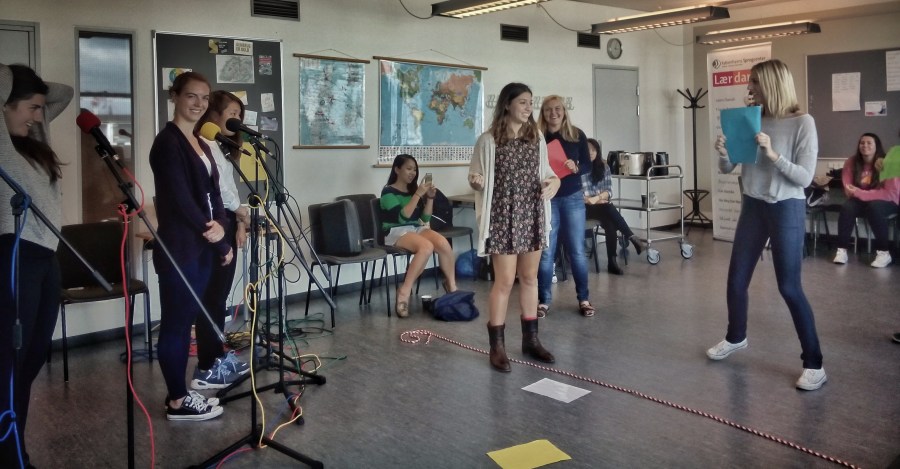
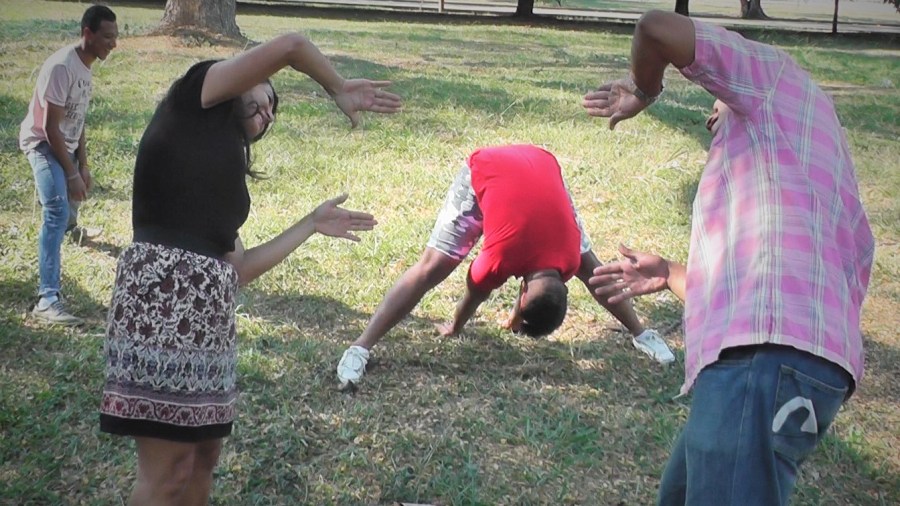
Today: Workshop with 18 young people from DIS – Danish Institute for Studies Abroad.

On the menu:

  1. Building the collective through: gesture imitation, gesture merging, jibberish, jibberish emotionalized, emotionalizing the space by attributing an emotional state to each corner.
  2. Totemizing the collective. Dividing the group into 6 “tribes”, with “totems” borrowed from our natural biotope, ie elements from free commercial postcards, such as “queen”, “beer”, “car”, “art run”, etc.
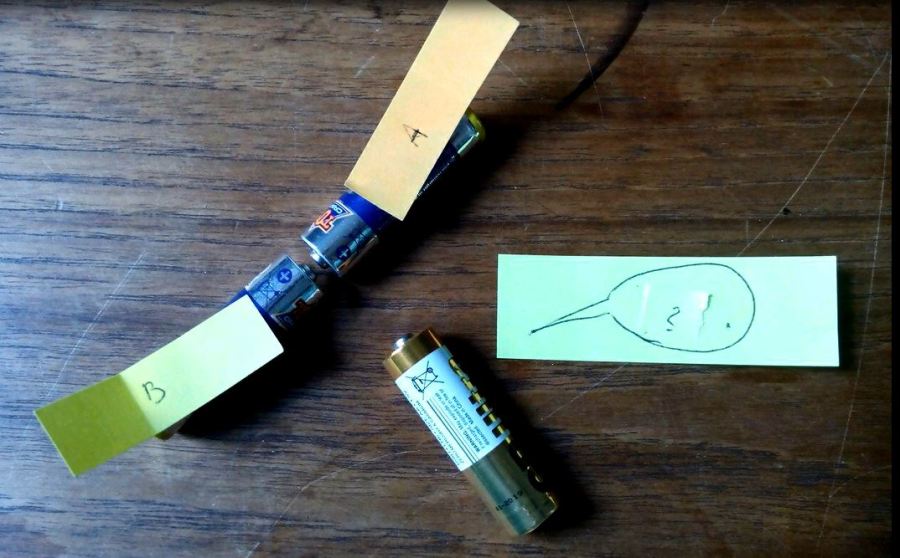
  3. Building immaterial instruments. Each “tribe” created an “instrument”, only using what was at hand, with the constraint of using the principle of either an idiophone, membranophone, aerophone, chordophone, electrophone, none-of-the-above-ophone.
  4.  With the sound from the “instruments” recorded, and after a break, we proceeded to performing collective improvisations, a “chorus” using microphones to form the “instrumental” sounds with their voices, “dancers” conducting the chorus by moving in the emotional space. etc.

Here are the resulting collective improvisations:

https://soundcloud.com/akutsk/sets/totemized-president-of-dis

The Role of Culture in a Sustainable Society, seminar in Helsinki, September 2015

“Culture and art provide our society with creativity, critical thinking, empathy, confidence, risk tolerance and mutual respect. We believe that working with culture and art and through the cultural meeting, we create an essential part of the foundation for the Nordic region and societies to become sustainable”

– Per Voetmann, director, Nordic Culture Point

Programme

We are pleased to have assembled a versatile and exciting programme with speakers and examples of inspiring projects from all over the Nordic region:

  • Katriina Soini (FI), postdoc researcher, Cultural Policy, University of Jyväskylä. Topic: Introduction to culture and sustainability
  • Angela Goldin (NO), director, The International Museum of Children’s Art. Topic: How does art projects for, with and by children contribute to a sustainable society?
  • Ola Jacobson (SE), chairperson for the Culture and Art Programme and strategist and responsible for international affairs for Culture Skåne. Will comment on Angela Goldins´ presentation
  • Casper Hernández Cordes (DK), composer, Fonografit and Building Sound Collectives. Topic: Sustainable support and culture and art as a driver for cultural sustainability + artistic intervention about sustainable collectives through sound and movement
  • Kenneth Flak (NO), chairperson for Mobility Funding and choreographer and dancer at Roosna & Flak. Will comment on Casper Hernández Cordes´ presentation and intervention
  • Ulrika Lind (AX), freelance culture and art strategist

Read more here.

Building sound academia. What actually happened in Helsinki?

How do we build sound collectives? How do we create an atmosphere of playfulness and free flow of ideas between adults? If human interaction is much more than words, if it’s also a lot about nonverbal interaction, how can we add this dimension to events where scholars meet to discuss cultural aspects of human life – using almost exclusively words? Are human beings more than merely brains attached to a chunk of flesh&bones, and does it make sense to imagine a modality of human interaction, we could call corporeal reflection? If academia is the institution entrusted with the task of to understanding and finding solutions to our problems, is it meaningful to not involve the reflection taking place in sensorial, bodily reflection in this institution?

These are some of the question that are put into play in the workshop I was facilitating in Helsinki, at the Cultures in sustainable futures conference, May 2015.

The whole session was video recorded. I have experienced that this is a fantastic way of learning from the workshops, I am facilitating. Since we are working with nonverbal interaction, with sound and gesture as means of expression and communication, of course, the temporal aspect is extremely important. In order to get an idea about how the timing works, and in order to get a clearer image about the building of ‘cultural tissue’ that is going on in the collective, analysing a video recording of the session is crucial.

I have picked some highlights of the workshop session, and I am sharing them with you here, for you to get an image about how the tools and methods work.

1) “Pick Two” – Establishing equal distance between you and two other participants of your (secret) choice. Description.

2) Gesture imitation. Read more here.

3) Gesture imitation, with sound

4) Gesture merging

What do you think? Can we reflect via the body?, without words?, in higher education? Does academia need to include bodily reflection as a modality? Can you present a thesis in the form of a choreography?

Join the discussion!! Pitch in!! Write your comments below. Join us on Facebook, join our group ‘Art in Organisations’ on Linkedin.

Workshop exercise: Gesture imitation

  1. Gesture imitation; In pairs;
    1. B makes a gesture with one arm, while A watches and memorises;
    2. A now imitates B’s gesture.
    3. A and B swaps roles and repeat 1.1 and 1.2
  2. Gesture imitation version B; enhanced by sound; Same drill as above, this time the gesture maker will accompany the gesture with sound, voice, hissing, breathing etc.
  3. Gesture saying yes, and. Same pairs
    1. B makes a gesture 1 with one arm, while A watches and memorises;
    2. A now imitates B’s gesture 1, and add a new gesture 2, inspired by the gesture
    3. B now imitates A’s gesture 2, and add a new gesture 3, inspired by the gesture
    4. 2) – 3) is repeated for 3 – 4 minutes
  4. Gesture loops; plenum
    1. Facilitator explains about time before/ after a phrase, and loops;
  5. Gesture Merging; pairs
    1. A & B both mentally prepare a gesture
    2. At an agreed upon sign, they start looping their gestures, at the same time
    3. While gesturing, they notice the other’s gesture
    4. When ready, at a nod, they start merging each other’s gestures into a common third gesture.
    5. They repeat 5.1 – 5.4 until they drop
  6. Gesture mass merging; break up pairs
    1. A & B repeat step 5.1 – 5.4
    2. This time, they break up, repeating the new third common gesture, venturing out in the world with it
    3. THey each meet a new participant, line up, notice, when ready they start merging
    4. Repeating 6.2 – 6.3 until they drop
  7. Gesture merging, with helper
    1. The group splits up into trios (extras become observers)
    2. A & B do their drill as in step 5.1 – 5.2
    3. This time, C observes, and when having computed a 3rd new common gesture
    4. C taps A&B on shoulders; Theys stop and observe, while C perform the new gesture as a loop
    5. A & B (and a possible observer) now learn C´s gesture;
    6. A new member of the trio is appointed to be helper, and 7.2 – 7.5 is repeated
    7. Until they drop
  8. Gesture mass merging, with helpers
    1. The trios perform 7) again, once. You will from now on have different roles.
    2. A and B will now leave the trio, walking and looping their new gesture, looking for other loopers.
    3. C (helper) will from now on stay in the role as a helper, C will stop do the gesture, and will start looking for new duos, if possible with new members.

Dance: finding the balance of the self within the group

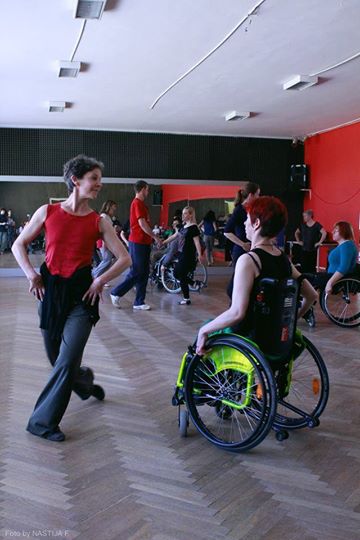
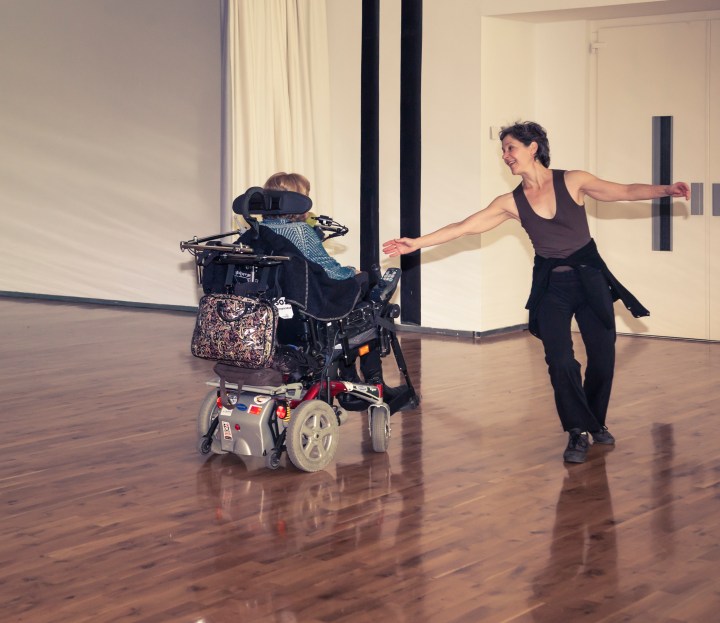
I stumbled upon this video on the Internet, and I was immediately overwhelmed by it

https://vimeo.com/128789589

I wrote Becky Siegel, who is the choreographer behind the project, and asked her if I could do an interview with her, and luckily she said yes.

Casper: Becky please tell us something about the path that led you to start working with people with chronic illness and/or disability.

Becky: I had a growing sense that I wanted to help people that were suffering, through dance. It was so clear to me that dance is so therapeutic. All dancers know how we enter the studio and how much better we feel when we are finished. So I thought that if dance was so helpful for people who are basically healthy, the effect on people who are struggling with serious health problems had to be tremendous. I had a student who is a physical therapist at the Navarran association for Multiple Sclerosis and I asked her if she thought that they might be interested in trying some work with dance and she thought they would be. And that was how it began.
But I think on an even deeper level I had a sense that having been able to dedicate my life [to dance] was a tremendous gift and that somehow I wanted to give that gift back.

Casper: Thanks, Becky! I guess this raises a question about dance as therapy versus dance as an art form. Do you have any points on this?

Becky: That’s something that I think about a lot. And it can be very delicate. I think it’s a question that must be addressed head on in this kind of work. I am not a dance therapist, have no training in that area. I’m a trained dancer, improviser, choreographer, and teacher and try to bring all my experience – of about 40 years – to this work that I have started doing in the past 2 years.
On the one hand it is clear that dance is always potentially therapeutic, and that even the more therapeutic practices are also very artistic, but I see very clearly that in the different facets of the work that I do sometimes it is fundamentally therapeutic, and therefore totally about process and not intended for an audience, while other groups that I work with consider themselves dancers, or come to consider themselves as dancers, and have a desire to perform.
I myself am much more interested in the process than in the “result” (i.e. a performance), but often the work is so exquisitely beautiful that I am very interested in sharing it, feel that it is worthy of being seen by an audience.
So while I feel that dance always has that element of therapeutic benefits, I don’t feel that all dance needs an audience. I think that dance that is primarily therapeutic is a private experience. In the case of my work, it is a group experience so it is shared and witnessed by the other dancers present and that is enough. On the other hand, when one sits down to see dance as an art form, ideally one is not focussing on the fact that there are dancers of different abilities but on the beautiful dancing and the great choreography. So the great challenge for creating dance that is art when there are dancers with limited movement possibilities is being able to transcend those limitations, to really push their technique, as with any dancer, and to bring the greatest compositional skills possible to the creative process. I work primarily with improvisation, so all my students are given tools for finding their own languages as well as discovering choreographic possibilities.
In my work with illness and disability I find a difference in the way I teach depending on whether it is more “therapy” or more “art.” The therapeutic focus implies that these are people who need help and are, in some ways, dependent on me and my assistants to help them have a positive dance experience. The closer that we can get to my students’ being actively engaged in the creative process the closer we are to creating dance as an art form. The more that these students are able to get beyond experiencing themselves primarily as disabled, the more they are able to get beyond the self, the more that they are able to create art.

_MG_4874

Casper: I would like to move on to the core of my interest in your work, namely the collective. Could you say a few words about what happens to group dynamics in your activities as a choreographer, teacher and dancer?

Becky: Being born and raised in the U.S. and having lived and worked in Spain for the past 28 years I have the opportunity to understand these two very different cultures, and their very different realities when it comes to the self and the group. The U.S. is an essentially individualistic culture while Spain is fundamentally social. Working in dance, I am very focussed on the relationship between the self and the group and place great emphasis in my training on the dancers’ being able to reach their fullest potential as individuals, attain a true consciousness of the self, and at the same time have a total awareness of the group. Attaining this balance can be very challenging: there are people who are not able to transcend the self and others who are so focussed on the group that they lose themselves, but my work deliberately addresses this question.
As a choreographer I find it most difficult to achieve this balance in the group: I have expectations that are perhaps beyond the dancers’ capabilities; the dancers are often immersed in their egos, trying to get the choreography “just right.” It can be a very long road before the dancer is able to transcend the self, get beyond their focus on their own performance and truly understand the whole.
When I myself was a young dancer I used to get terrible anxiety before performances. Then I remember the first time that I made a piece of choreography that I liked: I felt part of something larger than myself, that my performance wasn’t what mattered but rather the work itself. And I stopped getting so nervous before a performance.
In my teaching of group improvisation I feel more successful at helping dancers to reach this happy balance than when I am directing my choreography projects. We work on it everyday, starting out with individual exercises to explore each students’ possibilities. The transition to group work can be difficult, changing that focus from inward to outward without losing the self. But we all see the results when we are able to make that shift and they are very beautiful.
Curiously, the work with disability seems to make it easier to make that shift. It seems that the challenge of the difference of languages awakens the outward focus: without turning into condescension, there is an automatic empathy and excitement, equal on both sides of the mixed ability spectrum. At the same time, this challenge requires that the dancers be able to count on their own technique, so they are immediately in tune with their finest abilities. Somehow, this work brings out the best in all my students and brings them closer to this exquisite balance between the self and the group.
Another interesting thing happens in these groups: the students with more experience instinctively “teach” the less experienced ones: through their good example they instruct the newcomers in the art of choreographic improvisation (this is true regardless of whether it’s a mixed-ability group or not). Over the years I’ve loved witnessing how naturally the more experienced improvisors take on this role and essentially welcome the newer students through dance. They become teachers in a way; it’s like a passing on of knowledge from generation to generation.
As for how these group dynamics carry on into the other areas of our life, I’ve seen how my students have become dear friends, will sometimes go on vacation together, will welcome any occasion to dance together. They are my dear friends, too. And we all notice how much we need to apply the lessons that we are learning in the studio to our lives outside the studio, namely the ability to maintain that balance between the self and the other in our relationships, in our families; how to have relationships without losing ourselves.
And I’ve also seen how my students have carried on these ideas into their own teaching as they, in turn, have become teachers.

Becky Siegel has been teaching dance for more than three decades, both to professionals as well as to beginners. She was born in Denver, Colorado, but was raised in New York City where she received her dance training, studying classical Ballet and the modern techniques of Merce Cunningham and Martha Graham, and where she performed in the improvisational dance company of Richard Bull for several years. She has a degree in the Arts from Barnard College (Columbia University, New York) and a Masters in Performing Arts from the University Rey Juan Carlos (Madrid), where she wrote her thesis on the Sacred and the Profane in Dance. Becky has lived in Pamplona (Spain) since 1992, where she directs the companies Tempomobile – for whom she has created fourteen productions – and Kon moción, a semi-professional improvisational ensemble. In 2013 she created a dance program at the Navarran Association for Multiple Sclerosis (ADEMNA). In 2014 she created a similar one in the Navarran Association for Parkinson (ANAPAR). And in 2015 she began to collaborate with Lua, the dance group affiliated with the Association for persons with physical disability of Southern Navarra (AMIMET), teaching them modern dance technique, choreographic improvisation, and creating a collaborative improvisational project with the dancers of Kon moción.

Non-verbal communication and the “voice” of drums

“The garamut have two functions in this society. First, they are used to communicate between people through a code of beats, which enables the Reite to say things such as “the whiteman will come to eat banana in [a particular] hamlet tomorrow afternoon, as long as there is no rain” – this last sentence demands very good skills, but basically everyone is able to hear their own names when called by the slit-gongs. The second functions of the garamut is to “accompany the voices of water-dwelling spirits when the spirits are drawn to the village by men of the cult”[9], in other words to communicate with them. Besides, each spirit “is known by the unique tune of its voice, and by the unique beat which properly accompanies it””

nonhumanentities's avatarNon human entities: cosmopolitics and modern politics

Non-verbal communication and the “voice” of drums
Understanding perissological resonators

Our inquiry on how non-human entities are made to speak now leads us to wonder about non-verbal communication. Speech is indeed not the only way to communicate, and alternative media used in rituals may be interesting to look at. Non-verbal communication can go both ways: from humans to non-humans, or from non-humans to humans. Bruno Latour proposed to take some facts as propositions, such as the “drip-drip” of melting glaciers warning about global warming. Pierre Lemonnier now proposes to consider that objects produce non-verbal statements and are great tools of communication.

A non-verbal statement can be defined as “the communication of an idea, position, mood or the like through something other than words”[1]. Tim Ingold insists on the idea that “objects might do what words alone cannot”[2] in the domain of ritual. Rituals indeed enjoy the necessity…

View original post 1,979 more words