How can sound help us building our collectives?

A contact wrote a message to me on facebook, saying that he didn’t want to collaborate any more on a project we had been working on together. He suggested that we meet face to face. This made me glad. We met and we talked our way through, and though we didn’t continue the collaboration, at least we cleared the air, and we both learned what had to be learned from that experience.

Had we finished our interaction via Facebook messenger, we probably wouldn’t have come to an understanding, and the issue would have been left unresolved, – or worse. Why is it that we keep misunderstanding each other when communicating through social media, sms and emails?

Is it because  text is not the right medium to solve complex problems? I say that no matter how many emoticons we add up in an sms, it is never going to convey all the nuances of our feelings.

What about a phone call? Well. Am I the only one experiencing that the connexion is horrendous most of the time? “Did you hang up?” “No, no! It was the connexion!!”

It seems that nothing beats real life face to face communication.

Also read this: Can social media help us build our collectives?

Gestures with our faces, bodies and voices are all intertwined channels of communication, and it makes a lot of sense to regard them in a holistic way. For a moment, however, let’s look at what happens in the interactions we have through sound alone. And how this affects our capacity for building sustainable collectives.

When speaking, we are not only simply saying words. We accompany our words and other utterances with certain ways of using our voices. We are capable of expressing and perceiving very intricate patterns in melody, breaks, volume, quality of voice and rhythm. In other words: We rock at prosodyTweet:

First of all, sound has to do with our voices. Since the voice sits in the body, it reflects what’s going on in there. All the processes and rhythms of my body are influencing the way I sound. My heart rate, the rhythm of my breathing, and the degree of tension or release I am feeling, – it will all affect the tempo, timbre and volume of my utterances.Tweet:
Let’s look at it this way: I make a sound. The vibrations of my body make the air vibrate. And these waves of air will reach you, causing vibrations in your body, creating a similar kind of feeling in you. In other words: we have an innate capacity for empathy.

Empathizing is fundamental when it comes to building sustainable collectives. Tweet: Still, our societies fail at it. Why? Group dynamics based on social control, competition and exclusion teach us to control our voices, making sure nothing slips through. And if it does, the recipient has learned to suppress his or her natural physical reactions.

Also read this article: What Is Empathy?

Secondly, the way we distribute time in our interactions is staged through sound. Breaks, pauses, hesitation are all markers of how you react to what I am saying. It tells me something about the extent to which you are taking me seriously. Are you giving me space in the conversation? Are you snapping off my words? Are you RAISING YOUR VOICE so that you can conquer space and impose your points in the conversation? Therefore timing in conversation is about power and hierarchy. Tweet:  When building a collective, the question of power and hierarchy is important. I believe that in a sustainable collective, there should be an equal amount of space for each member. It’s a place where we all have an equal right to be heard.

A third aspect of sound as a means of expression is our capability of establishing a link with movement through sound. We are excellent at mimicking movement, acceleration, and physical volume with our voices.
This allows us to bring aspects of our bodily intentions into the dialogue in an abstract form. I might feel the urge to punch someone in the face, but there might be many reasons for not doing it. What I can do, legitimately, is to give life to this wished for movement through sound. “Aaaaaaaarr-he-is-simply-so-aaaaaNOying!”. A crescendo and a raise in pitch with a full stop. No need for broken knuckles there.

Also read: Non-verbal communication, – a world of valuable information

In many situations we are not using the words that correspond to our intentions. Think about flirting, which is all about NOT saying what we intend to do, with words. Here, words are simply marionettes for a whole performance in sound and gesture about all kinds of hinted at activities.

Read about one of my workshops here.

Aggression and love are a few out of an unlimited number of forms of interaction. We need to be able to handle these in ways that don’t challenge the cohesion of the collective.Tweet:

By imitating real or imagined bodily movements through sound, we are capable of staging actual as well as possible scenarios, and it enables us to test real or imagined outcomes of our social interactions, in a safe way, before proceeding to actual action. In other words: A sustainable collective is capable of handling controversy.Tweet:

Let’s sum this up:

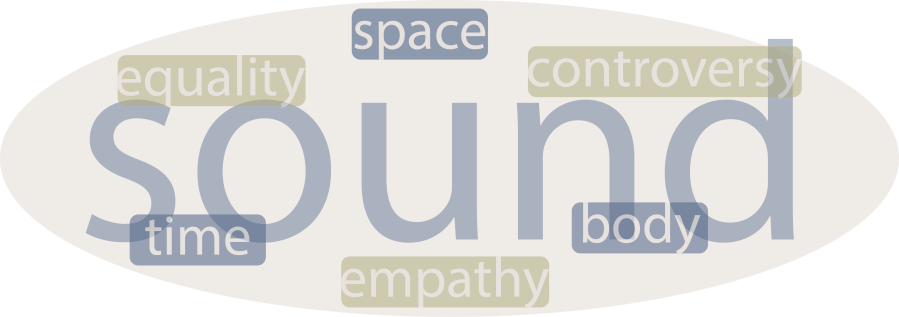
Our voices are.. through (primarily)… This helps the collective … while establishing a relation to …
 conveying our feelings  timbre  Building trust  the body
timing our utterances  rhythm  Establishing equality time
giving an abstract form to our physical intentions  melody  Handling controversy space

Does this make sense? Please contribute with your comments below!

For my part, I think that these questions are relevant for a further discussion:

  1. Does the table above make sense? Is there a relationship between specific characteristics of sound,  and the way we use them in specific modalities of building collectives?
  2. Can we create better collectives by training our capacity for using sound as a means of expression?
  3. Does our current conception of musical practices and learning strengthen our capacities for interaction through sound? Or is it merely teaching us to become good consumers?
  4. Which kind of practice would help us become experts in building sustainable collectives through sound?

We need tools for building sustainable collectives

Building a collective is about listening to the other, about trying to understand the other’s world, Tweet: and try to find a ground for building a new common world. We usually do this through words. This is smart when we talk with people that we are already agreeing with. But what about those with whom we disagree? Preaching to the choir always gives the best results, right?

It’s a very adult way of doing things. Talking. Using words. When you think back to the time where you went to school, you might agree with me that we had other ways of connecting with other people.

When I was in school, officially the point was about us learning stuff. There was a teacher talking about something seemingly relevant to us. But actually most of the activities I engaged in had to do with building a collective with the other classmates. And how did we do that? Did we sit around and talk and discuss and debate? Well, to some extent. But most of the time we where playing around with meaning, playing around with sounds, we were playing around with nonsense, we interacted through our movements. We didn’t only talk. We didn’t only use this one channel. We had a lot more channels to draw upon, when building our collective.

A lot of people say:

“I am not musical. I don’t know how to play an instrument. I can’t sing. It sounds terrible.”

My answer to these people is: We are all musical! We are using sound ALL the time as a means of expression. Tweet:  We are doing it at a very high level. Everyone. All the time. Most people simply don’t see it. They understand working with sound at a high level as something only musicians can do.

I am saying: we are all musicians. In our everyday life, when speaking, we are expressing ourselves in very intricate patterns in sound. We are able to perceive what is going on in another person through the sounds he or she is making. Not only through the words, he or she is using – sometimes people use words that are different from, or even opposite to what they actually feel, whether conscient or not. How can we know what’s going on in another person, when the words don’t match? We listen to sounds! Tweet: We are listening to all the intricate changes in the tone of the voice, the intensity, the timbre. From these little clues, we can build an understanding of what is going on in the other person.

When we are trying to create new ways of producing, consuming goods, and making decisions, we use new innovative  tools and methods. If we want to build cultural sustainability, we need tools and methods as well. Indeed there are many new technological innovations that we can use. There are tons of apps, and online tools for people to be create new expressions, and recycle old expressions. However, few of these innovations give the users the ability to be creative as a collective.

Also read: Can social media help us build our collectives?

So which tools and methods will help us be part, as a collective, of the creative moment itself?

Let’s start singing and dancing, right?! Well. Most people are not very fond of using their bodies and voices in unfamiliar ways. We learn that it’s wrong to stick out, and we think we are going to make a fool out of ourselves. Most of us. Then you have those who are good at it, and they will shine, and we will be ending up with the good old consumer-expert duality.

Focusing on performance, on excellence and on what we call talent is a residue from the good old industrial society. The thing is, that the way we use our bodies and voices, – our gestures and intonations – are embedded cultural patterns, that have a very strong effect on our collectives. They can sustain ways of doing and being that are excluding new people, new thoughts, new possibilities. A simple example is the handshake. Or  looking people into the eyes. In some cultures people don’t shake hands. And looking into other people’s eyes is impolite. Good luck with the job interview in a Western company!!

We need tools and methods for building sound collectives, and for them to have an effect, they should be

  • intuitive – building on existing ways of doing things, on known technologies, on everyday life.
  • sufficiently challenging, but not too much. People will back off. Or just start fooling purposelessly around.
  • open design. Participants must be able to influence the design in real time.
  • rhythmical. No learning without repetition, we must find ways of repeating the processes, keep them going, sustaining them

Read more about methods and workshops here.

Can social media help us build our collectives?

I see many benefits in the social media. It is a place where I can easily get in touch with people, and make things in real life happen. Still, I have some serious and growing worries when it comes to their capability for enhancing or building sustainable collectives.

When I am on Facebook, the world that I meet is a highly constricted one. And it is certainly different from the one you  experience. This gradually aggravating digital autism is a consequence of my own – conscious and unconscious  – choices. And of mechanisms, that are working behind the scenes, on which I have absolutely no influence. The algorithms of the social media have an enormous power deciding which information reaches each one of us, and  it is fair to say that they are the most important cultural battleground of our time Tweet:

I am often engaged in interesting dialogues with interesting people on Facebook, much more so than on any other online platform. Unfortunately, I rapidly loose contact with these temporary collectives, and the discussion will die out. Maybe it will start again some other time, but from scratch.

Social media forces us to constantly embrace the new while forgetting about the old, lost in a river of collective digital amnesia. Tweet:  It fosters a logic that matches the way of thinking that has brought us in a situation where we have to look for a growing number of planets to sustain our way of living.
Let’s face it: Facebook is about accumulating cash. This is not less true since the company went public. The push towards commercialization enhances the linearity and the fetishism for the new of Facebook’s surface design and hidden algorithms.

Do you remember in the good old days, when we were told that we were part of a multi-media revolution? What has  happened since then? It is true that we are now sharing photos and videos like crazy at the social media. And that these formats are creating more engagement from followers. Still, when it comes to interaction as such, we are almost exclusively using text. It is still definitely much faster and more efficient to comment on an update via text than via audio and/or video.

Also read this: Is audio the next big social media trend?  

 When reducing our interactions to text alone, what do we miss out? Can smiley faces and other textual tricks substitute for the nuances that are being conveyed through speech? And by this, the whole range of elements of human interaction that serve to build empathy, trust and understanding. Again, the digital deafness of the social media is a consequence of choices that are out of our handsTweet:

Also read this: What’s keeping audio from going viral?

 In an environment of digital autism, amnesia and deafness, how are we supposed to build and sustain our collectives?Tweet:

Cultural sustainability via social mediaSupposing that our collectives are feeding on the access to, and the capacity for understanding the other’s world. Supposing that we need ways of storing our collectively build knowledge and reflections in intuitive and easily retrievable ways. Supposing that we need to engage in dialogue in a way that stimulates trust and empathy. Our social media do not look to good, do they?
There are examples of places on the Internet where parts of these requirements are met. In wikis, we are able to store collectively build knowledge. Check. There are probably thousands of forums where people interacting around more or less obscure shared interests. In a sustainable way. Check. The fact is that most of the time most people spend online is on the social media. And the majority of the social media platforms are failing to provide us with the tools to build and sustain our collectives.Tweet:

Is this a technological problem? Or a cultural one? So you are still thinking about technology as if it was something external to us? Guess what! Our so-called technological revolution is driven by cultural forces. And cultural forces, that’s you and I!Tweet:

Also read this: “Does social media really empower local communities?”

Discuss this on Quora

What makes us a collective?

The current discourse around sustainability has a tendency to focus on either the level of the individual or the level of “society” as a whole. This way of thinking is not working. We need to take into account the level of the collective. So far this level has been approached through the lens of a minority-majority dichotomy. This doesn’t work either. We need to understand the workings of our everyday life connections in larger and smaller circles and find ways to connect them in  smarter and more sustainable ways.

First of all, we must find out what mechanisms make us establish collectives in the first place. And what keeps them going. It seems that what initiates and sustains a collective is that people in it have some activities in common.

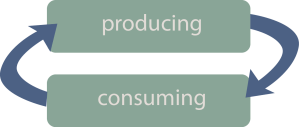
At a basic level of human interaction, we are producing and consuming things together.

model_level1_producing-consuming-cultural-sustainability
First level of building collectives

At our workplaces and educational institutions, we engage in activities around production. Producing goods, services and knowledge is the main common motor, in these places, that will drive the collective – in a sound direction or not.
In our spare time, we are consuming things together. We go shopping, watch a movie, eat, drink and take drugs. Consumption is the driving force in the collectives we build in our spare time, and again this may go in a sustainable direction or the opposite.

What about playing football, dancing, playing music, painting, making jokes etc., where do these activities fit in? I suggest we add a second layer of activity:

model_level2_producing-consuming-cultural-sustainability_inclusive
Second level of building collectives

With this model, I am suggesting that there is a connection between what we are doing when we are playing and what we are doing when we are producing and consuming: Our playing activities draw and feed back upon our activities around consumption and production.

Playing is not a form of interaction that attracts much attention in the general discourse in these years – unless when it allows for commercialization. Nevertheless, it has a huge importance, I would say, when it comes to building sound collectives. Tweet: Playing can play a role when the collective is under pressure. Humor and satire is a way of letting out steam for instance when we are facing ridiculous bureaucratic procedures. Physical activities, like dancing in front of the inbox, can help us sharpen our attention, create a better work flow and sync our rhythms in a team.

Also read this: What Maslow missed

By building a playful environment around our daily activities, we create space for creativity and innovation. This is because playfulness gives us the capacity to take elements from our basic level of interaction and open new spaces, mental and physical, where we allow ourselves to experiment with them in new ways.  In an environment of sensuous well-being.

I guess that if you agree that the activities of production and consumption are what brings us together in the first place. And that since we are continuously repeating these activities, they are a reason for us to keep on seeing each other. You would probably by now add that this isn’t enough. Something else is going on, that makes the collective evolve, – in a good or bad direction.

I suggest that we view this something else through the lens of the words depth, narrative, and ritual.

The more activities a collective shares, the deeper the connection between the participants will be. In the good old days, we were all consuming, producing and playing together in family-production units. Around the fireplace. This is sort of not the case anymore. Our activities are divided between an increasing number of circles, all of which are dealing with a small part of our everyday life activities. We are producing with our  colleagues, but we don’t see them after work. This is typically the case in Denmark, at least. We divide our spare time activities between family, friends, and the stamp collector’s club.
Most people are probably OK with this atomization of collectivity. It’s a matter of choice, and a consequence of the prevailing tendency towards marketization of human interaction. Does a successful  development towards a general sustainability require that we rewire these atomized loosely knit circles into more compact interwoven entities? Tweet:

Also read this blog post: Can social media help us build our collectives?

How did you meet? How did it start? The origin myth of a collective plays a significant role.  “All groups start with some kind of originating event”, writes Schein. It tells the story about what made the framework for the collective come to existence. And it continues to be an important glue binding the participants together. Sharing narratives is important for a collective, and these narratives will be enforced through repetition, debate and controversy.

Are narratives only textual? I would say that we store a huge amount of elements from our activities in the form of patterns in our body language and our way of interacting through sound, ie. prosody. These non-verbal narratives are important in the sense that, neglected and ignored as they are, they can provide the collective with valuable elements for positive changes. Interaction through movement and sound is a key that opens up to our playfulness, and as such it will enhance creativity, innovation and well-being.Tweet:

Also read this blog post: How can we build collectives through sound?

No learning without repetition. Rituals play the role of reaffirming what we already know and do in our collectives, and they are breaking down our activities in intervals in time and space, that are easier to handle. Mentally and physically. We are composing new rituals, and affirming existing ones, all the time, whether conscious or not.
Rituals allow us to sync and reformat the rhythms  – from small scale to large –  of our interactions. In order to build sustainable collectives, we  need access not only to the rhythms of our collaborations. These are handled via clock time, and can be dealt with using spreadsheets and school bells. The rhythms of our bodies – unfolding in the domain of lived time – are at least as important. Our access to these rhythms is dependent on our capacity for expression through sound and movement, ie. prosody and gesture. Tweet:

Gesture as a collective phantasm?

“.. we suggest viewing gestures as key constituents of phantasms , quasi-present objects that are produced through multi-modal utterances. This perspective highlights the ways in which gestures mark profound transformations of participants’ experiential histories, transformations that open up, for the speakers, new insights into the matters they strive to imagine. The study of these insights led us to emphasize not the simulative, but the creative roles of gestures.”

From: Gesture and Imagination: On the Constitution and Uses of Phantasms


Building sound collectives – a workshop concept

//
upgesture

So, we want to work with sound as a means of building a culturally sustainable collective, and we want to do it in an open, intuitive, sufficiently challenging, though comfortable way. This workshop is designed for groups of adults and young adults. It is aiming at providing the group with tools and methods for building the collective through non-verbal means.

The workshop is intended to be a supplement to contexts where people are working with new ways of living, towards economical, ecological and social sustainability. This might be in connection with conferences, festivals, theme days in education, or seminars in organisations.

midgesture

Basic info
Name Building Sound Collectives
Duration 1 – 2 hours
Target group Young adults and adults
How many? 12 – 20
Where is it relevant? In organisations, in education, at festivals and events with a focus on sustainability
Location A larger room with free floor space. If outdoors, in a quiet, private place.
Equipment used Computer, audio interface 8 in 8 out. Four microphones. Four (homemade) instruments with (contact) mics. Four smartphones. Wifi. A “magic square” 3×3 meter on the floor marked with adhesive tape. A pair of loudspeakers.
Aims 1) to find the groups “common core gesture”; 2) to develop new gestural expressions from the core gesture 3) to find our way to imitate gesture through sound 4) to create a collective electroacoustic composition
Learning keywords Collaboration, non-verbal communication, other-centeredness, gestural and sound imitation, sharing ideas, improvisation, collective creativity.
The workings

Expressing ourselves in sound is one of our most efficient modalities to reach out to each other, and to try to understand each other’s worlds.  But there is no sound without movement. This is true on a fundamentally physical level. It is also true on what we could call a meta level. When we are  expressing emotional content, we are imitating physical movement with our voices.

Therefore, we want to start with gesture. We want to explore gesture as something that members of the group are already using as a means of expression in their everyday lives. And we want to experiment with ways of imitating our gestures through sound.

The workshop comprises six parts.

  1. Our first aim is to search for what I would call a common core gestural phrase
    • In pairs. A comes with a gesture. Any gesture. B imitates it and adds a variation. A imitates B’s variation and add another variation.
    • Each pair present one gestural phrase that they liked. The rest of the group imitates.
    • Now everyone moves around in space. Each participant performs the gestural phrase they have selected, and when seeing another participant he/she will try to merge to two gestures.
    • All gestural phrases will eventually merge into one.
    • This is group’s core gestural phrase
  2. Gesture jam.
    • In this part we will improvise in different ways with gesture based on the core gestural phrase. Imitating with other body parts; varying the size of the movements; making supplementary gestures, filling out the “blank spaces”.
    • This way, we develop a common new gestural grammar, and a living library of movements for the group.
  3. Sound on top. This is where we work with imitating gesture through sound
    • in pairs. A performs a gestural phrase from the ‘library’. B imitates with sound.
    • In the whole group, the pairs give samples of their work, showing a gestural phrase and the corresponding sound phrase.  The group imitates the sound phrase, with sound
  4. Sound from the bottom
    • The group records one sound from each of the four homemade instruments. This might be done in a break by some of the participants.
  5. Collective electroacoustic improvisation
    • The group is divided into three groups of four: a gesture group, a voice group, and a remote control group.
    • The gesture group will move around inside and out of the square, using gestures from the collectives’ library.
    • Each member of the sound group will imitate one of the gesture performers with their voices. Each of the four sound group members has a microphone, and their phrases form the previously recorded sounds from the homemade instruments, live.
    • Each of the four members of the remote control group use a smartphone to follow the movements in the magic square of one gesture person.
    • During this improvisation,  in the loudspeakers we will hear the sound of the four homemade instruments
      • formed by the voices of the sound group (intensity and pitch)
      • moving in soundspace according to the position (left – right, back – front) of the sound group members in the magic square
  6. The collective improvisation is recorded. After the collective impro, everyone listen to the recording.
    • New impros can be made. New experiments tried out. New sounds from the homemade instruments used.
    • For each new impro, people switch roles. Ideally, everyone tries all the different roles once.

down

If there are enough people, a possible variation is to have a group of “musicians” adding new sounds from the homemade instruments, according to the movements of the gesture group.

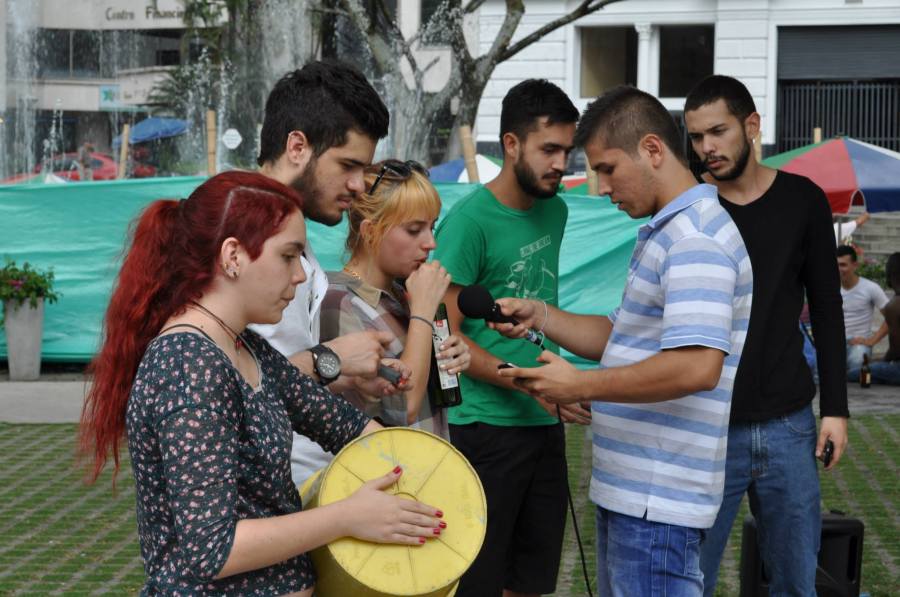
See an example of a street performance using a similar approach, in Cali, Colombia, here.

Follow our page on Facebook.

All work and no play? Not anymore!

These are images and sounds from a street intervention in Cali, Colombia in June 2014 made by composer Casper Hernández Cordes during his time as an artist in residence in Lugar a Dudas.

The performance concept “The Work and the Play” is build up in two parts:

1) WORK. In this part, a participant is cleaning a 3×3 meter square on  the pavement. A group of participants watch the movements of the working person and imitate them on instruments made from trash. For example: the participant holding a bucket makes a sound each time the “worker” puts a foot to the ground.

Sounds from the “players” are being recorded, as individual loops in Fonokolab.

2) PLAY. When the “worker” has finished his/her job, he/she walks slowly, foot by foot, around the square.

Three to four players now move around in the square, each of them forming a sound by their position in the square.

The 3-4 improvised sound gestures are recorded.

When the “worker” reaches back to where he/she started, the collective improvisation stops.

And it’s time to invite a new person to do the working!

Find the event page on Facebook: https://www.facebook.com/events/1636561273235682/

The performance was made possible thanks to

Danish art council logo Lugar a dudas logohttp://www.caminaelrio.com/

Read more about the project here:

http://champuscolectivo.tumblr.com/acercade

Is even my mother tongue corrupt?

Improvising with my voice, starting experimenting with singing INTO things in my home; when I starting using a white ceramic bowl, I noticed it had this damping effect, and it felt good;
It made me start thinking: What if our spoken language itself, is corrupt? The core of my search so far has been the spoken language, and I have seen it as a kind of collective bio recorder, a place where we store cultural traits, gesture, movements, and experiences, IN SOUND.
We store them, and are able to retrieve them throughout generations. In this manner, a treasure of valuable cultural knowledge survives through time. And I have seen this heritage as some kind of true, authentic, and …. real testimony. I have seen it as a bulwark against the attacks from the efforts from a centralized and centralizing, atomizing corporate state system. As opposed to the now spoiled relationship between production and culture, … read more in the comments below…
– the loss of a real folklore – spoken language would be the hiding place for a surviving cultural sustainability.

But what if my mother tongue itself has been corrupted as well? What if the prosody of my mother tongue is a bearer of the wounds inflicted by hundreds of years of assaults from unsustainable cultural processes?

The question I used to ask myself was: How can we draw on the sound patterns embedded in our spoken language to (re)build cultural sustainability?

Maybe the question I should ask now is: How can we draw on culturally sustainable patterns/gesture/sounds and embed these in our mother tongue?

We would then cure our spoken language, and provide our future generations with a means – through a healthy spoken language – to resist attacks from the ongoing colonizing efforts it might encounter.

“Digte er kommunikation, og selvom sproget er korrumperet af magten og den almindelige nedslidning, så lever drømmen om at skabe et kunstnerisk „parallelsprog“, der kan sætte verden i bevægelse.
Det fremgår især af det, men også af Christensens romaneksperimenter
Evighedsmaskinen (1964) og Azorno (1967) og af hendes hørespil for radioen.”
http://www.denstoredanske.dk/Dansk_litteraturs_historie/Dansk_litteraturs_historie_5/I_skriftens_verden/Det_er_det_hele_-_Inger_Christensen