My 10 favorite tweets from Day Two at the Culture(s) in sustainable futures Conference

https://twitter.com/shiftNGroup/status/596239308467605504

12 favorite tweets from day One at the conference about Cultural Sustainability in Helsinki

Day one at the Culture(s) in sustainable futures conference.

These are my favorite tweets from the day:

Bruno Latour was not at the conference (that would have been really awesome), but here is a tweet popping up from @latourbot, that I find really relevant:

https://twitter.com/LatourBot/status/595690741009129473

Going to the conference in Helsinki? If not, join the live streaming

Not participating in the conference? Here’s a chance to experience part of the program as a live stream.

Cultures in Sustainable Futures, webcast schedule:

Wednesday, 6th May
9.30 – 11.00 Opening plenary
11.30 – 13.00 Plenary I: Culture as the fourth pillar of sustainability and beyond – a dream or achievable goal?

Thursday, 7th May
9.00 – 10.30 Plenary II: Just and sustainable culture(s) from local to global
11.00 – 12.30 Plenary III: Transformations: Towards sustainable ways of life

Friday, 8th May
14.00 – 15.30 Concluding session

Are you joining us at the conference? Or the live stream? Hook up with me on twitter, @fnogr, I will be tweeting along the way!

Link to the webcast:
http://videonet.fi/culturalsustainability/live/
Read more about the conference:  http://www.culturalsustainability.eu/helsinki2015/programme

Read about my workshop at the conference (not live streamed!) here:
http://cultural-sustainability.eu/2015/02/10/building-sound-collectives-in-helsinki/

Building Sound Collectives in Helsinki

Building Sound Collectives has been selected for the Conference “CULTURE(S) IN SUSTAINABLE FUTURES: theories, policies, p􀀀ractices”, Helsinki, May 6 – 8 2015.

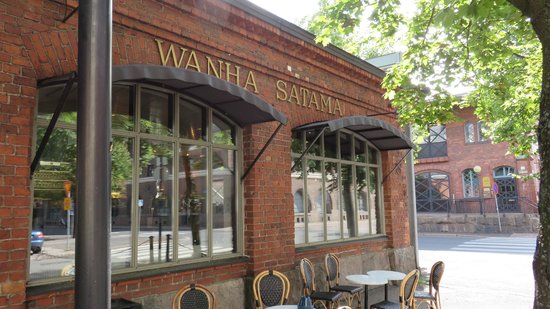
For three days, the University Jyväskylä will host a series of talks, sessions and panels at the “Wanha Satama” (Finnish for “Old Harbour”), – a renovated warehouse for coffee and spices located in the heart of Helsinki and close to the seashore.

Wanha Satama - before: coffee and spices, now: conference about cultural sustainability

As a part of the conference Ph.D Taru Elfving, is curating the “Open Stage” program, which is “a space for posters, art and performances”; this is where our workshop Building Sound Collectives comes into the picture. It will take place on Friday 8th of May, scheduled as a part of the program for the conference.

This conference is an excellent opportunity to continue our work, learning from knowledgeable people, and inviting participants to engage in a practical, hands-on research into what role non-verbal interaction plays and can play in a  collective’s cultural sustainability.

Read more about the conference here.

Join us! Share, like and comment!!

Publishing music as a living eco system

As a member of Barefoot Records, I am fortunate to be part of a vibrant and inspiring environment of excellent improvisers and composers. This is an environment of people, who – as improvisors – see music as something that is susceptible to immediate changes in the surroundings; these are artists that are challenging the mainstream understanding of music, both from within, – in the internal logic of musical forms – and from without, – in the way music is presented and the way it interacts with its audience.

Being part of this collective of musicians, with their steady production of albums and concerts, has given me a strong impulse – and a forum – to question the way music is published and distributed.

The fact is that although in these time we have an ocean of new opportunities to create interaction and context dependency in the digital media, the record industry is still stuck in a linear, closed format when publishing music. Whether we are talking downloads or streaming, the end result is still the same kind of linear, black boxed product that we have seen since the first recording technologies in the beginning of the 20th century.

Since when did we accept the idea about music as a static product, immune to the context in which it is experienced? We want to challenge that! We want to develop a new form of publication which is taking the vibrant liveliness of music, that we know from the concert, and bring it to the everyday experience of music, – in the headphones, the living room, and wherever people choose to listen to music.

This project unfolds in three stages:

  1. A living work
    This is a pilot phase, where the goal is to create a work which, depending on the time, place and other variables at the moment, will sound different every time you listen to it. It is a collaboration between composers and musicians from Barefoot Records.
    The work developed in MaxMSP and published and distributed to the desktop.
    Read about the living album here, and join us in its development
  2. Naked Toe (working title)
    Following the evaluation of feedback from users and creators the project continues in an operational phase, where we develop a series of living works
    This phase opens up  for a number of collaborations where we can curate works by other composers and musicians. It is a platform which also allows for the (re) release of music that has never been suitable for the linear formats – there is a treasure of open form works waiting to find the right format of publishing.
    This phase will involve visual artists and designers, and we can collaborate on releasing works in the form of living sound sculptures.
  3. The big picture
    We want to challenge the way people listen and relate to music. In this phase, the task is to develop an app and / or browser-based platform, where users can experience the live plants and record “live” versions which they can comment and share with other users

The first two phases of the project will unfold within the format of artistic research, and the funding will most likely come from national art funds and private funding .

The third phase will need a good deal of financialisation, and the model for this phase is the tech startup. A lot of funding is possible for this format, and the success of the phase is depending on the results and experiences in the first two steps.

It’s alive!! – a collaborative “living album”

Did you ever wonder why live music is so much more exciting than listening to music in your living room? Isn’t it partly because the music you download from iTunes or stream from Spotify is exactly the same each time you listen to it? No surprises!

Recorded music just keeps repeating the same old patterns not caring about who is listening, when, where and how often. Just like some halfway autistic aunt who babbles about herself for hours, not aware that everyone else is sick and tired of listening to the same stories over and over again.

Barefoot Records is a collective of improvisors and composers, who are very active on the Danish music scene. As a  proud part of this collective, I have engaged in a journey that will explore ways of challenging the way we publish and distribute music.

Read about the project here: Publishing music as a living eco-system

First step in this journey is to develop a “living album”. This is a pilot project, and we – the artists at Barefoot Records – are inviting you to collaborate!

You might have heard about crowdfunding? Would you like to be part of a crowdsourcing experiment? You are hereby invited to take part in a collaboration, where anyone on the Web can pitch in with ideas in a creative effort to break new ground in the way we listen to and conceive of music!!

This is how it works:

  1. The Barefoot artists are recording a series of improvisations. In each take a single musician is improvising freely.
  2. The takes, – let’s call them soundscapes –  are released on soundcloud.com, please visit the set here.
  3. On Soundcloud, you can comment on the soundscapes, in the sound itself. For each comment, we open a small discussion, and we can add links to other comments, thus building conceptual connections between different parts of the soundscapes. Please share your comments about the improvisations, giving special attention to
    1. what images/ambiences/atmospheres/landscapes do the soundscapes evoke? Where are the aesthetic bridges between the soundscapes? Which parts match, and how? This will help us build banks of sounds, that we can combine in different ways, according to the musical imagery they evoke.
    2. how do you perceive the overall forms of the improvisations? If you consider each improvisation as a narrative, what is the form of the story? These analyses will give us some macro-forms to use when programming the generic structural elements of the album.
    3. imagine that you are listening to the final “living album”. The sounds will combine according to the above mentioned banks of sound and the macro-forms, in a way that is dependent on what happens at the specific time and place where you listen. In which way would it make sense for the sounds to interact with your environment? When programming the album, we can play with time, place, and we can connect with the computer’s “sensors”, i.e. camera, microphone, as well as streams of data from the Internet.
  4. After this process of crowdsourcing, of co-creating the collective living work of sound art, composer Casper Hernández Cordes will compile sounds, forms and interaction patterns in a living album, an application, that you can download for free. Every time you open the application on your computer, you will hear new pieces.
  5. The app will enable you to save the pieces, and you are invited to upload them to soundcloud. There, you will comment on the piece, and on the living album, sharing your experiences with the community of co-creators.

How about that? Click here, and you can participate! Join us! Comment! Share! Create!

Non-verbal communication, – a world of valuable information

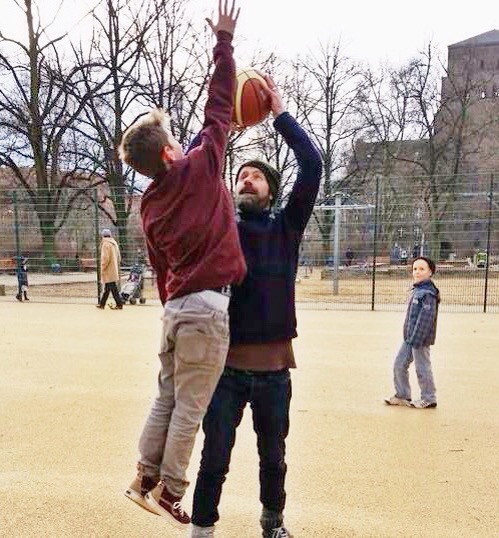
At Christmas I was with my kids for a four day trip to Berlin. I gave my thirteen year old son a basketball, and while the kids were sleeping the whole morning of the 25th, I went exploring the unfamiliar neighborhood. Back home, the kids were up, and we all wanted to play some basketball. I explained to my son that I had seen two places where we could play.

– “There’s one place here”, I said pointing to the north, “and another place here”, I said pointing to the south. “Which one do you prefer?” These were the words I used.
– “I prefer that one”, he said, pointing to the North.
– “Why?”
“Because it’s closest”
“How did you know that?”
I actually hadn’t said anything that would indicate the distance to the two places.
– “Because of the way you said it”, my son finished. Off we went to the nearest basketball court.

What’s interesting here is that not only didn’t I use any words that would indicate distance, I actually didn’t have any intention of communicating anything about it. What more is: I hadn’t even come to any conscious conclusion in my mind about it, only realising the fact about the proximity of one of the places the moment my son expressed it in words.

I think it is possible to draw three conclusions from this little story:

  1. our non-verbal communication is a source for precise information about spatial relations between physical places, people and objects. Our bodily and vocal gestures are adding valuable gradient information to the conversation, where words – in their binarity – fall short
  2. we are carrying a lot of information in our bodies from daily experiences, – like an imprint in flesh and bones – but we are not necessarily conscious about how and when we are conveying the information.
  3. of the vast amount of non-verbal knowledge we are bringing in to the interaction, only a small portion will surface, and only when someone has an interest in that specific information. It seems that the idea of wasting too much energy walking towards a basketball court is more important to a teenager than to his 43 year old father

Also read How can sound help us building our collectives?

Cultural-sustainability-via-non-verbal-communication

Top 5 talks at 11th International Conference on Sustainability – from a cultural sustainability perspective

The 11th International Conference on Environmental, Cultural, Economic and Social Sustainability is taking place in Copenhagen, Denmark January  21-23rd 2015. For three days the conference center of Scandic Hotel will be abundant with scholars from all over the world giving sessions about numerous topics.

As a participant I have been working my way through the enormous program, scanning it for sessions that are relevant for those who are interested in cultural sustainability.

These are my top 5:

1) Belonging, Identity, and Sustainable Heritage Development of a Danish Diaspora Community in the American Midwest

The global electronic environment has allowed a network of communities linked to Denmark, each other, and the shared past. Various artifacts that display these linkages will be presented at this poster. Societies that have faced a diaspora can now follow this model of continuous electronic involvement, communication, and re-discovery to maintain identity and heritage.

Time: Thursday January 22nd, 14.10 – 14.55, Plenary

I am curious to go to this session because 1)  it is about a Danish cultural diaspora, seen from a non-Danish perspective. This is relevant for the Danish society, where immigrants are expected to abandon their cultural heritage in order to fit in – ie being “integrated”. 2) It deals with how we can sustain our cultural heritage via new technologies.

Also read: Can social media help us build our collectives?

2) Ontological Pluralism and Education for Sustainability: Indigenizing Higher Education Curriculum

Our aim has been to act on the outcome of our previous research and maintain a Community of Practice approach to challenge academics within the School to embrace ontological pluralism to inform new and innovative approaches to the teaching of sustainability.

Time: Thursday January 23rd, 10.00 – 11.40, Room 2

This session is relevant because it deals with a distributed understanding of knowledge, as something embedded in cultural practice, as something that is negotiable across cultural differences.

 3) Historical Representation and the Crafting of Attitudes toward the Environment: Understanding the Role of History to Affect Sustainability

The promotional literature, actual design, and subsequent histories of suburban subdivisions in Sacramento reveal the striking extent to which suburban developers, real-estate firms, and later suburbanites constructing local histories have employed the language of Sacramento’s early urban boosters, and, ultimately, became a contributing part of the overall booster packaging of a metropolis that has helped shape how many in Sacramento view the environment and, likewise, themselves.

Time: Wednesday January 21st, 14.00 – 15.15, Room 5

This is interesting to me, because it gives us an insight into how cultural patterns ie local narratives of self and belonging are linked with socially constructed, dynamic processes.

4) Creative Aging City: Place-making in Old Neighborhoods by Elderly Communities in Asia

This paper therefore aims to study the place-making efforts by the elderly community, taking cases in Asia [..] to understand how the elderly residents cope with various environmental and artificial constraints in old neighbourhoods, [..] by appropriating them into socially sustainable places for ageing community, collaboratively and creatively.

Time: Wednesday January 21st, 12.30 – 13.45, Room 3

This is interesting because it establishes a link between space, health and community, –  and this is an important connection to make when it comes to creating cultural sustainability.

5)  Weaving: The Mixtec Palm Hat from Anthropology and Design

Some of the implications of this project are the study of cultural and social sustainability, a combination that in the future can contribute to the improvement of artisan economic conditions, and as a consequence, a better relationship between humans and their natural environment, as well as a reduction in cultural heritage loss.

Time: Thursday January 23rd, 12.40 – 13.55, Room 3

This session is relevant because it provides us with insight in the processes at work when it comes to collective production and it’s relation to cultural heritage ie. cultural sustainability ‘classic’.

Luckily none of the sessions above are at the same time!! Are you joining me? Give a comment below

onSustainability_full_rgb

PS: Of course there are many more really interesting presentations. Check out and comment upon my top 19 here.

How Time Can Dispossess: On Duration and Movement in Contemporary Performance

“Due to the accelerated and project-like character of our inner time, the subject finds himself in a no man’s land (that is very often a non-place, as defined by Marc Auge) if something does not function or if nothing goes on; he feels as though the duration intrudes upon him and, paradoxically, steals his most intimate time (which is actually heavily managed by the contemporary apparatuses)”

Read Bojana Kunst’s excellent text about duration, and how we need to forget ourselves – as subjects – in order to create opposition to the current agenda of acceleration. It relates to my discussion of the social media and their (in)capability for helping us building collectives: http://cultural-sustainability.eu/2014/11/20/social-media-cultural-sustainability-collectives/