- It began with a simple swim in the lake. I first heard an intriguing birdsong, filled with a fascinating array of musical ideas. The very next day, I returned to record its performance. Luckily, the bird was still there, and I captured a fairly good recording.
- It was a European Reed Warbler.
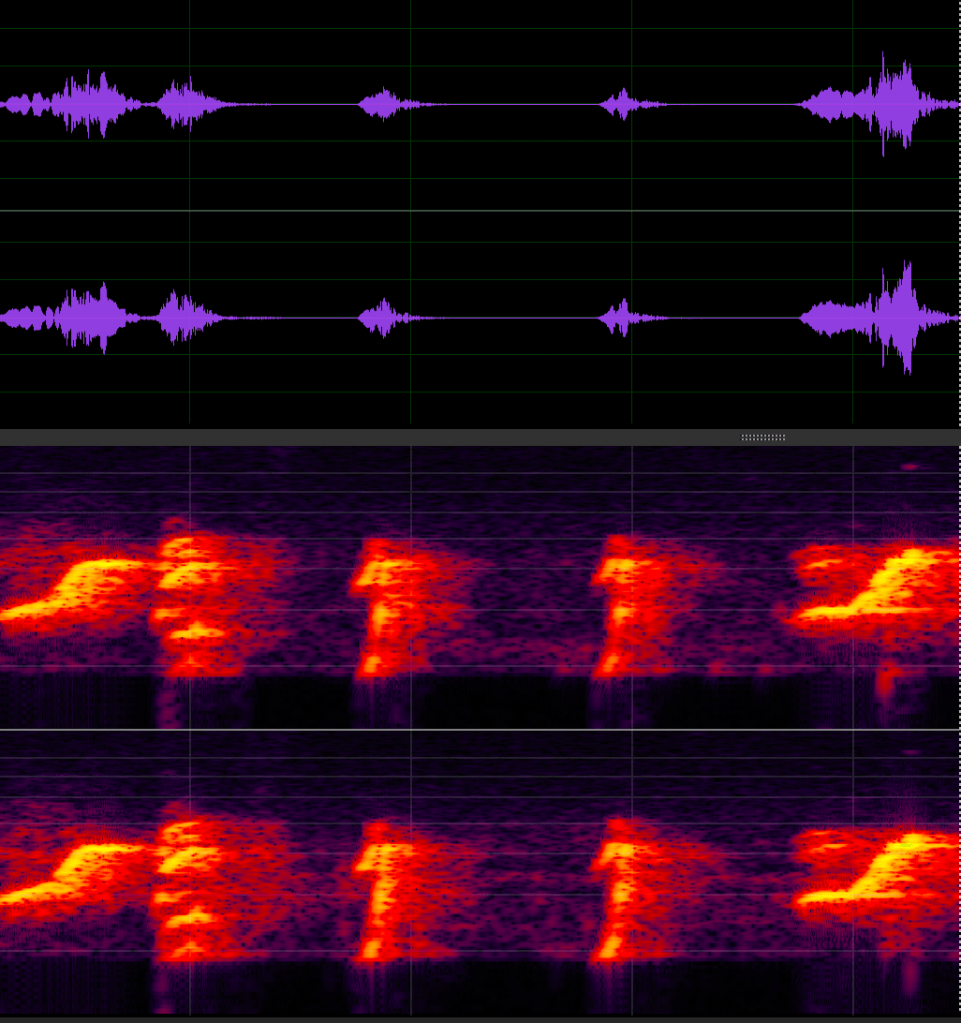
- Back home, I immediately set out to analyze the song. My initial approach involved meticulously notating every aspect of each sound: its duration, amplitude, pitch, and so on. I then developed a program to synthesize the sound. My idea was to go from analysis to synthesis, with the ultimate goal of playing my synthesized “fake” birdsong to the Merlin app, a tool known for its ability to recognize birds from their calls.
- To my surprise, while the Merlin app instantly and without hesitation recognized the European Reed Warbler from my original recording of the actual bird, my synthesized version didn’t impress it at all – the app heard nothing.
- This sent me back to the drawing board. My next approach will be to shift away from annotating every single sound from the bird, and instead, think in typologies. I can clearly hear (and see from the waveforms) that there’s a certain, seemingly limited, number of different kinds of sounds that the bird has in its repertoire. So now, the focus is on identifying these types, understanding their variabilities (in pitch, duration, amplitude, etc.), and analyzing how these sound types are typically combined (e.g., the number of repetitions, the adjacent sound types, etc.). This will likely involve an analysis akin to a Markov model.
- Stay tuned for more updates on the project!.


 Building Sound Collectives